Research bases for quantum technology to accelerate the nation's research and development in the field for use in next-generation high-speed computers will be set up.
The government has decided to set up eight such bases within existing facilities such as Riken in Wako, Saitama Prefecture, which is expected to become a core base.
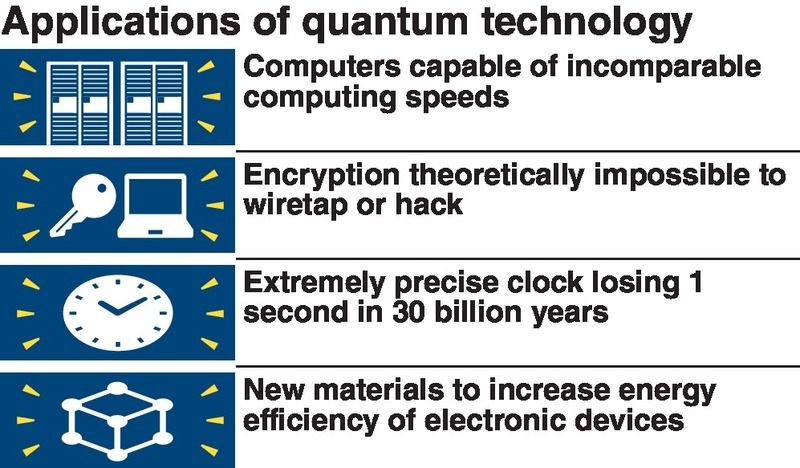
Besides cutting-edge quantum computers, encrypted communications that are theoretically impossible to wiretap or hack make use of quantum technology.
Quantum tech applies the properties of a quantum, a subatomic particles in a special state, to a wide range of fields, including communications, computing and measurements. Quantum mechanics is utilized for the development of various technologies.
The government aims to strengthen Japan's international competitiveness by attracting human resources and funds for research into the quantum-related technologies that Japan is strong in to compete with the United States, China and Europe, the leaders in the field.
Global competition is intensifying in the field of quantum tech because it is a fundamental technology that is directly linked to national strength.
The government's strategic plan adopted in January pointed out that Japan is "far behind other countries" in this field, and earmarked about 34 billion yen in its budget request for the next fiscal year for the entire quantum technology study.
The government has selected themes for meaningful research using quantum technology, such as quantum computers with incommensurable computing capability, quantum encryption that is theoretically unbreakable and optical lattice clocks that are extremely precise, losing once 1 second in 30 billion years.
Each research theme will be taken up by the eight bases that will be set up within this fiscal year. The bases will work on those themes in an integrated manner, from basic research to demonstration and human resource development.
Of the eight bases, one each will be set up at the University of Tokyo and five national institutes, including Riken and the National Institute of Advanced Industrial Science and Technology (AIST) in Tsukuba, Ibaraki Prefecture, because those facilities have expertise in the above themes.
The government will make a public call for proposals for the remaining two bases.
Each base will nurture human resources through symposiums for young researchers and serve as a liaison office for overseas research institutes.
Read more from The Japan News at https://japannews.yomiuri.co.jp/