
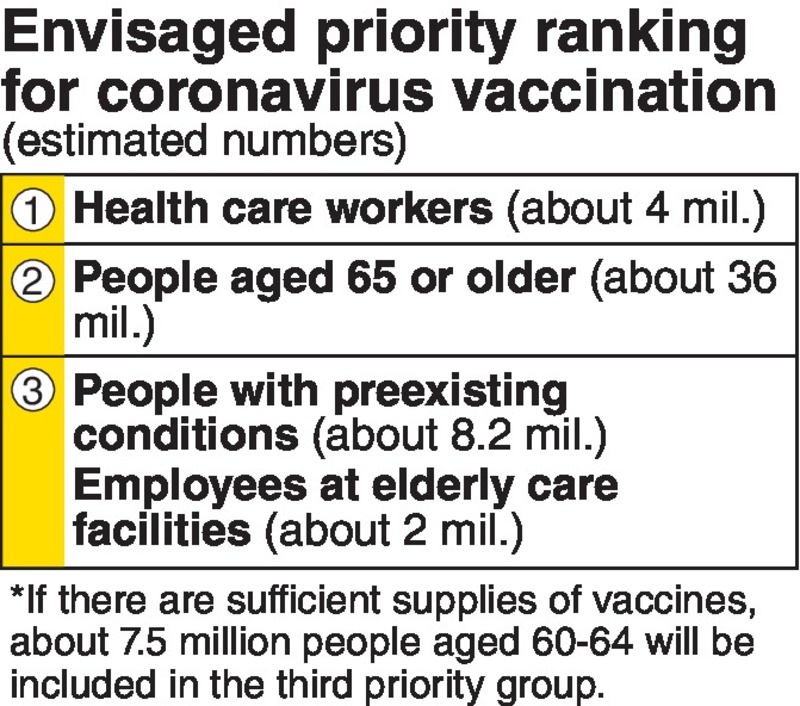
The government intends to set three priority groups for vaccination against COVID-19, targeting about 50 million people, such as health care workers, the elderly and those with preexisting conditions, according to sources.
A subcommittee of the government's coronavirus task force met Wednesday and discussed a vaccination system and related matters. The government is expected to approve the plan officially after discussions by a working group at the Health, Labor and Welfare Ministry. The aim is to start vaccinating residents in February.
The health ministry has indicated that health care workers should be the top priority for vaccination, followed by people prone to severe illness if infected with the virus.
The number of health care workers to be given priority totals about 4 million people. They include doctors, pharmacists, staff at public health centers, emergency service workers, Self-Defense Forces personnel and others who have frequent contact with COVID-19 patients.
The government envisages about 36 million people in the second priority group, consisting of those aged 65 or older.
The third priority group will comprise those aged 20 to 64 with preexisting conditions and is expected to total about 8.2 million people. Conditions will likely include 14 types of illnesses, including heart disease, diabetes and respiratory ailments, as well as people with a body mass index over 30, which indicates obesity.
For people with preexisting conditions, the government is planning to adopt a system in which those who want to be vaccinated will fill out a preliminary medical checkup report on their own.
The government also envisages the third-highest priority group will include about 2 million employees at elderly care facilities.
Pregnant women are not included in the priority groups at this time due to the lack of data on the efficacy and safety of the vaccines.
If there are sufficient supplies of vaccines, the government is also considering giving priority to about 7.5 million people aged 60 to 64.
The health ministry plans to present these plans to its working group, which is scheduled to hold a meeting on Friday.
At the subcommittee meeting on Wednesday, discussions were also held on revising the special measures law to cope with new strains of influenza. The subcommittee deliberated issues such as support measures for stores and eateries that respond to requests to temporarily close or shorten business hours, and the establishment of penalties for businesses that do not comply with requests.
The legislation is likely to be submitted to next year's Diet session after further discussion in the subcommittee.
The ruling Liberal Democratic Party and the National Governors' Association have made proposals regarding establishing penalties.
"We want to swiftly review what legal measures are necessary to prevent the spread of infection, while giving due consideration to the rights of businesses and individual people," said Yasutoshi Nishimura, the minister in charge of economic revitalization and measures against the novel coronavirus.
Read more from The Japan News at https://japannews.yomiuri.co.jp/


.png?w=600)









