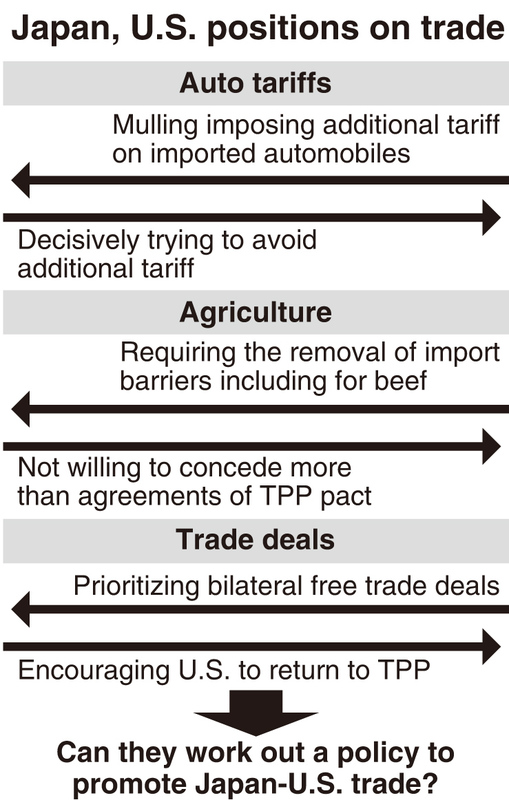
The Japan-U.S. ministerial-level trade talks scheduled on Monday and the summit talks on Wednesday are expected to focus on how far Japan can compromise regarding opening its markets for specific sectors such as automobiles and agricultural products while avoiding new tariffs -- currently mulled by Washington -- on cars from Japan.
Tokyo wants to discuss what Prime Minister Shinzo Abe describes as "a grand direction" to promote bilateral trade. He expressed Thursday his strong desire to deter any form of additional tariffs on cars from Japan under Section 232 of the Trade Expansion Act, a U.S. law. "I want to reach an agreement [with Washington] so that [such tariffs] will not be imposed," Abe said during an NHK program shortly after winning the ruling Liberal Democratic Party's presidential election.
U.S. President Donald Trump ordered the Commerce Department in May to consider measures to impose new tariffs on imported cars, reasoning that an increase in foreign car imports will weaken the domestic car industry and thereby threaten the national security of the United States. A probe by the department is under way to examine the necessity for such tariffs.
Japan's automobile industry has a significant presence in bilateral trade. According to the U.S. Commerce Department, the U.S. trade deficit in goods with Japan in 2017 was 68.8 billion dollars (about 7.7 trillion yen). Automobiles and automobile parts accounted for over 70 percent of the figure.
Concerns persist that Washington will demand concessions from Tokyo in the auto sector by using tariffs on imported cars as a bargaining chip.
Tokyo eyes EU as model
On Sept. 7, Trump used unprecedentedly strong rhetoric to warn Tokyo over the bilateral trade talks. "If we don't make a deal with Japan, Japan knows it's a big problem," the president said.
Tokyo sees the trade talks between the United States and the European Union as a model. In July, President Trump and European Commission President Jean-Claude Junker agreed to commence new trade talks with a view to abolishing tariffs, nontariff barriers and subsidies for non-auto industrial products.
They did not use the term "free trade agreement" (FTA), which would have given a strong impression that Washington was leading the discussion in its own favor. Both sides intend not to invoke new tariff measures while the talks continue.
Japan and the United States could not close the distance between them during the first meeting in August of the trade talks; Washington persisted in seeking a bilateral FTA, while Tokyo stressed that the best option was for Washington to return to the Trans-Pacific Partnership (TPP) multilateral free trade pact.
Tokyo is expected to keep this position during the coming meetings. However, there is a possibility that the two countries will agree to begin talks only on reducing barriers on a wide range of items regarding rules on trade and investment, without referring to the FTA or the TPP, in the manner of the U.S.-EU talks.
TPP as maximum limit
Regarding agricultural products, Abe has said that Tokyo will not offer anything besides what it has presented in the TPP negotiations. A TPP agreement requires Japan to lower tariffs on imported beef from 38.5 percent to 27.5 percent, and eventually to 9 percent in the 16th year after the agreement enters into force.
Meanwhile, the agreement reached by 12 countries including the United States -- although Washington subsequently withdrew from it -- required Tokyo to immediately set a tariff-free quota of 50,000 tons of rice produced in the United States. The withdrawal has made it impossible for the United States to receive such benefits.
Eyeing the House of Councilors election next year, Tokyo stands ready to thoroughly resist Washington's pressure by setting its own market opening concessions in the TPP talks as a maximum limit.
Read more from The Japan News at https://japannews.yomiuri.co.jp/