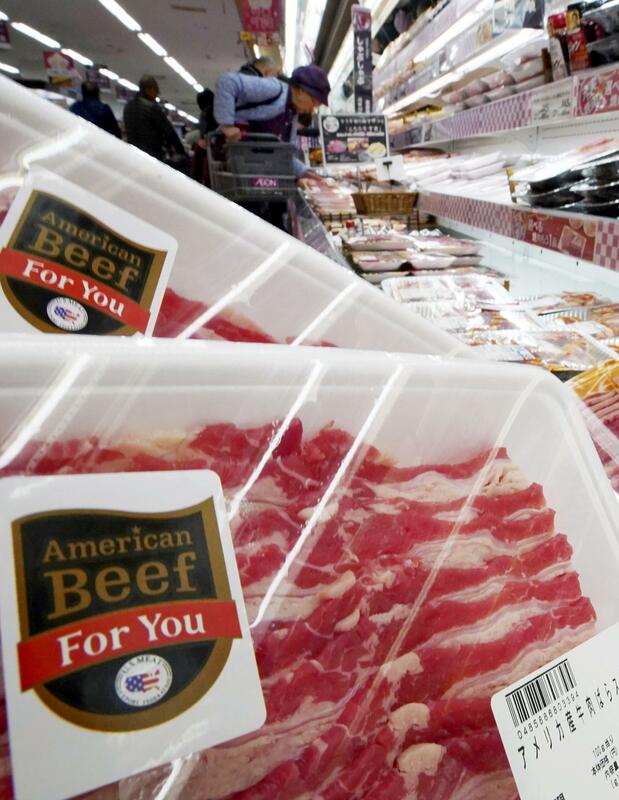
For the first time in just over 3-1/2 years, Japan is employing a safeguard measure in response to a rise in the volume of U.S. beef imports.
From Thursday through April 16, tariffs on U.S. beef will increase from 25.8% to 38.5%, adding a burden on the restaurant industry and consumers.
U.S. beef imports have been increasing after the Japan-U.S. trade agreement reached last year lowered tariffs and Australia, the rival major beef exporter to Japan, had its production reduced by drought.
-- Aussie imports falling
The trade deal with the United States included the safeguard to protect Japan's livestock industry, allowing the raising of tariffs for a 30-day period when imports exceed a set criteria.
U.S. beef imports from April 2020 to February 2021 increased by 1.6% year-on-year to 233,112 tons, or 96% of the fiscal 2020 maximum of 242,000 tons, according to the Finance Ministry. As of March 10, the volume exceeded the maximum, hitting 242,229 tons.
The Japan-U.S. trade deal aided U.S. beef imports by dropping the tariffs to the same level as those of countries participating in the Trans-Pacific Partnership (TPP) free trade agreement with Japan.
U.S. beef has become increasingly competitive, often sold at about half the price of Japanese beef and accounting for about 40% of the beef circulated in Japan.
Imports of Australian beef, however, fell 10.6% year-on-year from April 2020 through January 2021 to 222,641 tons.
The last time safeguards were imposed was in August 2017, when increased tariffs were applied to frozen beef imported from the United States, Canada and New Zealand. At that time, the conditions triggering the emergency tariff hike included import volumes exceeding a 17% year-on-year increase in a quarter.
For eight months, tariffs were raised from 38.5% to 50%, drawing strong opposition from Washington.
-- Extent of impact
Because of its reasonable prices, U.S. beef has penetrated Japanese households. U.S. beef is also widely used in the restaurant industry, including for gyudon (bowls of rice topped with thin strips of beef), hamburgers and yakiniku (grilled thin slices of meat). There is the possibility the increased tariffs will be passed down to retail prices.
"We want to coordinate with our suppliers so that consumers are not affected," said an official of a yakiniku chain that uses U.S. beef.
"There is the possibility that purchasing costs will increase," said an official of a major gyudon chain. "We are discussing the prices."
But many industry sources believe the impact will be limited because the safeguard can only be in effect for 30 days.
Once the safeguard is activated, the Japan-U.S. trade agreement says Tokyo and Washington will begin talks within 10 days. The theme of such talks is expected to be a review of the criteria that triggers the safeguard, such as the maximum tonnage. As U.S. President Joe Biden's administration is also focusing on protecting U.S. industries, all eyes will be on these discussions.
Read more from The Japan News at https://japannews.yomiuri.co.jp/