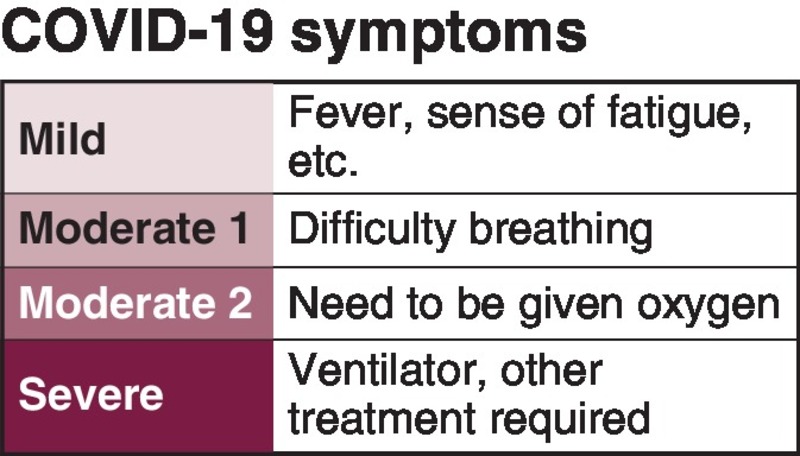
Only COVID-19 patients with severe symptoms, or who are at high risk of developing such symptoms, will be eligible for hospitalization in areas where infections are rapidly increasing, the government has decided.
Japan's government intends to review its treatment guidelines for people with COVID-19, it was announced Monday. Under the changes, patients in areas where the virus is quickly spreading will in principle be required to recuperate at home.
The policy change is aimed at preventing a serious shortage of hospital beds due to the recent surge in new infections, but concerns are being voiced about the dangers of having people with moderate symptoms recuperate at home.
The government will officially ask local authorities to adopt the new guidelines by the end of this week at the earliest.
At a meeting of relevant ministers regarding the medical system on Monday, Prime Minister Yoshihide Suga said, "We compiled the [new] guidelines so that patients with severe, moderate and mild symptoms will be able to receive the medical treatment they need, in accordance with the severity of their condition."
The current guidelines deem people with severe or moderate symptoms as eligible for hospitalization, as well as people at risk of developing severe symptoms, such as the elderly and those with respiratory diseases.
However, who actually is hospitalized is left to the judgment of municipal governments or doctors in each area. As a result, patients with mild symptoms are sometimes hospitalized.
Under the new guidelines, only people with severe symptoms and those at risk of such symptoms will be hospitalized, while other infected people will in principle have to recuperate at home.
If recuperating at home could cause problems, such as the possible infection of a family member, an infected person will be allowed to stay elsewhere, such as at a hotel.
In either case, the government intends for infected people to be immediately hospitalized if their condition worsens. It plans to have more pulse oximeters, which measure blood oxygen levels, distributed to people recuperating at home, to more accurately gauge the risk of someone developing serious symptoms.
The government will raise the compensation paid to doctors who make house calls, so that the symptoms of patients recuperating at home can be more precisely determined. The number of accommodation facilities where infected people can recuperate will be increased.
Another measure will be to boost the availability of so-called antibody combination treatment, in which medicine is administered intravenously for patients with mild or moderate symptoms.
At Monday's meeting, Suga emphasized, "The number of infections has been rapidly rising, and the most important task is to ensure the medical system works properly."
However, under the new guidelines, even patients with moderate symptoms who are suffering from pneumonia are expected to have to recuperate at home. In that case, it will be vital to know when severe symptoms emerge.
The review of the guidelines was prompted by the high occupancy rates of hospital beds exclusively for COVID-19 patients in many parts of the nation, in keeping with the renewed growth in infections.
According to government statistics as of Sunday, the occupancy rate was 73% in Ishikawa and Okinawa prefectures, and had surpassed 50% in Saitama, Chiba, Kanagawa and Kyoto prefectures.
An occupancy rate of 50% or more falls into Stage 4 of the government's severity indicators, the most serious position on the four-level scale.
As of Monday, 75.8% of people aged 65 or older in Japan had received a second shot of vaccine.
Read more from The Japan News at https://japannews.yomiuri.co.jp/





.jpg?w=600)