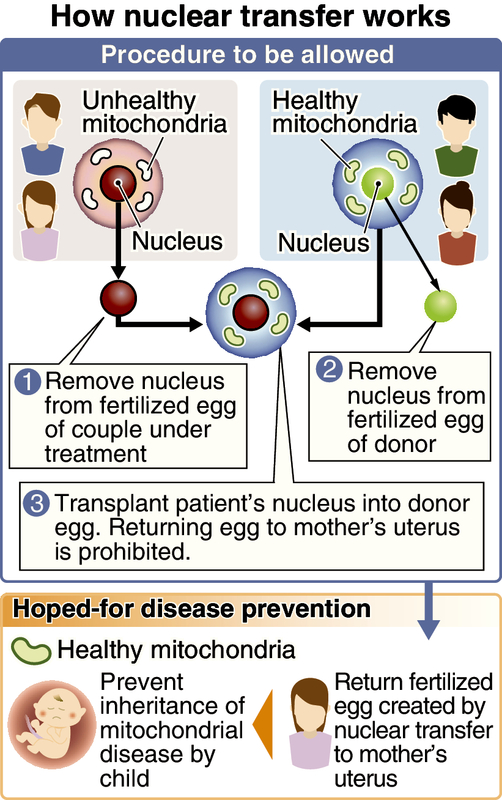
The government will lift a ban on nuclear transfer, in which a fertilized egg nucleus that contains genetic information is transferred into the fertilized egg of a third person, solely for the purpose of basic research on intractable mitochondrial disease, The Yomiuri Shimbun has learned.
The decision will be finalized in the new fiscal year at a meeting of the government's Council for Science, Technology and Innovation headed by Prime Minister Yoshihide Suga. Returning a fertilized egg created by nuclear transfer to the mother's uterus will remain prohibited.
Mitochondrial disease can be genetic, and it is hoped that basic research will help scientists find a way to prevent it from being passed on to children.
Because of the possibility of producing a child with the same genetic information, the Education, Culture, Sports, Science and Technology Ministry's guidelines based on the Law on Regulation of Human Cloning Techniques currently prohibit the nuclear transfer of a fertilized egg, and the return of a fertilized egg created by nuclear transfer to the mother's uterus.
Symptoms known as mitochondrial disease are caused by dysfunctional mitochondria -- organelles that generate energy within cells. Conditions include muscle weakness, cramps and heart disease, and there is no fundamental cure.
It is designated as an intractable disease by the government. About 1,400 patients were eligible for medical subsidies in Japan in fiscal 2018.
The genetic information for mitochondria is inherited from the mother. Thus, combining the nucleus of a fertilized egg of a couple with unhealthy mitochondria and a fertilized egg from a donor with healthy mitochondria from which the nucleus has been removed could possibly create a fertilized egg without unhealthy mitochondria.
The council compiled a report in 2019 stating that it is "appropriate to give a green light" to basic research on nuclear transfers to find a way to prevent the inheritance of mitochondrial disease, because the technique is believed to be useful for it.
In response to the report, the ministry drew up a draft of revised guidelines after studying the matter at the council. If the council approves the draft at a meeting to be held in April or later, the ban on nuclear transfers will be lifted for the purpose of basic research.
Yuichi Goto, director of the Medical Genome Center at the National Center of Neurology and Psychiatry, said, "If [nuclear transfer] is established as a treatment in the future, it will become an option for patients and their families who want to have children, giving them great hope."
"There's a lot we still don't know about mitochondrial disease, so it's important to proceed with basic research first," said Goto, who also serves as a member of the ministry's council and is an expert on mitochondrial disease.
Read more from The Japan News at https://japannews.yomiuri.co.jp/