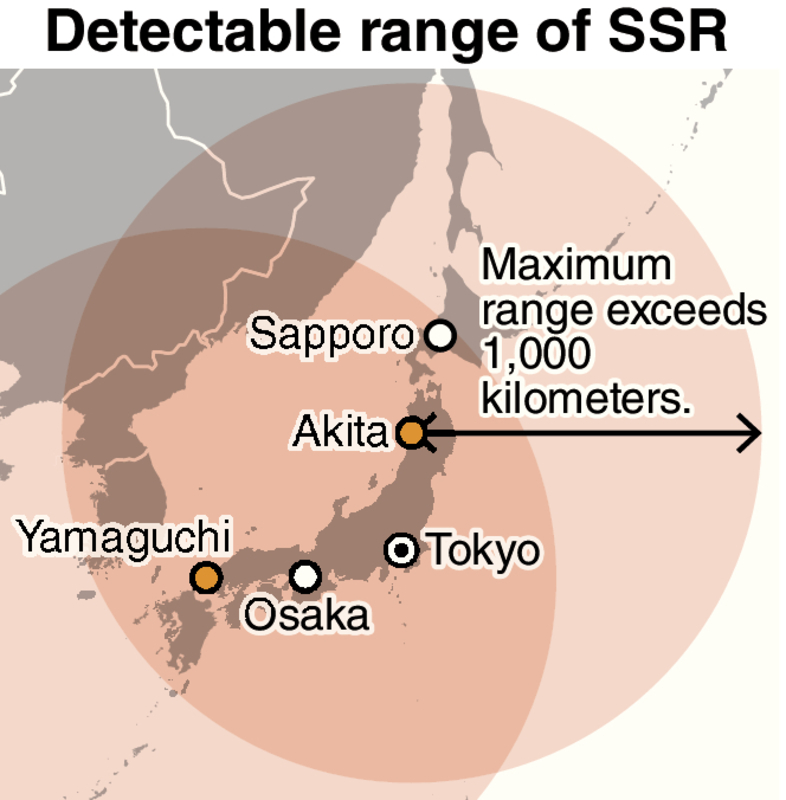
The Defense Ministry plans to install Lockheed Martin Corp.'s state-of-the-art radar in Aegis Ashore units, with the aim of monitoring the entire Korean Peninsula, according to sources.
The government will introduce a land-based Aegis system, known as Aegis Ashore, to strengthen the nation's missile defense system. The advanced Solid State Radar (SSR) is capable of monitoring the entire Korean Peninsula around the clock from Akita and Yamaguchi prefectures -- where the Aegis Ashore units are scheduled to be deployed.
The government aims to start operating the system in fiscal 2023, and is expected to make an official announcement about the plan in the near future.
Aegis Ashore is a land-based system specializing in missile defense. The technology used for SSR is the same as that for the radar system to intercept ballistic missiles that is now under construction by the U.S. government in Alaska.
The maximum detectable range of SSR is far more than 1,000 kilometers, more than double the range of the SPY1 radar currently installed on an Aegis-equipped destroyer of the Maritime Self-Defense Force.
The ministry's selection process focused on two candidates: Raytheon Co.'s SPY-6 and SSR, with the detectable range being the decisive factor in selecting SSR.
The Defense Ministry intends to keep a close watch on the Korean Peninsula using SSR, and focus on deploying Maritime Self-Defense Force Aegis destroyers to monitor the East China Sea and other areas where China has been stepping up its maritime advances.
U.S. President Donald Trump and North Korean leader Kim Jong Un reached an agreement on the denuclearization of the Korean Peninsula at their June 12 summit meeting.
However, the Japanese government plans to proceed with the deployment of the Aegis Ashore units as planned, given that the future course of the negotiations on ballistic missiles remains unclear, and China's missile threat is increasing.
Read more from The Japan News at https://japannews.yomiuri.co.jp/