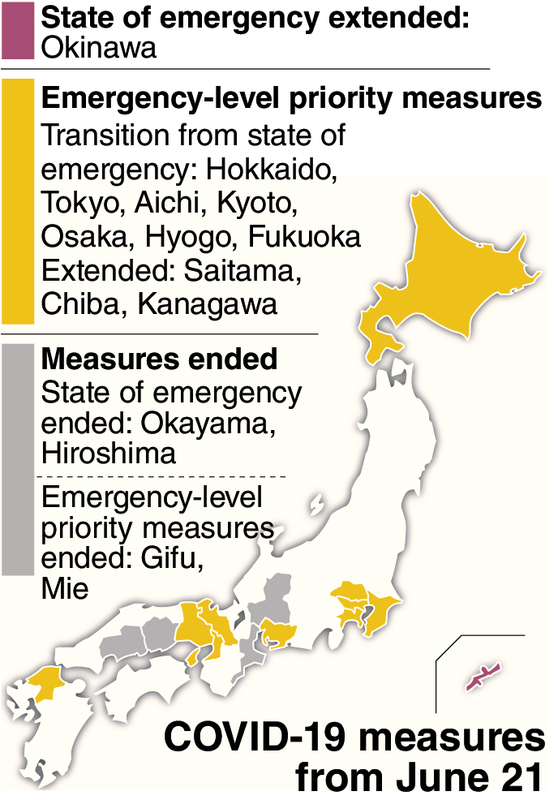
The government is set to decide to end the current state of emergency over the novel coronavirus on Sunday as scheduled in nine out of the 10 prefectures where it is currently in effect, including Tokyo and Osaka.
Okinawa will be the only prefecture to remain under a state of emergency.
Tokyo, Osaka and five other prefectures will shift to emergency-level priority measures, which will remain in effect until July 11. This transition is aimed at preventing the virus from spreading again in the run-up to the Tokyo Olympics, which are just one month away.
In the areas where the priority measures will be applied, restaurants and other eating and drinking establishments will be allowed to serve alcoholic beverages until 7 p.m., on condition that infection prevention measures are thoroughly implemented.
Depending on the situation, however, prefectural governors will be able to stop restaurants from serving alcohol to customers.
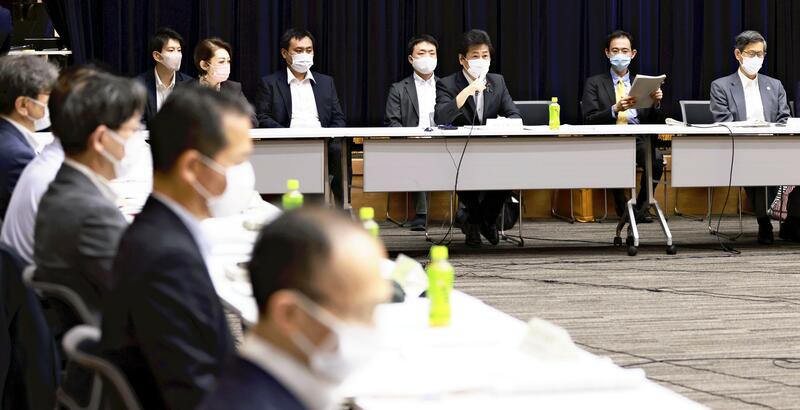
On Wednesday night, Prime Minister Yoshihide Suga discussed the situation with relevant Cabinet members, including Health, Labor and Welfare Minister Norihisa Tamura and Yasutoshi Nishimura, the minister in charge of economic revitalization and government's COVID-19 measures. After their meeting, Suga told reporters that he would make a decision on the state of emergency after consulting with experts.
The government's subcommittee of experts on basic coronavirus measures approved the government's plan on Thursday.
The state of emergency for nine prefectures -- Hokkaido, Tokyo, Aichi, Kyoto, Osaka, Hyogo, Okayama, Hiroshima and Fukuoka -- will end. Seven of these prefectures, excluding Okayama and Hiroshima, where the infection situation has been noticeably improving, will shift to emergency-level priority measures.
This will be the first time for areas subject to a state of emergency to be transitioned to priority measures.
In the Tokyo metropolitan area, the number of new infections has stopped falling and people are increasingly going out. In addition, mutations of the coronavirus are prevalent. Given these circumstances, the government determined that substantially easing countermeasures could cause infections to spread once again.
"Although the burden on the medical system has been reduced, it's necessary to prevent a rebound in infections, given the trend of more people going out and the mutated viruses," Nishimura said at a meeting of the subcommittee, regarding the situation in the seven prefectures.
In Okinawa Prefecture, the number of newly infected people remains at Stage 4, the most serious level according to government criteria, with about 90% of the hospital beds for COVID-19 patients occupied. The government will extend the state of emergency in Okinawa until July 11, in keeping with a request made by the prefecture on Wednesday.
Regarding the five other prefectures currently under emergency-level priority measures, the government is set to end those measures for Gifu and Mie prefectures.
In the three remaining prefectures --Saitama, Chiba and Kanagawa -- emergency-level priority measures will be extended until July 11. Since Tokyo and the three prefectures share a living area, the priority measures will be implemented in the same way.
In areas that are subject to the priority measures, restaurants and other establishments will continue to be asked to shorten their business hours and close by 8 p.m. The government will promote a system to certify eating and drinking establishments that have taken appropriate measures to prevent infection.
For the time being, eating and drinking establishments will be asked not to offer karaoke services to customers. Prefectural governors will decide whether to ease restrictions on karaoke based on the infection situation.
A state of emergency has been in place in Tokyo and the prefectures of Osaka, Kyoto and Hyogo since April 25.
Read more from The Japan News at https://japannews.yomiuri.co.jp/