The Internal Affairs and Communications Ministry plans to use small beacons to collect location information on about 33,000 people who will climb Mt. Fuji in August, according to sources.
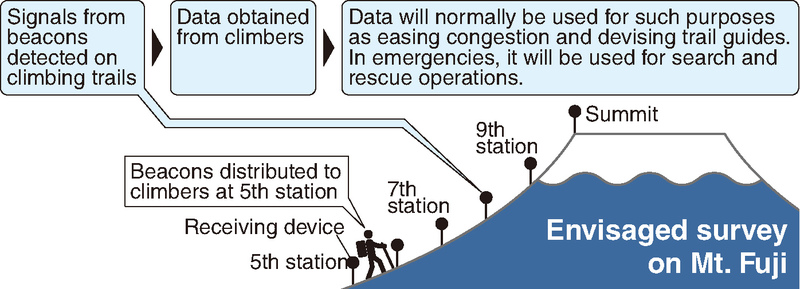
The ministry aims to use the information for such purposes as setting up signs to prevent climbers from getting lost on trails and helping future rescue operations when eruption alert levels are raised, the sources said.
Commissioned by the ministry, five entities, including the incorporated body Fujisan Challenge Platform and the Yamanashi prefectural government, will carry out the survey from 8 a.m. to the evening on Aug. 18-27. During this period, they will distribute beacons to climbers at the fifth station of each of four routes on Mt. Fuji.
Data on the number of climbers and the time they pass certain points will be collected through devices that receive radio waves from the beacons, placed at 50 locations from the fifth station to the summit. Climbers can also confirm their position information with their smartphones.
As many as 6,000 people are estimated to climb Mt. Fuji each day during the climbing season. About 7,000 beacons have been prepared and are planned to be distributed to almost all the climbers.
Every year, 1,000 climbers get lost on Mt. Fuji. This project has been spurred by a failure to set up up appropriate signs and offer guides on climbing routes, as the geography of the climbing trails has yet to be accurately ascertained.
There are currently no signs of an eruption, but if Mt. Fuji erupts, climbers could be harmed. However, as climbers' movements cannot be accurately ascertained at present, disaster-related information cannot be relayed to them quickly.
This project will be conducted for a limited time. However, "we want to create a system to distribute [the beacons] to all climbers in the future," said Yoshiro Tanaka, the head of Fujisan Challenge Platform.
He said the information collected with the beacons will help ease congestion on climbing trails, as well as evacuation guidance and rescue operations at the time of a disaster.
Read more from The Japan News at https://japannews.yomiuri.co.jp/