
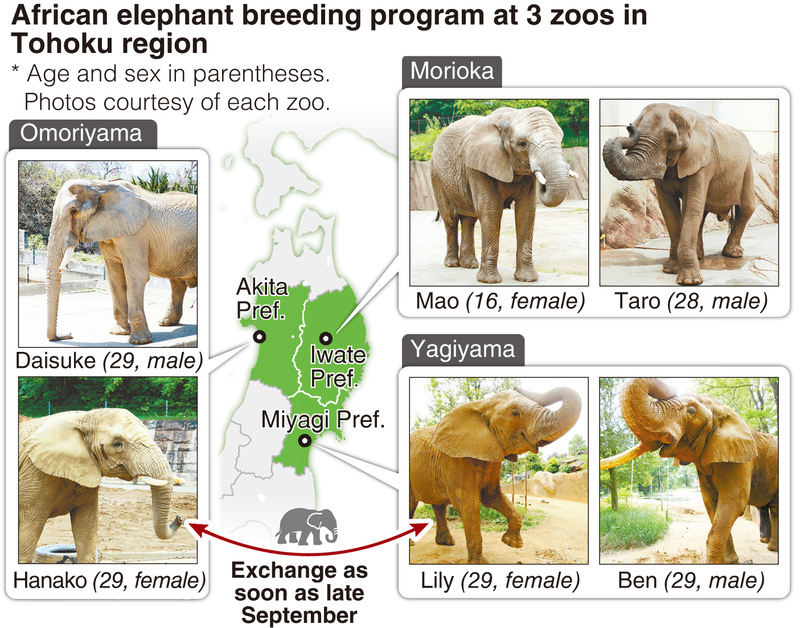
Three zoos in Miyagi, Akita and Iwate prefectures plan to encourage their African elephants to breed by exchanging their animals to create new pairs, as early as late September.
It will be the first such attempt in Japan, with the aim of establishing a new approach to breeding African elephants, which has not been successful since 2014. Imports of the animal are strictly restricted under the Washington Convention.
The African elephant is the largest land-dwelling animal and lives in the savannas and forests of Africa. Its average life span is around 60 years and it is desirable for the female to give birth to her first calf by her 30s. According to the World Wide Fund for Nature, the number of wild African elephants is estimated to have decreased to about 420,000 in 2016 from about 740,000 in 1987 due to being poached for their ivory tusks and other reasons.
There were 80 African elephants in Japan in 1986, but the number had dropped to 34 by 2017 according to the Tokyo-based Japanese Association of Zoos and Aquariums. This is because the Washington Convention prohibits wild African elephants from being imported for exhibition, and also because breeding has not progressed in Japan.
The zoos that will participate in the project are Selcohome Zoo Paradise Yagiyama in Sendai, Akita Omoriyama Zoo in Akita and Morioka Zoological Park in Morioka. The pairs at Yagiyama and Omoriyama are all 29 years old, and the male and female at Morioka are 28 and 16 years old respectively. They are all old enough for breeding.
However, no such behavior has been observed at Yagiyama, while the pairs at Omoriyama and Morioka have been mating without it resulting in pregnancy. The association believes that, since each pair has been together for a long time, different pairings might lead to better results.
Given that, the three zoos in the Tohoku region decided to exchange elephants to prompt breeding between new pairs, as exchanging them among zoos in the same region has the advantage of causing less stress to the animals during transport.
To begin with, Hanako, the female at Omoriyama, will be exchanged with Lily, the female at Yagiyama, to create new pairs at both zoos. After attempting to have the new pairs breed for several years, the pairings will be changed by adding Mao, the female at Morioka.
Zoos in Japan have previously made efforts to breed African elephants by lending and borrowing the animals. However, because African elephants are popular, the zoo that lends an elephant has struggled to attract visitors during its absence.
Shigehisa Kawakami, 65, administrator of the population of African elephants at the association, which supports the project, said: "By proceeding with the breeding attempt through exchanges, the zoos will be able to continue to exhibit African elephants. I hope this project will be successful and become an example of advanced efforts."
Mamoru Komatsu, 66, head of Akita Omoriyama Zoo, said: "African elephants are precious animals. While safely transferring and carefully accepting the animals, we want to lead the project to a successful breeding [result]."
Takayuki Kanatsumi, 53, head of Selcohome Zoo Paradise Yagiyama, also said, "First, we'd like to make every possible effort to accept Hanako [of Omoriyama] and prepare an environment in which she can concentrate on meeting [with her new partner] in a relaxed manner."
Read more from The Japan News at https://japannews.yomiuri.co.jp/




.png?w=600)








