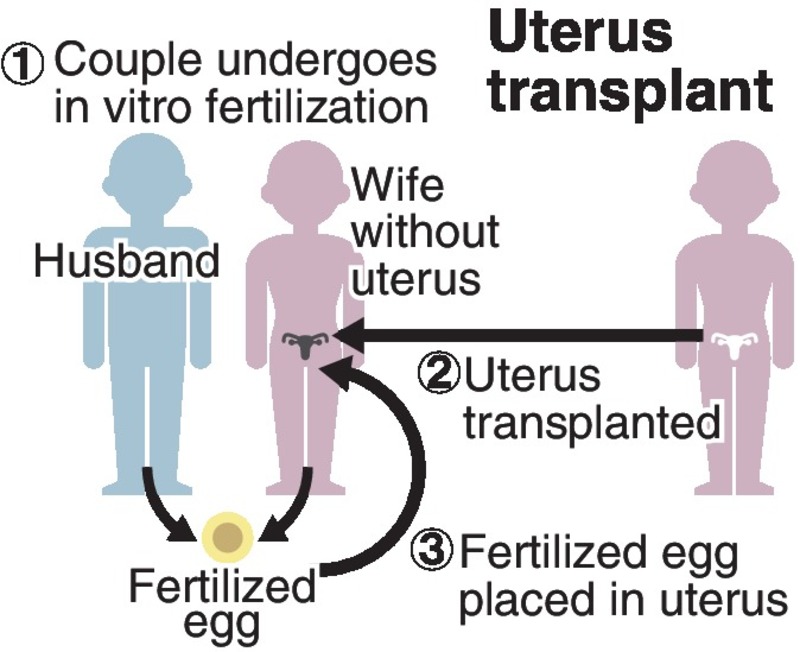
A committee of the Japanese Association of Medical Sciences is set to approve uterus transplants as part of clinical research under certain conditions, paving the way for women who do not have a uterus due to illness to possibly conceive and give birth to children, The Yomiuri Shimbun has learned.
The committee has been discussing the issue and is expected to release a report soon. If such clinical research is conducted, it will be a first in Japan.
An estimated 60,000 to 70,000 women in Japan do not have a uterus due to a congenital condition or because they underwent surgery for cancer. Uterus transplants are not covered by the Organ Transplants Law, and the organ cannot be harvested from a person who has been declared brain dead.
In 2016, a team from Keio University began considering clinical research in which women with Rokitansky syndrome who were born without a uterus could receive a donated uterus from a relative. The team submitted the research plan to the Japan Society of Obstetrics and Gynecology and the Japan Society for Transplantation in 2018.
The two societies asked the Japanese Association of Medical Sciences, their parent organization, to examine the matter. Its committee has held discussions since 2019 regarding the ethical and medical issues involved.
The committee concluded that uterus transplants should be a treatment option as long as there are patients who wish to have such an operation, sources said. The report will present the view that uterus transplants from living donors should not be excluded.
However, the committee also decided that such operations should involve organs taken from brain-dead donors in principle, and the report will call for a revision of the Organ Transplants Law, according to the sources.
Living donor transplants impose a heavy burden on donors, as a uterus will be removed from a healthy person. There are also concerns about the possible effect on a fetus if a recipient becomes pregnant, as she will take immunosuppressive drugs to control rejection after the transplant.
The report will include such conditions as donors and patients being fully informed, and donors agreeing to donate their organs voluntarily and without any monetary compensation.
The first uterus transplant was conducted in 2000 in Saudi Arabia. More than 80 had been performed worldwide as of 2020, and recipients in 33 of those cases, or about 40%, successfully gave birth to children.
Read more from The Japan News at https://japannews.yomiuri.co.jp/