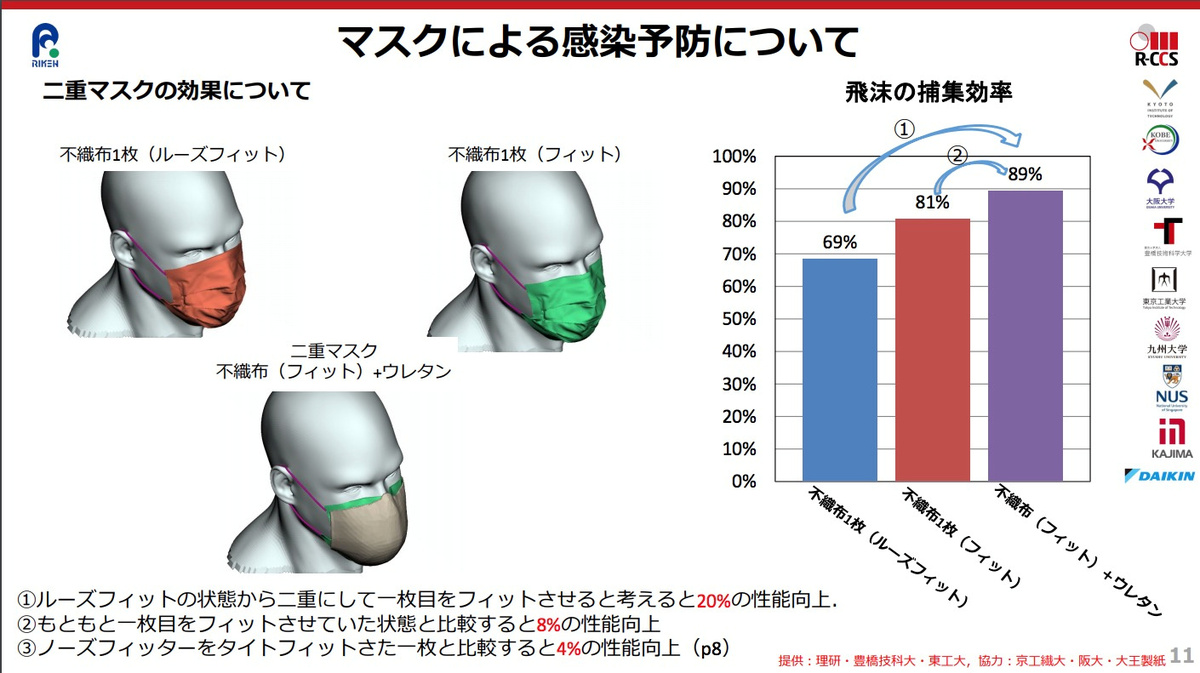
Japanese supercomputer simulations showed that wearing two masks gave limited benefit in blocking viral spread compared with one properly fitted mask.
The findings in part contradict recent recommendations from the U.S. Centers of Disease Control and Prevention (CDC) that two masks were better than one at reducing a person's exposure to the coronavirus.
Researchers used the Fugaku supercomputer to model the flow of virus particles from people wearing different types and combinations of masks, according to a study released on Thursday by research giant Riken and Kobe University.
Using a single surgical-type mask, made of non-woven material, had 85% effectiveness in blocking particles when worn tightly around the nose and face. Adding a polyurethane mask on top boosted the effectiveness to just 89%.
Wearing two non-woven masks isn't useful because air resistance builds up and causes leakage around the edges.
"The performance of double masking simply does not add up," wrote the researchers, led by Makoto Tsubokura.
In general, professional grade N95 masks were the best in protecting against infection, followed by non-woven masks, cloth masks, and finally polyurethane types, the study showed.
The Riken research team previously used the Fugaku supercomputer to model how humidity can affect viral contagion and the infection risks in trains, work spaces, and other environments.
As the COVID-19 epidemic has worn on, scientific consensus has grown that the virus is spread through the air and masks are effective in controlling contagion.
(Reporting by Rocky Swift; Editing by Lincoln Feast.)