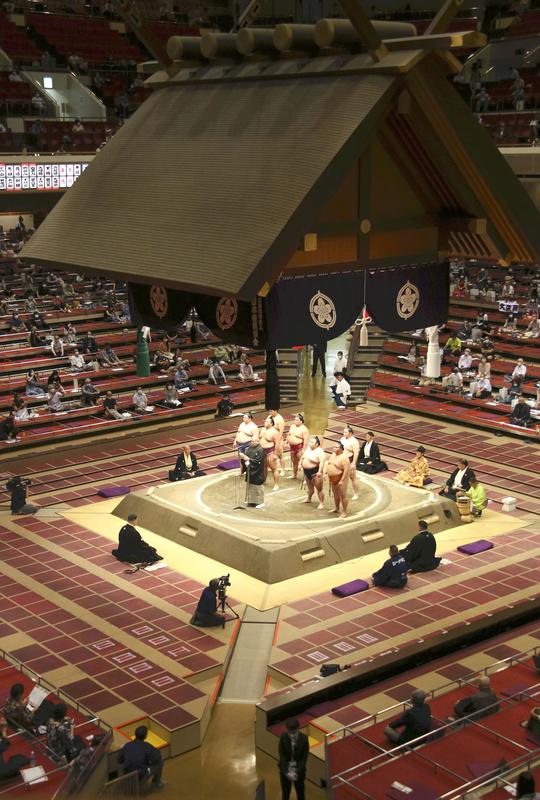
Due to the nature of sumo as a martial art, contact between wrestlers is inevitable. The fact that wrestlers also live communally in their stables adds to the risk of infection. The Japan Sumo Association is taking the utmost care to prevent the spread of the coronavirus.
The association allowed no spectators at the Spring Grand Sumo Tournament in Osaka in March and called off the summer tournament in May following the extension of the state of emergency. In mid-May, a Sandanme-ranked wrestler named Shobushi died of COVID-19 at the age of 28.
In the wake of this tragedy, the association compiled guidelines for the prevention of infection with the help of experts, and managed to hold a tournament in July.
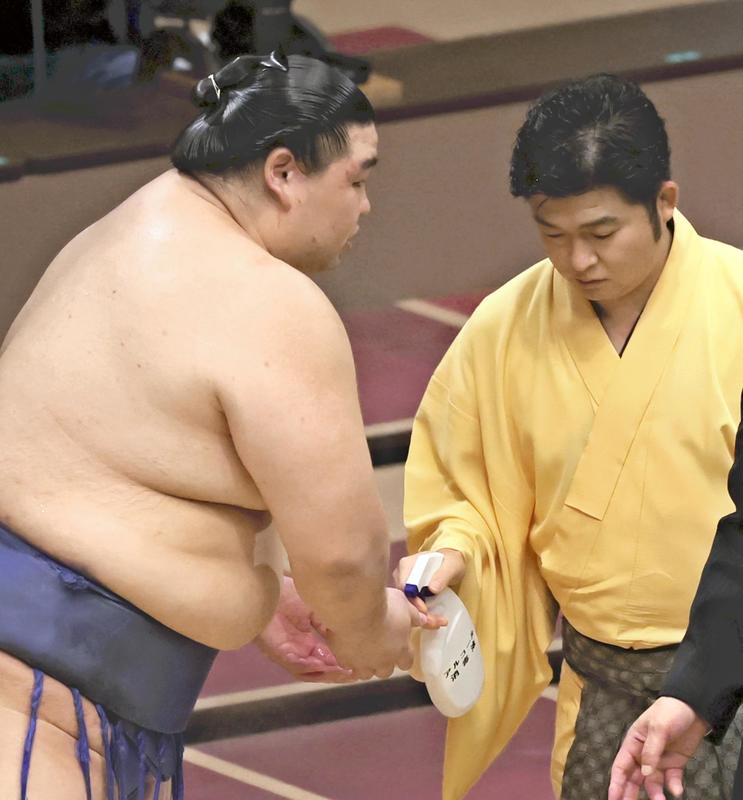
Acrylic boards were installed in rooms where wrestlers wait for their matches, and wrestlers were asked to wear masks even when they do warm-up exercises. Other measures were also taken to avoid the spraying of droplets and people-to-people contact as much as possible.
Spectators were limited to just about 2,500 a day, or a quarter of the capacity of the Ryogoku Kokugikan, and they were urged to clap instead of shouting when they wanted to cheer for their favorite wrestlers.
Measures were enforced in each stable as well. Visits to other stables for training were banned, and food was divided into individual portions rather than served on big platters for wrestlers to share.
In September, a cluster was discovered in the Tamanoi stable, but infection to other stables was prevented and the Autumn Grand Sumo Tournament was held for 15 days as scheduled.
The restrictions are gradually being lifted. Joint training was conducted during a limited period in mid-October, in place of the prohibited visits to other stables.
The Japan Sumo Association plans to ease the cap on the number of spectators for the November tournament, based on the results of antibody tests conducted on all wrestlers.
Read more from The Japan News at https://japannews.yomiuri.co.jp/