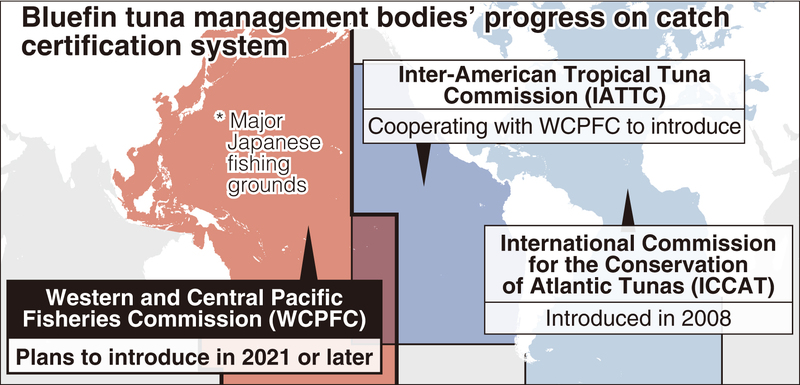
An international catch certification system for endangered Pacific bluefin tuna (see below) is expected to be introduced at the initiative of Japan, according to sources.
In the system, inspectors will certify the volume of catch that ships unload at ports in Pacific Rim countries and the fishing methods they use. The system aims to more strictly manage Pacific bluefin tuna resources by promoting transparency and more accurately tracking stock levels, the sources said. It is expected to start as early as 2021.
Two international bodies responsible for managing Pacific bluefin tuna -- the Western and Central Pacific Fisheries Commission (WCPFC), comprising 26 countries and regions including Japan and the United States; and the Inter-American Tropical Tuna Commission (IATTC), comprising the United States, Mexico and others -- have already agreed to work together to introduce the catch certification scheme. Japan will propose the system at a subcommittee meeting of the WCPFC to be held in Fukuoka in September.
An international organization that tracks Pacific bluefin tuna released a report this year indicating that stocks of the fish have been gradually recovering, reaching about 21,000 tons in 2016. Still, this figure is only about 10 percent of the peak figure in 1961, and there remains a real possibility that the fish will become extinct.
In Japan, fisheries cooperatives tally the volume of transactions at fish markets in ports and report them to the Fisheries Agency. However, a growing number of transactions take place outside of the markets, such as through direct distribution to supermarkets and shipping to operators that farm small tuna, making it difficult to accurately track the amount of fish being unloaded at ports.
If the catch certification scheme is introduced, officials from the Fisheries Agency, prefectural governments and other entities would observe the fish being unloaded at ports and record the catch volume, fishing method, names of the fishermen and so on. The scheme also requires verifying such data as sales conditions at ports, outgoing shipments, and whether a shipment is exported abroad.
By introducing the scheme, Japan intends to demonstrate to the international community that it takes resource management seriously, and take the initiative to create an international structure, the sources said.
The WCPFC has set fishing quotas since 2015, but Japan surpassed its upper limit during the fishing season from July 2016 to June 2017.
Japan came in below the limit at 99.5 percent of its quota for the season that ended in June this year. However, illegal fishing and other acts have drawn criticism from around the world.
--Pacific bluefin tuna
The fish migrates long distances in the Pacific Ocean and is a popular high-grade sushi topping. Years of overfishing small tuna have caused a drastic decline in the population of mature fish, prompting strict catch quotas. Compared to widely eaten yellowfin and bigeye tuna, bluefin tuna including those caught in the Atlantic Ocean comprise only 3 percent of tuna consumed worldwide.
Read more from The Japan News at https://japannews.yomiuri.co.jp/