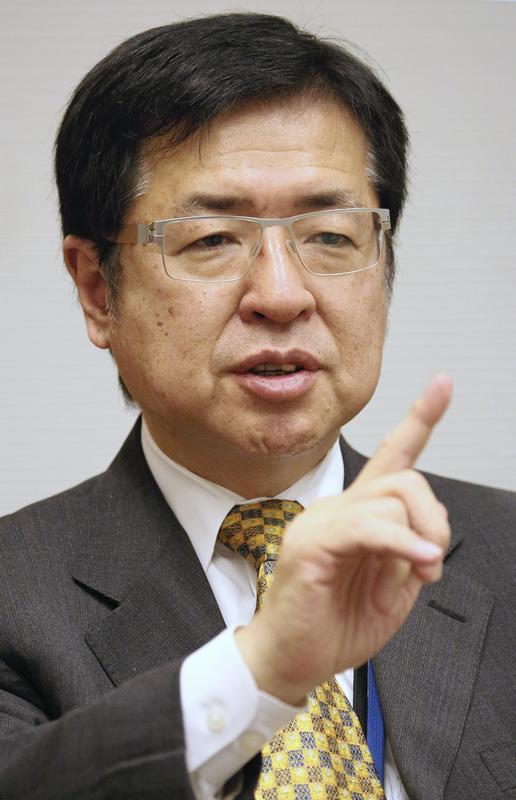
Nobukatsu Kanehara, a special guest professor at Doshisha University, was involved in the establishment of the economic division in the National Security Secretariat. The Yomiuri Shimbun interviewed Kanehara, former deputy secretary general of the secretariat, about the background to the establishment of the economic division and its future activities.
The Yomiuri Shimbun: Could you tell me what led to the establishment of an economic division within the National Security Secretariat?
Kanehara: It all started about two years ago when I was deputy manager of the National Security Secretariat, which is the secretariat of the National Security Council. A high-ranking official of the Economy, Trade and Industry Ministry came and said it was necessary for Japan to do something in response to the U.S. strengthening its export controls on cutting-edge technology.
The ministry's trade control division was sensitive to U.S. moves because it had an experience of bearing the brunt of U.S. anger in connection with the 1987 incident involving Toshiba Machine Co. The company was accused by the United States of exporting sensitive technologies to the Soviet Union in violation of regulations set by the Coordinating Committee for Multilateral Export Controls (COCOM) to restrict exports to communist countries. Given this, the NSC began discussing various measures to restrict technology exports.
Q: Did the discussions go smoothly?
A: The first thing the ministry said it wanted to do was to make the investment regulations of the Foreign Exchange and Foreign Trade Law more strict. This is because it was possible for foreign companies, including those of China, to legally acquire sensitive advanced technologies through corporate acquisitions. But investment control is under the jurisdiction of the Finance Ministry, which did not have a department that could determine which technologies from various industries -- not under its jurisdiction -- posed a security risk.
We looked for assistance from the Internal Affairs and Communications Ministry, which has communication networks under its jurisdiction, and the Health, Labor and Welfare Ministry, which holds pharmaceuticals under its governance, but there was no single department that was in charge of supervising entire government offices, thus creating the situation in which nobody took responsibility for what was done.
At that time, if foreign firms tried to acquire equities of Japanese firms, reports on the moves were circulated among the government ministries and agencies. But it cannot be said that technologies of industries under their jurisdiction were checked by these offices, except for the Economy, Trade and Industry Ministry, from a national security perspective. Even if the scope of these restrictions were to be expanded to apply to cases in which "1% or more" of equities are sought, I didn't think the restrictions would work.
NSC's setup at the time, when its staff included only a few officials from ministries and agencies in charge of economic policies, did not have the sufficient capacity to deal with the economic security issue. Therefore, I gathered government officials who dealt with economic issues to adequately check the security of technologies held by Japanese firms, with the help of the Assistant Chief Cabinet Secretary. During this process, discussions regarding the need for a team to oversee all economic policies from a security perspective had advanced within the NSC.
Q: What do you expect from the establishment of the economic division?
A: In the United States, the Committee on Foreign Investment in the United States (CFIUS) consolidates the information collected from government offices and determines whether foreign investment under review is risky or not. Officials from intelligence sections take part in the discussions to help make a decision.
The economic division of Japan's NSC also includes officials from the National Police Agency. To ensure economic security, cooperation from all government offices, including the intelligence division, is indispensable.
I hope that the economic division will contribute to not only protecting technologies but also fostering them. Japan's academic circles, including the Science Council of Japan, use a 4 trillion yen national budget but show little interest in applying researched technology to develop new products and services. Since they use hard-earned taxpayer money, they should utilize [their research] for the benefit of the public. It is important for the research budget to be channeled into such fields as defense and prevention of disaster and epidemics, which are needed by the government.
Defense technology is essential for protecting the lives of Self-Defense Forces members in times of an emergency, but industrial circles take a passive stance toward defense technology citing that it would "damage the corporate image." Unless defense equipment exports are expanded, Japan's defense technology will not make progress. More cooperation is needed between industry, academia and the government.
Q: How should Japan deal with the U.S.-China competition for technological supremacy?
A: Decoupling of China has been making headway in the United States since the closing days of the Obama administration. The U.S. industry, which was originally pro-China, began to say "China is peculiar" in connection with the issue of intellectual property and has since taken a stern stance toward China partly because of the issue of a huge trade deficit with China.
The Japanese business community now opposes stronger restrictions on foreign investment under the Foreign Exchange and Foreign Trade Law. But if the U.S.-China confrontation becomes more fierce, Japan will have to choose between the two. During the Cold War period, the business community did not need to consider its economic relationship with the Soviet Union. But when it comes to the U.S.-China confrontation, the Japanese business world is tested on how it can balance security and business.
Even if former U.S. Vice President Joe Biden wins the presidential election in November over the incumbent Donald Trump, the U.S. government's stance toward Beijing will not return to the pro-China line pursued a decade ago.
Kanehara's Profile: A graduate of the University of Tokyo. After serving as director of the International Legal Affairs Bureau at the Foreign Ministry, he joined the second Abe Cabinet as an Assistant Chief Cabinet Secretary, in charge of foreign policy, and as deputy secretary general of the National Security Secretariat. He retired from his bureaucratic career in 2019 and has been at his current post since April of this year. His fields of expertise are international law, security and territorial issues regarding Russia. He was born in Yamaguchi Prefecture and is 61 years old.
Read more from The Japan News at https://japannews.yomiuri.co.jp/