Preliminary data shows the number of foreigners who applied for refugee status was 3,015 for the January-March period this year, down about 13 percent from the same period last year, The Yomiuri Shimbun has learned. This is the first decline in applications in eight years.
Starting this year, the Justice Ministry has greatly restricted the employment of people who have filed applications for refugee status. This is meant to prevent false applications that aim to only obtain permission to work in Japan. It is believed the ministry's restriction has been working well to decrease the number of applicants for refugee status.
Japan's refugee recognition system, whose operations were revised in March 2010, allows all applicants to begin working six months after they submit a refugee application.
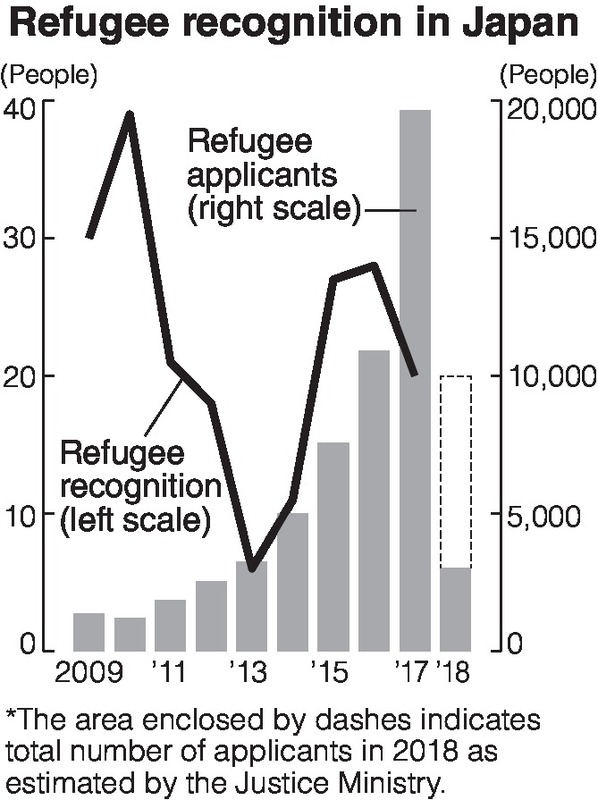
With the revision, the number of applicants rapidly increased from 1,202 in 2010 to 19,629 in 2017, marking record highs for seven consecutive years.
The majority of applicants are seen as those who have filed fake applications to only gain permission to work in Japan. This has had an adverse effect on assistance for real refugees, such as prolonging the screening period of their applications.
Under the revised system the ministry started in January, regional immigration offices conduct a basic screening, based on submitted documents, within two months of applications being filed. People who clearly do not fall in the refugee category, such as those who have applied due to debt problems in their home country or those whose applications have not been accepted in the past, are not allowed to seek employment in Japan.
The ministry has also taken strict measures such as holding such applicants at immigration facilities after their period of stay has expired.
According to the ministry, the number of applicants for the January-March period decreased by 464 from 3,479 in the same period last year. The number of applicants per day was 79.8 over the full 12 months of 2017, but was 43.1 during the three-month period this year, down about 45 percent from the 2017 figure.
Looking at the number of applicants by country in 2017, the Philippines, Vietnam and Sri Lanka were ranked as the top three. But the number of applicants from those three countries in the three-month period this year decreased by 60 percent to 70 percent.
In addition, the number of applicants for foreign technical trainee positions who came to Japan with official permission from their country and those who applied to come to Japan to study -- some of whom are suspected of staying in Japan only to work part-time -- from these countries was 50 percent to 80 percent lower.
As the total number of applicants during the three-month period decreased, immigration authorities could handle more cases, with an increase to 3,140 from 1,953 in the same period last year. The number of recognized refugees also increased to four people from one person.
The ministry expects that the trend of fewer applicants will continue, and it will be able to reduce total annual applicants to around 10,000 in 2018.
A senior ministry official said: "If the new operations of the system become well known to foreigners, fake applications would drastically drop. We'd like to make efforts to recognize refugee status for as many foreigners as possible who need help at the earliest opportunity."
Read more from The Japan News at https://japannews.yomiuri.co.jp/