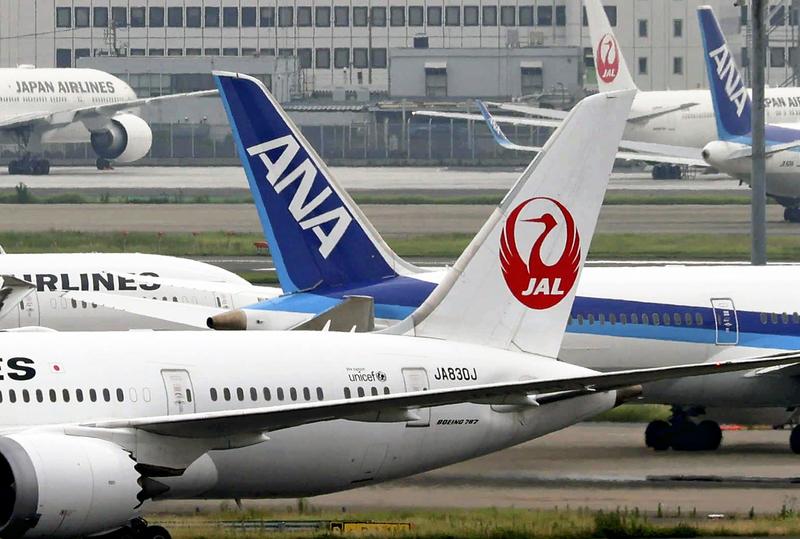
The aviation industry is facing a difficult time because of the sharp drop in demand caused by the COVID-19 crisis. All Nippon Airways and Japan Airlines, the nation's top two carriers, search for a solution to their predicament, while keeping an eye on those pushing for the two companies to integrate.
-- Crisis
"If this situation continues, airline companies' annual sales will be halved." From March through April, when the coronavirus was affecting the world, senior officials of the Scheduled Airlines Association of Japan visited ruling party executives, the Prime Minister's Office and government ministries and agencies every day, explaining their difficult situation.
The organization was aiming to get government assistance for the industry included in an emergency economic package, which was to be compiled in early April. ANA Holdings Inc. also requested to "secure 2 trillion yen for the entire industry, with 1 trillion yen or more for ANA."
In response, the government decided on a plan to provide financial support through emergency loans from the Development Bank of Japan, a government-affiliated financial institution, and other measures.
In other countries, the German government has formally decided to give up to 9 billion euros (about 1.09 trillion yen) to help national carrier Lufthansa, in exchange for a 20% stake. The U.S. government will provide about 16 billion dollars (about 1.7 trillion yen) in subsidies and other forms of assistance to three major airlines, including American Airlines Group. In return, the U.S. government will, in principle, receive stock acquisition rights, and monitor the management of each company.
In comparison, the Japanese government's policy appears to be moderate. Both ANA and JAL are in good financial shape. With other industries in trouble, it is difficult to support specific major companies.
On the other hand, ANA and JAL wanted to receive loans to secure financing. However, they also wanted to avoid any capital injection that could jeopardize their management independence. They were cautious about allowing the government to get involved as they might be pressured to merge.
"For 68 years, we have always stood on our own feet as a purely private company," said ANA Holdings President Shinya Katanozaka at a shareholders meeting in Tokyo on June 29. "We will overcome the coronavirus crisis with knowledge and hard work."
-- Recent history
The two corporations have been battling for years over which company will become No. 1 in the country. This is even seen in their fight over the allocation of airport slots. Each slot at the international departure and arrival terminals at Tokyo's Haneda Airport, where demand is high for business trips, is said to generate an annual revenue increase of 10 billion yen, according to some aviation officials. The government had a great deal of authority over the distribution of the slots and the issue sometimes became the center of political confrontation. One example is JAL's bankruptcy 10 years ago.
ANA teamed up with the Liberal Democratic Party to launch a campaign criticizing the Democratic Party of Japan, the ruling party at that time, saying, "The competitive environment was distorted" by the public funds given to JAL for its revival. In August 2012, the Land, Infrastructure, Transport and Tourism Ministry restricted JAL's business expansion, and the LDP returned to power in December of the same year.
As the number of departure and arrival slots increased, ANA received nearly twice as many compared to JAL. This allowed ANA to expand its routes, mainly international ones, which had a lot of room for improvement.
The route to Wuhan, China, the epicenter of the coronavirus outbreak, was one of those routes that recently opened.
"I'd like to express my sincere gratitude for your courage and great contribution," Foreign Minister Toshimitsu Motegi said on June 23, in a letter of appreciation to ANA for its cooperation in evacuating Japanese nationals by sending a chartered plane to Wuhan.
In 2014, it was decided that ANA would take over maintaining government planes, which JAL had consistently undertaken. The era of ANA arrived both in name and reality.
In recent years, the company has continued to grow its business. The ANA group increased the number of its employees by 17% and the number of aircraft by 35 over the three years ending in March 2020. When the airline revised its schedule this spring, it planned to open 14 new international routes but when the COVID-19 crisis hit the company, its business plans backfired.
The airline suffered a group net loss of 58.7 billion yen in the January-March quarter, more than double that of JAL.
In the wake of the bankruptcy, JAL cut about 30% of its routes, mainly unprofitable ones, and cut about 16,000 jobs. Its interest-bearing debt is 191.7 billion yen, less than a quarter of ANA's. The more streamlined, the shallower the wound.
-- Integration?
Currently, the two companies do not need immediate capital reinforcement.
The equity ratio, which indicates the proportion of capital a company has to cover its assets, stands at 41.4% for ANA and 58.9% for JAL, far higher than the about 20% ratios of major U.S. and European airlines. In addition, ANA and JAL have secured funds of about 1 trillion yen and 500 billion yen, respectively. The two companies will be able to maintain operations for at least one to 1-1/2 years even if sales continue to decline.
Still, some people in financial markets and the government are discussing a possible integration between the two companies.
As a result of competition between the two companies, many routes overlap and both companies operate domestic and international flights that connect major cities. When JAL collapsed in 2010, an initial plan was for ANA to rescue and integrate JAL's international flights.
"Even now, integrating the international services [for the two companies] does not violate the Antimonopoly Law," a senior economy ministry official said hypothetically.
But can these observations be negated?
Read more from The Japan News at https://japannews.yomiuri.co.jp/