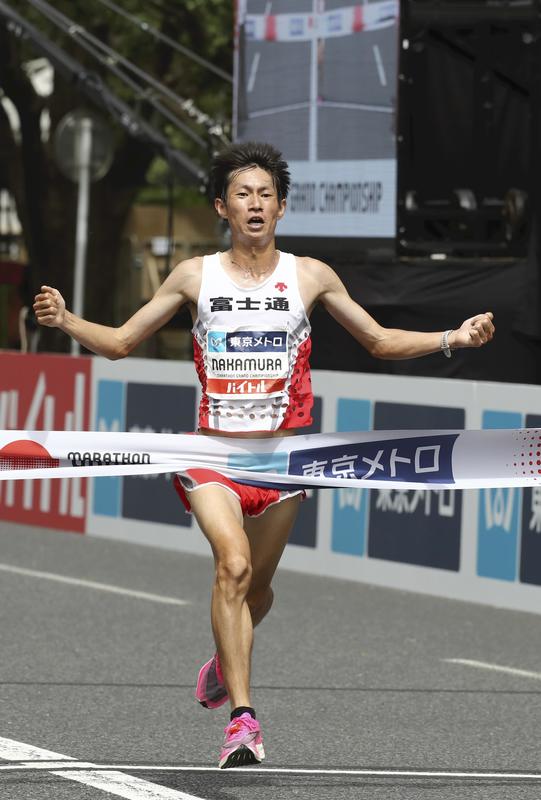
Three Japanese men have secured berths in the marathon at the Tokyo Olympics.
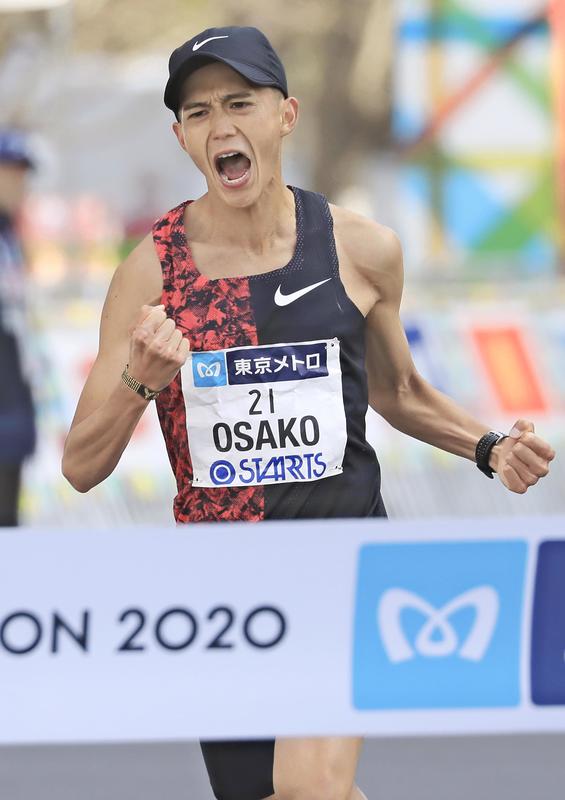
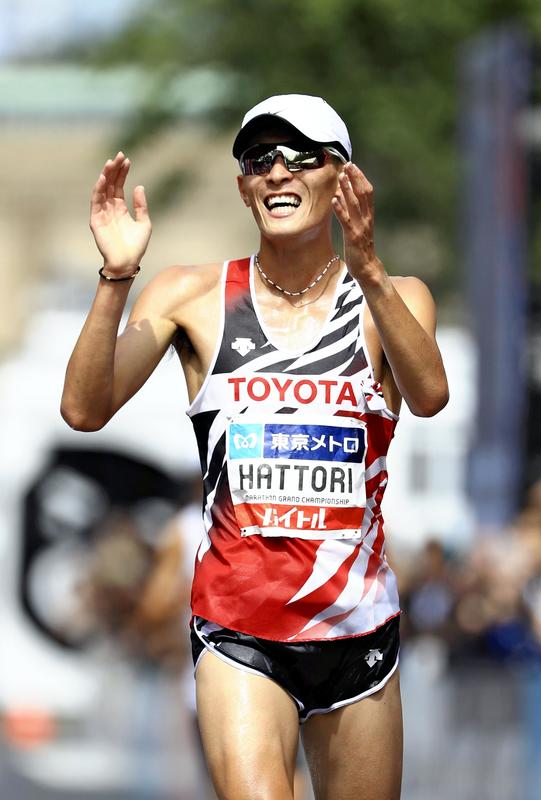
The list includes Shogo Nakamura, who won last autumn's Marathon Grand Championship (MGC); Yuma Hattori, who was second behind Nakamura at the MGC and Suguru Osako, who broke his own national record at the March 1 Tokyo Marathon.
The three runners, who all performed well in the Tokyo-Hakone Intercollegiate Ekiden as university students, have had their eyes fixed on the Olympics.
All three are aiming to become the first Japanese runner in 28 years to reach a podium at the Summer Games as they try to recreate the excitement brought on by Kokichi Tsuburaya, who earned the bronze medal in the marathon at the 1964 Tokyo Olympic.
Shogo Nakamura, 27
A knack for pushing the pace
At last autumn's MGC, Nakamura surprised the distance-running world by finishing first, despite the fact that his previous top time was the eighth best among the competitors.
What decided the race was a lengthy spurt, which has been Nakamura's characteristic since his days at Komazawa University.
Near the 39-kilometer mark, where the lead group thinned out, Nakamura sped up the pace and broke away from the crowd.
While Osako eventually caught up to him, Nakamura shifted gears again with about 800 meters to go and pulled away. With an outstanding two-stage spurt, Nakamura dominated as he defeated a formidable rival whose resume featured much faster times and more experience.
"If I can run races this way, I will be able to compete at the world-class level," Nakamura said, showing confidence.
When he was a student at the Mie prefectural Ueno Kogyo high school (now Iga Hakuho High School,) he finished third in the 5,000 at the All-Japan Inter-High School Championships.
At Komazawa University, Nakamura was the section winner in the first stage in all three major college ekiden races, and was active as an up-and-coming opening-leg runner. The experience of running in numerous fierce battles and seizing the lead in ekiden races, Nakamura has developed a sense of bargaining and when to go on a spurt.
"These help me run marathon races," Nakamura emphasized.
After the MGC, the 2020 Olympic marathon site was moved from Tokyo to Sapporo. In response, Nakamura has put effort into increasing speed, assuming a quick-paced race. In a half marathon held at the beginning of the year, Nakamura set a personal best of 1:01:40.
From here on, Nakamura will do practical track training and other workouts to hone his skills and abilities to vie with overseas runners.
His tolerance for heat was proven at the MGC.
"It is natural for an Olympic athlete to aim higher," Nakamura said about the Olympics. "I want to win a medal."
With a hidden strength that cannot be measured by just recording times, Nakamura eyes playing a starring role at the upcoming Olympics.
A Mie Prefecture native, Shogo Nakamura has participated in three Hakone Ekiden races and won the section award in the first stage when he was a senior. His personal best in the marathon is 2:08:16, which he ran in Berlin in 2018.
Suguru Osako, 28
Developing speed overseas
"I just pursue faster times. That's all I think about now," Osako said. That comment sums up his philosophy.
When he reached the high school level, he left his home of Tokyo and entered prestigious Saku Chosei High School in Nagano Prefecture.
After a productive career as the top runner at Waseda University, he left his domestic corporate team after a year and joined a U.S. team that included top world-class runners such as Britain's Mohamed Farah, who won gold medals in both the men's 5,000 and 10,000 in two Olympics -- the London Games and the Rio de Janeiro Olympics.
Osako set a national record in 2018 in Chicago with a time of 2:05:50. However, he failed to secure a Tokyo Olympic berth at the MGC, at which he finished third.
He sensed his own shortcomings and before the Tokyo Marathon decided to do a long-term training camp in Kenya for the first time.
"The training gave me confidence because I could do more quality training than Kenyan runners," Osako said. He shaved 21 seconds off his national record and seized the final Olympic berth.
Since he is in an environment in which he trains with overseas runners on a daily basis, he no longer feels inferior, even at major competitions.
"I finished fourth in the Tokyo Marathon in the end. I would like to work on things ahead of the Olympics and trust in myself as I do my preparation," Osako said.
Japan's fastest challenger is taking it one step at a time as he moves toward the top podium spot.
Suguru Osako is a native of Tokyo who twice broke the national record in the marathon and holds the national record of 13:08.4 in the 5,000. He ran in the 5,000 and the 10,000 for Japan at the Rio de Janeiro Olympics.
Yuma Hattori, 26
Inquisitive mind, dynamic style
Hattori is a two-time section winner over the second stage of the Hakone Ekiden, a leg seen as an important battle in the race.
As for marathons, he won the 2018 Fukuoka International Open Marathon Championship, becoming the first Japanese runner to win there in 14 years. Hattori has followed an orthodox path in the long-distance world since his college days.
A standout characteristic Hattori brings is his powerful running style, in which he takes advantage of his 176-centimeter, 63-kilogram frame.
Meanwhile, he has also improved his approach to running with a thoughtful and detailed as well as naturally inquisitive mind.
Hattori is a heavy sweater and does not do well in the heat. Because of that, since his time at Toyo University, he had done a long-term analysis of perspiration and other components with the support of Kagawa Nutrition University.
As a result, he came up with a water-feeding system in which he runs with two bottles tied by a string around his neck to sufficiently make up for the nutrients he loses. His efforts bore fruit, as Hattori finished second in the MGC run in very hot temperatures.
"Taking the right steps makes things easier for me," he said with a confident look.
He regularly listens to former top-level runners and coaches to pick up hints that he uses in competitions against runners worldwide.
"If I can make the most of my preparation up to this point at the Tokyo Olympics, a good result will come," Hattori said.
Using all the strength he has built up steadily and diligently, Hattori will go against the world head-on.
Out of Niigata Prefecture, Yuma Hattori set the Japan collegiate national record of 1:28:52 over 30 kilometers in his second year at Toyo University. His personal best in the marathon was a 2:07:27 at the 2018 Fukuoka International Open Marathon Championship, which he won.
Read more from The Japan News at https://japannews.yomiuri.co.jp/