Japan just cannot seem to get its economy growing. The latest drop in GDP marks the country’s fourth descent into recession in five years.
It is a blow to the prime minister, Shinzō Abe, who came to power in 2012 vowing to stamp out deflation and bolster a flagging economy with his so-called Abenomics policies.
Two recessions on from his electoral victory, it is becoming clear that for all the excitement around Abenomics when it launched, the plan is doing little in practice.
The idea was that three arrows would tackle chronic problems in the world’s third largest economy. They were looser monetary policy from the Bank of Japan (BoJ), a fiscal boost from increased spending on public works and sweeping structural reform to make the economy more productive and competitive.
What Japan’s policymakers are learning is that if the three “arrows” of Abenomics are to work at all, they have to work together.
Using the first two arrows of easier money and more spending to buy time and ease the path for the third, more difficult, arrow of reform has failed. By holding back on tackling longstanding problems such as sluggish private sector investment and labour shortages, Abe and his government have dampened the effectiveness of the other two arrows.
Construction workers wanted
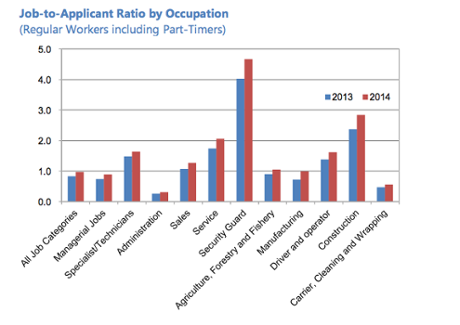
Take the example of fiscal stimulus. The government hopes to boost spending and create a better environment for businesses with big building projects, yet a shrinking workforce means it struggles to find construction workers to do the building. In other words, it is like putting fuel in car and then trying to drive off with the handbrake on.
The two arrows of fiscal and monetary stimulus are being dampened by a host of such brakes.
Jobs outnumber applicants
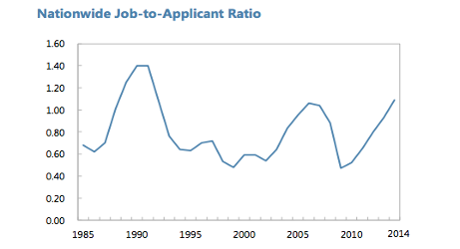
The population problem is chief among them. Similar to other advanced economies such as Germany, Japan is struggling with an ageing workforce in which more people are retiring than joining. The population started shrinking four years ago, while its working age population has been falling since the mid-1990s and is projected to drop much further still.
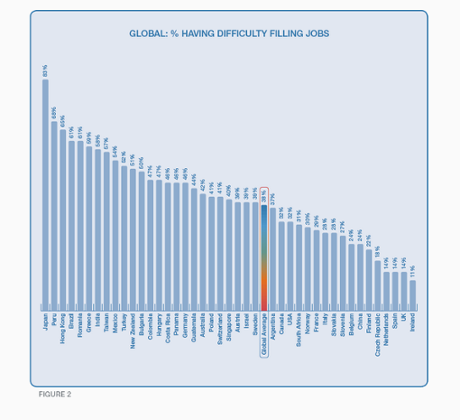
Japanese employers simply cannot find enough workers. It is by far the toughest country to fill a vacancy, according to a recent report covering more than 40 states by the recruitment company ManpowerGroup. In Japan, 83% of employers said they were struggling to hire, more than double the global average of 38%.
Hiring headaches
The government says it is tackling the population problem with plans for better childcare and tax incentives for parents. But like neighbouring China, which recently announced it was scrapping its one-child limit, Japan will face a long wait for such birth rate policies to bear economic fruit. In the meantime, its small tweak to immigration policy has done little to boost the workforce.
Another challenge, again shared by other advanced economies, is the downturn in China, Japan’s biggest trading partner. Weaker demand for exports, owing to troubles in China and a wider global economic slowdown, are compounding the already cautious mood among Japanese businesses hurt by a sluggish domestic outlook.
The gloomy private sector wants more government support for the economy. Abe and his colleagues fire back that they want business to play its part in hauling Japan out of the doldrums. The government is calling on Japanese firms to spend some of their record cash piles on higher wages and more capital spending.
The third arrow of change is undoubtedly the toughest. But after the fourth recession in five years, it is clear that just pouring on the easy money is not the answer for Japan.