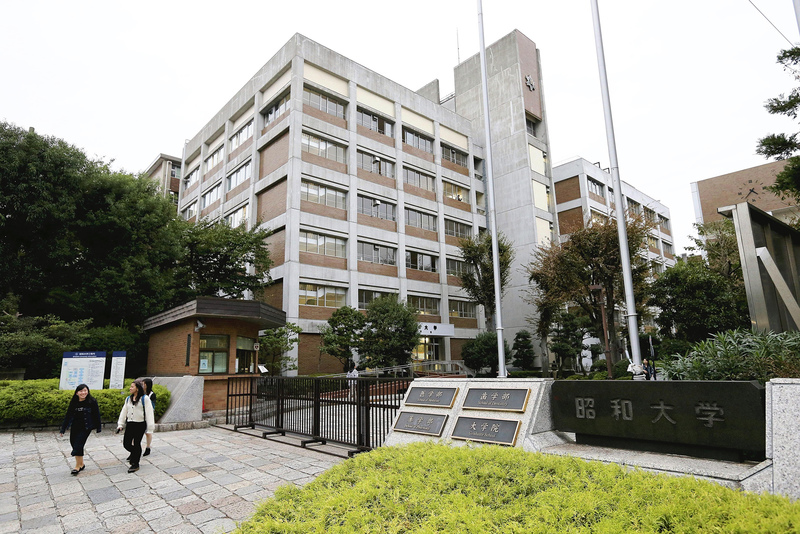
Showa University has announced that since 2013 it has manipulated the scores of applicants who took the second stage of the entrance exam for its medical school.
The Tokyo university said during a press conference on Monday that it padded the scores of those who took the examination while still enrolled in high school or within a year of graduating.
It also said that since the same year, it has preferentially accepted a total of 19 applicants who were the children of alumni on the waiting list for places. No indication of this practice was stipulated in the university's exam guidelines.
The university is considering setting up a third-party panel to investigate the situation and establish how to deal with examinees impacted by the manipulation.
Showa University President Ryohei Koide and Yoshio Ogawa, dean of the School of Medicine, attended the press conference.
"We sincerely apologize for impairing the trust of exam-takers and the general public," Ogawa said. The university said that it will not manipulate scores or give preferential treatment in next year's exam.
Showa University holds its general entrance exam for its medical school in two stages. Candidates are tested in English, mathematics and science in the first stage, in which they can earn a maximum of 400 points.
The second stage comprises a short essay, an interview and a written personal statement for a total of 80 points. Candidates' scores over the two stages are combined to determine if they have passed.
In the second stage, the university gave 10 extra points to those who took the test while still enrolled in high school and five extra points to candidates who had spent a year after graduating from high school preparing for the exam.
No points were added to those who had spent two or more years preparing for the test after graduating from high school.
Ogawa reasoned that: "Examinees still enrolled in high school or those who have spent one year after graduating from high school in preparation for the exam tend to improve their ability more after enrollment. We took their higher potential into consideration."
In the second stage of the general entrance exam, the university gave priority to the children of alumni on the waiting list for places. The 19 applicants who received offers as a result of the preferential treatment all enrolled, according to the university.
Ogawa explained that many successful applicants do not enroll and that there is a higher possibility that the children of alumni would accept places after receiving offers from the university.
Founded in 1928, when it was then known as Showa Medical College, Showa University has departments of dentistry, pharmacy, and nursing and rehabilitation science. It has about 3,200 students, with about 720 of them being medical students. The university also has eight affiliated hospitals.
Fruitless effort
"Those preparing for exams after having failed in the past study day and night. I want universities to stop manipulating scores and making such efforts worthless," said a 21-year-old male preparatory school student from Mitaka, Tokyo. His next entrance examination will be his fourth attempt.
At high schools and prep schools, it is often said that the higher the number of entrance exam attempts for medical schools, the more difficult it becomes to pass.
A 20-year-old male preparatory school student in Saitama failed Showa University's second-stage exam in spring this year and last year. He said he had doubted that he would pass on his second attempt even though he felt that he had performed better than the first time.
"It was just as I had suspected,'" he said, after hearing the announcement from Showa University about the manipulation.
On the other hand, a 23-year-old junior at Showa University who succeeded on his third attempt said: "I knew it was more difficult to enroll after failing many times. So I studied much harder to overcome the disadvantage."
He said he went to a preparatory school that specialized in entrance exams for medical universities for two years after he graduated from high school.
"Some students keep failing without knowing that fact even now. It's obvious that the university should stop such discrimination," he added.
Multiple cases
Manipulation of general entrance exam scores has also occurred at Tokyo Medical University, which in August was found to have deliberately reduced the scores of female test-takers and male applicants who spent three or more years studying for the entrance exam after completing high schools.
A survey conducted by the Education, Culture, Sports, Science and Technology Ministry on 81 universities with medical schools across the nation revealed that similar practices are suspected at Juntendo University and another private university in the Kanto region.
Read more from The Japan News at https://japannews.yomiuri.co.jp/