OSAKA ― Many of Japan's castle towers, built in the postwar period and cherished by residents as symbols of towns all over the country, have a reinforced concrete structure. These Showa era (1926-1989) structures are now facing deterioration.
The tower of Wakayama Castle in central Wakayama City was evaluated in a seismic diagnosis two years ago as "having a high possibility of a collapse in an earthquake measuring 6 or stronger." The diagnosis was a shock to locals because an earthquake with an intensity of 7, the highest on the Japanese seismic scale, is predicted for the area should a massive earthquake occur in the Nankai Trough.
Wakayama Castle, where the Kishu-Tokugawa family used to reside, burned down in World War II. When it was reconstructed in 1958 with a reinforced concrete structure, city residents donated a whopping 57 million yen for "their castle." A municipal government official expressed disappointment at the evaluation of the seismic diagnosis, saying, "We thought the concrete wouldn't deteriorate as much as assessed in the diagnosis."
Wakayama Castle is not the only one facing a crisis.
The risk of collapse has also been pointed out for one castle after another with a reinforced concrete structure, including Nagoya Castle in Aichi Prefecture, Gifu Castle in Gifu Prefecture and Matsumae Castle in Hokkaido.
The roof of the tower of Kumamoto Castle and part of its stone wall were damaged in the 2016 Kumamoto Earthquake, causing a sense of crisis in various parts of the country.
Castle towers across the nation that had been destroyed in air raids and natural disasters were restored with reinforced concrete structures one after another in the 1950s and 1960s. Behind this was the belief that concrete is "fireproof and long-lasting."
However, the lifespan of concrete was found to be a mere 50 to 60 years. Like such infrastructure as water pipes and tunnels, the castles rebuilt in the Showa era are now nearing the end of their lifespan.
For a long time, reconstructing old-fashioned castle towers to be "genuine reproductions of the originals" was a high hurdle.
Reflecting on its past laxity in granting permission for castle reconstruction projects during the castle construction boom, the Cultural Affairs Agency concluded in 1991 that reconstruction of castle towers on special and national historical sites "can be permitted only when it is designed to restore the original based on historical materials."
But given the current crisis, the agency's stance has begun to change again. Its task force of experts has been reexamining its supervision of castle reconstruction. The agency is expected to soon permit reconstruction of castle towers that lack historical materials if they meet other conditions for reconstruction. This is likely to affect castle rebuilding policies of municipal governments.
In reality, rebuilding involves high cost, amounting to tens of billions of yen for certain castles. For such castles as Nagoya and Matsumae, there are plans to use wood.
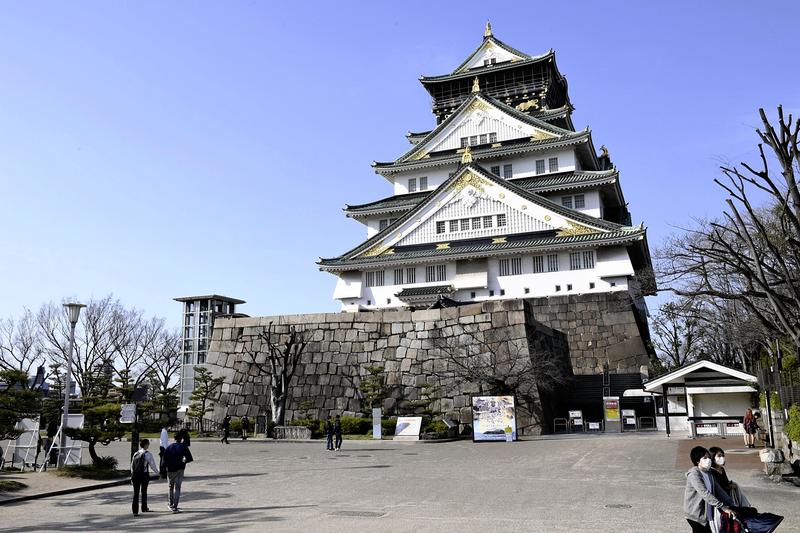
Once again attracting lots of attention in this respect is Osaka Castle, which successfully achieved a longer concrete lifespan after major repairs were undertaken in 1995-97 at a cost of about 7 billion yen.
At a banquet held during the G-20 Osaka Summit last June, Prime Minister Shinzo Abe said that the installation of elevators in the tower of Osaka Castle was "a major mistake," which placed the castle tower under the spotlight in an unexpected way. Nevertheless, it is perhaps the best-known reinforced concrete castle tower in the world.
The tower of Osaka Castle was rebuilt in 1931 as the nation's first castle restoration. It was initially planned for the 1995-97 repair work to be primarily cosmetic. But in light of the Great Hanshin Earthquake that hit Osaka immediately before repairs, the Osaka municipal government embarked on seismic retrofitting work.
Concrete is essentially an alkaline substance, but it becomes neutral when exposed to carbon dioxide, which leads to corrosion of the reinforcing steel. In light of this, a specific alkaline solution was filtered into the concrete, thus successfully achieving re-alkalization of the aged concrete. This was the latest technology available at the time for repair and maintenance of buildings and bridges.
In 1997, following the repair, the tower of Osaka Castle was registered as a tangible cultural property, becoming the first castle with a reinforced concrete structure to gain the status.
A vice curator involved in research on Osaka Castle said the tower "was restored to a brand-new state." He proudly said that "it's not an extension of the lifespan, but a reset." He was invited to a Cultural Affairs Agency task force meeting in January this year and explained achievements made during the Osaka Castle restoration. Alkalization of concrete could be an option for restoring Wakayama Castle, said an official in charge at the Wakayama municipal government.
Whether the spectacle of a towering castle keep can be handed down to future generations is a task to be tackled by those living in the Reiwa era.
According to the Japan Castle Foundation, there are about 100 castle towers across the country.
Among those built before the Edo period and still in existence today are five castles designated as national treasures, including Himeji Castle and Matsumoto Castle, and seven castles designated as important cultural properties.
Read more from The Japan News at https://japannews.yomiuri.co.jp/