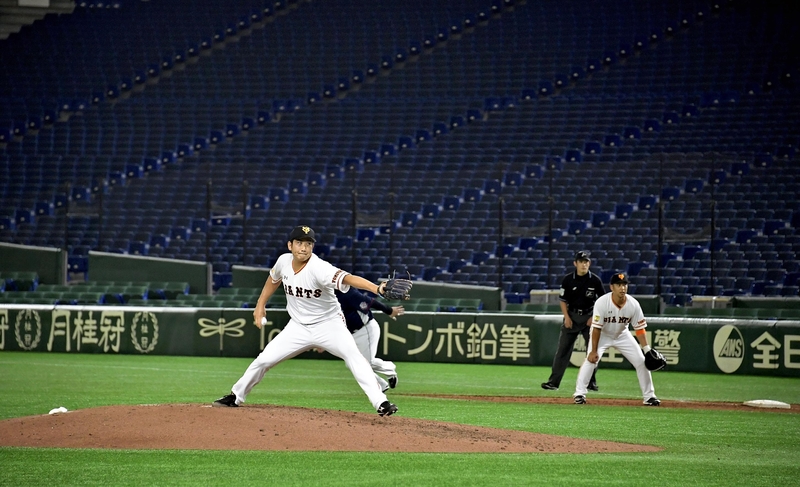
Professional sports in Japan are close to starting up again after being held up due to the spread of infections with the novel coronavirus.
The regular season for professional baseball in Japan will start June 19, while the top division of the J.League -- Japan's professional soccer league -- will resume matches July 4. Though spectators will not be allowed in the stadiums at first, both leagues have been devising ways to prevent infections in the hopes that fans can return to rooting for their teams at the venues as soon as possible.
There are challenges ahead, including how to accept spectators into the stadiums in stages.
--Reducing infection risks
"To help players compete in the games free from fear, we want to arrange the testing system for all players," said Atsushi Saito, the commissioner of Nippon Professional Baseball (NPB), during a press conference on June 8.
Following suit with the J.League, NPB has also decided to carry out PCR tests regularly, covering all players, staff and others connected to the game.
The NPB and the J.League on March 2 jointly set up a liaison council on measures to cope with the novel coronavirus. On the basis of opinions from a team of experts chaired by Mitsuo Kaku, specially appointed professor at Tohoku Medical and Pharmaceutical University, both leagues have discussed when to return to action and ways to prevent infections.
Regular testing was proposed before any return to action as an effective tool for early detection of infected cases within each team, but there were also teams reluctant to implement such a plan. As the testing environment improved, such as the health ministry approving the use of saliva samples for PCR tests, the momentum for adopting the plan heightened.
While the testing system has taken concrete shape, challenges remain. According to the opinions presented May 22 by the team of experts, even when a player has tested positive for the infection, "The team, in principle, will play the games and practice as scheduled."
Nevertheless, if an infection cluster arises within a team, or the central government or prefectural governors issue a request for limiting the holding of events, there could be such scenarios in which the leagues would be forced to suspend their regular season.
Rules are also needed for identifying those who have had close contact with infected people and for allowing them to return to the team.
Once action restarts, the matter of biggest concern is how to safely welcome spectators back to the stadiums. Both NPB and the J.League will play without spectators for the time being, with games transmitted on TV and over the internet.
Under the central government's basic policy, starting July 10 sporting events accommodating up to 5,000 people or up to 50% of total capacity, whichever is lower, will be permitted. From Aug. 1, up to 50% of total capacity will apply regardless of the number of people.
The J.League has confirmed that it will aim to hold matches with spectators, starting July 10 or later, while NPB has also said, "We will deal with the situation in accordance with the government's guidelines and with the understanding of local governments."
In order to establish a tracking method if spectators are found to be infected, the leagues are considering ways to identify the seats used.
As the start of the NPB season has been postponed by about 3 months, the number of regular season games will be reduced to 120 from the 143 games last year. The schedule of games has been announced only up to a month into the future. NPB has also contrived ways to reduce the risk arising from traveling by holding the games by region and scheduling six consecutive games in a row between the same two teams.
Though this season will be quite different from conventional ones, Yomiuri Giants manager Tatsunori Hara remained positive: "Our competitive style will not change. We will compete while adjusting to the rules."
--Impact on operations
The cut in the number of games and the holding of them without spectators will surely deliver a heavy blow to the operations of the teams. According to fiscal 2019 financial figures the J.League released May 27 for 45 clubs, the average annual proceeds from ticket receipts for first-division clubs was about 1 billion yen.
Even if the admission of spectators to the stadium is allowed step by step from July 10 onward, Fumiaki Koizumi, president of the Kashima Antlers, said, "Spectators may not come back so soon, making it likely for a drop of 1 billion yen or 2 billion yen" in total income.
The Urawa Red Diamonds also forecast a drop of about 2 billion yen in income.
There has also been a succession of requests made to clubs by those involved in sponsorship deals for a reduction in the fees.
To rescue clubs that might be driven to financial difficulties, the J.League has secured 38.5 billion yen through its credit line and other means with two financial institutions as it strives to maintain the current 56-club system.
Read more from The Japan News at https://japannews.yomiuri.co.jp/