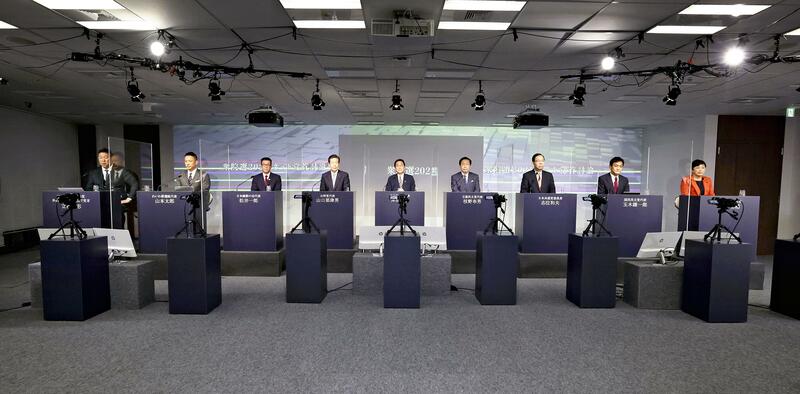
With the official campaign period starting Tuesday in the run-up to the Oct. 31 general election, the leaders of nine political parties have been engaging in policy debates.
The election will show whether voters prefer the continuation of the government led by the coalition of the Liberal Democratic Party and Komeito, or a new government led by a group of opposition parties centered on the largest of them, the Constitutional Democratic Party of Japan.
The nine faced off in a debate streamed online Sunday.
"We must think about raising wages," said the LDP's president, Prime Minister Fumio Kishida. "We want to advance economic measures by realizing a virtuous cycle of growth and distribution."
CDPJ leader Yukio Edano said: "We will place a focus on [support for] low-income people who are engaged in work related to medical care, nursing care and childcare. We vow to revitalize the Japanese economy by increasing consumption."
Komeito leader Natsuo Yamaguchi said, "We want to boost consumption to restore the Japanese economy."
"We must shift from this neoliberalism in which the strong prey on the weak," Japanese Communist Party Chair Kazuo Shii said. "We will support people's livelihoods, and we will improve the economy."
Ichiro Matsui, head of Nippon Ishin no Kai (Japan Innovation Party) said, "We want to carry out deregulation to create new industries."
Democratic Party for the People leader Yuichiro Tamaki said, "We want to realize an economy that will raise wages through a massive investment of 150 trillion yen."
According to a tally by The Yomiuri Shimbun as of Sunday, about 1,000 people are planning to vie for the 465 House of Representatives seats up for grabs. Single-seat constituencies account for 289 seats and the remaining 176 will be determined through the proportional representation system.
The CDPJ, JCP, DPFP, Reiwa Shinsengumi and the Social Democratic Party have coordinated to support a single candidate in more than 210 constituencies.
Read more from The Japan News at https://japannews.yomiuri.co.jp/