Hitachi, Ltd.'s decision to suspend its new nuclear power station construction project in Britain has put Japan's nuclear export strategy into an even tighter spot. How will the industry overcome the difficult problems of maintaining human resources and technologies for nuclear plant exports, which it had been counting on for its survival? Hitachi's decision could lead to a shortage of talented workers in the future and even have an impact on the decommissioning work at Tokyo Electric Power Company Holdings, Inc.'s Fukushima No. 1 nuclear power plant. Japan's nuclear policy will need to come up with its next move.
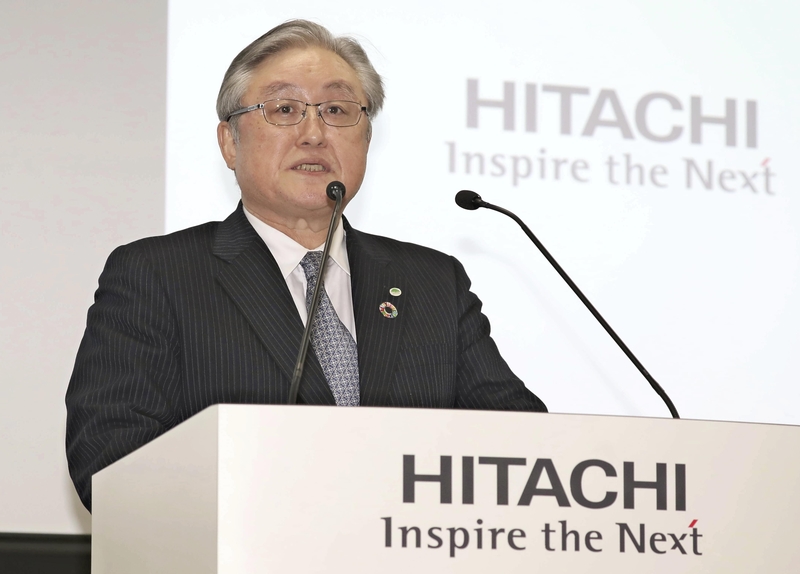
At a press conference held at 7 p.m. on Thursday, Hitachi President Toshiaki Higashihara laid bare the difficulties facing private companies involved in the nuclear business.
"If we continue development from now on, the costs would increase further. Hitachi is a private enterprise, and there are limits to what we could shoulder on our own," Higashihara said.
In comments on Hitachi's announcement, British Business, Energy and Industrial Strategy Secretary Greg Clark indicated he planned to continue negotiations on the project. "We will work closely with Hitachi and the industry to ensure that we find the best means of financing these and other new nuclear projects," Clark told the House of Commons on Thursday.
A high-ranking Japanese government official told The Yomiuri Shimbun: "We'll build a new framework from scratch with the British government. When negotiations will resume hasn't been decided, but this isn't a withdrawal."
The cost of renewable energy sources such as offshore wind technologies has plunged in Britain, which has indeed put nuclear power at a disadvantage. There is no guarantee that the British government will offer conditions that will enable Hitachi to resume this construction project.
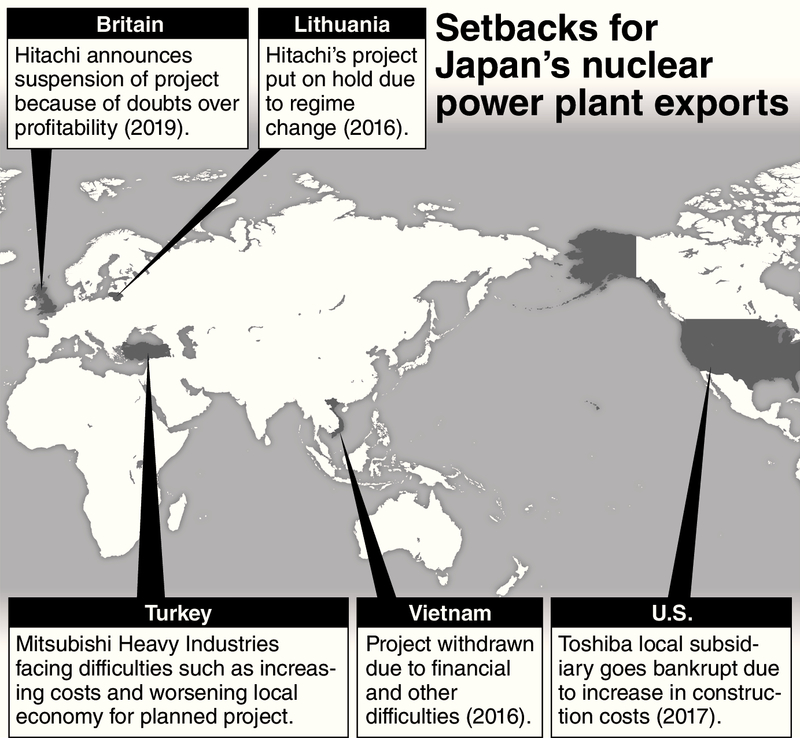
There is a growing view within the Japanese government that Mitsubishi Heavy Industries, Ltd. will not be able to avoid abandoning a nuclear power project in Turkey. It is highly likely the number of Japanese nuclear export projects could effectively become zero.
String of cancellations
Construction of new nuclear power plants in Japan has been more difficult since the March 2011 accident at TEPCO's Fukushima No. 1 nuclear plant. Consequently, the government decided overseas markets presented the best chance for the industry's survival. Although there were some moves to review nuclear plant projects immediately after the Fukushima accident, global demand remained robust and nuclear power plant exports were considered to be a promising growth field.
So why did things turn out contrary to expectations? One major reason is that construction costs have soared due to a growing global tendency to place greater emphasis on safety measures, and private companies have become unable to withstand these financial risks.
Since 2016, Japanese companies have been forced to withdraw from or suspend involvement in projects scheduled in Vietnam, Lithuania and the United States.
Securing personnel a problem
At a time when the prospects for construction of new nuclear plants or the expansion of existing ones in Japan remain uncertain, losing access to markets overseas will make it harder to retain talented human resources and develop nuclear power technologies.
"The number of personnel involved from the construction stage of a new nuclear plant will decline, and Japan's industry could become less competitive than overseas rivals and fall into a vicious cycle," Tokoha University Prof. Ryuzo Yamamoto said.
Looking ahead, Japan will need to decommission aging nuclear plant reactors over the next few decades, but it is possible the nation will have a shortage of human resources capable of handling decommissioning technologies.
Is there a way out of this situation? Hitachi Chairman Hiroaki Nakanishi, who is also president of the Japan Business Federation (Keidanren), is advocating the restart of domestic nuclear plants.
Developing new technologies that can give Japan an advantage over Chinese and Russian rivals in the field of nuclear plant exports is also a key issue that must be addressed. The government plans to devote resources to cooperating with the United States to develop new nuclear power technologies such as small modular reactors that are said to be cheap and very safe.
Realignment within the nuclear power industry is also likely to accelerate. Hitachi is considering working with Toshiba Corp., TEPCO and Chubu Electric Power Co. on the maintenance of nuclear plants, among other fields. Higashihara is keen to strengthen this tie-up among the four companies.
"What should we do together with other Japanese makers? We must discuss this issue more deeply," he said at Thursday's press conference.
Enhanced government support measures will also be necessary for Japanese entities in this field to operate in unison.
Read more from The Japan News at https://japannews.yomiuri.co.jp/