Three years have passed since the total liberalization of the electricity retailing market started in April 2016. Under the system, households can in theory freely choose their electricity suppliers from a range of smaller newcomers and the major companies that had monopolized supplies in their respective service areas, leading to a fierce price war.
However, as the major electric power companies maintain a big presence, challenges remain to improve the competitive environment.
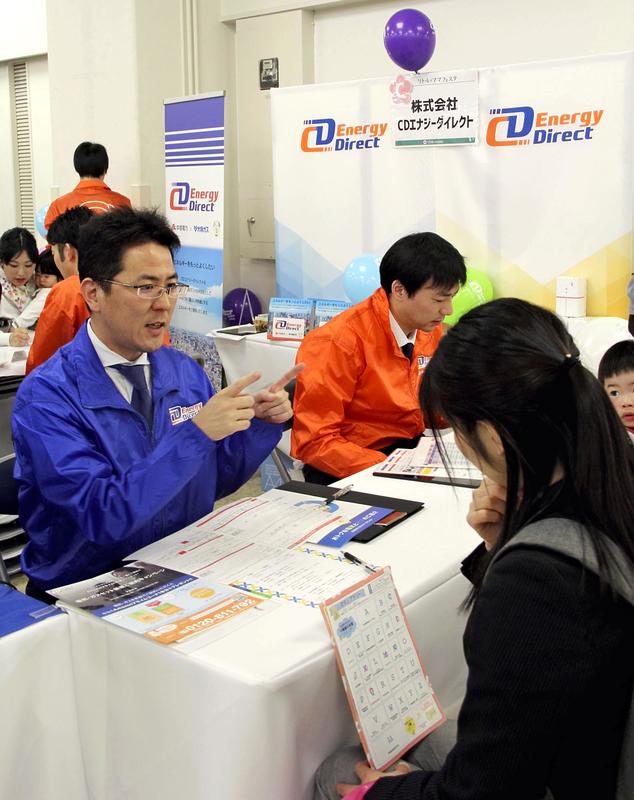
CD Energy Direct Co., a Tokyo-based joint venture firm established by Chubu Electric Power Co. and Osaka Gas Co., participated in an event for families in Tokyo in early March.
At the event, officials of the company proposed various fee plans that are cheaper than those offered by major firms, while listening to participants discuss their monthly electricity bills.
CD Energy Direct was established in April last year, and began commercial activities -- mainly in the Tokyo metropolitan area -- in August.
To date, the company has received about 70,000 applications for its service contracts, including those for gas supplies. A woman in her 30s who visited the event said: "I want to lower my electricity bill payments even by a bit. I am considering switching [to CD Energy Direct]."
Under the liberalization of the electricity retailing business, not only can newcomers enter the field, but also major established companies can offer services outside their traditional service areas.
For example, Chubu Electric Power, which operates mainly in the Tokai region, can now offer services on Tokyo Electric Power Company Holdings Inc.'s longtime turf.
The choice of electricity suppliers has diversified, while gas companies and firms from other sectors have also entered the business.
According to the Natural Resources and Energy Agency, 589 companies had joined the electricity retailing business as of March 29.
However, the major electric power companies' market shares for supplying households and other small consumers remain high.
Only two of the major electric power companies account for fewer than 90 percent of service contracts in their respective traditional service areas: Tokyo Electric Power at 85.58 percent and Kansai Electric Power Co. at 87.47 percent.
As there are not many newcomer suppliers in rural areas, where demand for electricity is lower than in urban areas, benefits for consumers are limited.
Economy, Trade and Industry Minister Hiroshige Seko said: "There is not enough competition. From now on, we have to tackle the task of having competitive circumstances prevail in provincial areas."
The liberalization of electricity retailing for factories and offices started earlier than that for households. Thus, market shares of electricity volume sold to large-consumer entities by newcomers tend to be higher than those for households: About 40 percent in Hokkaido, and more than 20 percent in the Tohoku and Kyushu regions. It seems that companies are keen to cut costs by switching their contracts from major companies to newcomers.
A key challenge ahead is how to build systems in which newcomers can procure electricity at a lower cost.
Because the newcomers do not own large electric power plants, they procure electricity mainly in the wholesale market, where their procurement costs tend to surge in mid-summer and mid-winter when demand soars. One newcomer has already incurred a deficit of more than 10 billion yen.
As of July last year, more than 100 companies had never provided electricity even though they were registered as electricity retailing suppliers. Nineteen companies nullified their registrations as the service suppliers as of December.
In 2020, power generation and power distribution businesses of the major electric power firms are set to be separated, marking the government's electricity system reform coming to the final phase.
Prof. Takeo Kikkawa at the Tokyo University of Science, who is an expert in energy industry studies, said, "To help the newcomers raise their market shares, it is necessary to increase the volume of electricity traded in the electricity wholesale market."
Read more from The Japan News at https://japannews.yomiuri.co.jp/