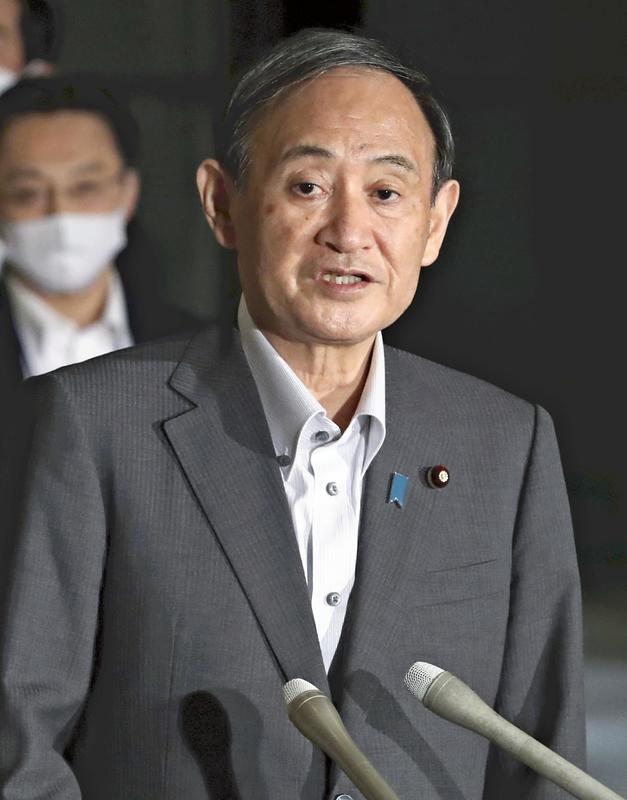
In his first week in office, Prime Minister Yoshihide Suga actively gathered information from academics and corporate managers through face-to-face meetings, an approach unchanged from his tenure as chief cabinet secretary.
"To keep my promise of 'creating a Cabinet that works for the people,' I've held discussions with ministers concerned and given them instructions. I can sense a good response in diplomatic affairs, too."
Suga said this confidently when asked Wednesday by journalists at the Prime Minister's Office about his feelings during his first week as prime minister. He went on to say, "I want to meet the expectations of the people with a sense of speed, by setting my antenna high," indicating his determination to manage his administration in the months ahead.
Suga took office on Sept. 16. Since then he has given numerous instructions to revelant ministers regarding the key tasks faced by his Cabinet. On Wednesday he called Tetsushi Sakamoto, the minister in charge of regional revitalization, to the Prime Minister's Office and instructed him to accelerate measures related to regional revitalization and the chronically low birthrate.
Also notable are the many direct conversations Suga has had with outside experts and corporate managers. On Sunday, during the four consecutive holidays, Suga had lunch with Keio University Prof. Jun Murai, who is knowledgeable about digital policy, at a hotel near the Diet. They discussed the challenges lying ahead in establishing a new digital agency, one of the centerpiece policies of Suga's Cabinet.
As to insurance coverage for infertility treatment, another key policy, Suga met on Monday with Rikikazu Sugiyama, doctor of Sugiyama Clinic in Tokyo, to hear about the situation on the frontline of health care. On Tuesday, Suga had lunch with Nobuhiko Okabe, head of Kawasaki City Health and Safety Research Center, from whom the government is receiving advice on ways to cope with the novel coronavirus.
Suga has also exchanged opinions with Takeshi Niinami, president of Suntory Holdings, and with scholars in economics, including Keio University Prof. Shumpei Takemori and Kaetsu University Prof. Yoichi Takahashi.
Since his time as chief cabinet secretary, Suga has had few particular staff who served as "brains." Instead he gathered information by meeting with well-informed officials and bureaucrats throughout the day.
Chief Cabinet Secretary Katsunobu Kato said during a Wednesday press conference: "Since the days when he was chief cabinet secretary, Prime Minister Suga has listened to diverse opinions through various channels, not just information coming from public organizations, and had them reflected in policy. This information-gathering style has probably not changed since he took office as prime minister."
However, some in the government and ruling parties are skeptical Suga can go on this way. A veteran official of the Liberal Democratic Party said, "It will be difficult for the prime minister to continue his style of meeting with many people as he currently does."
It is said that Former Prime Minister Shinzo Abe invited popular backlash regarding his measures to combat the novel coronavirus partly because, as a former Cabinet minister put it, "He started having lunch with outside experts less often, because of the impact of the coronavirus, making it difficult for him to obtain front-line information."
Many past prime ministers have suffered from a scarcity of information after they took office. Former Prime Minister Keizo Obuchi, whose frequent calls to others were nicknamed "bucchi phone," called people partly to gather information from outside experts.
Read more from The Japan News at https://japannews.yomiuri.co.jp/