It has been a month since the Cabinet of Prime Minister Yoshihide Suga was formed Sept. 16. The following is the second installment of a series analyzing Suga's brand of politics.
"Did he really pass away? That's sad, that's sad."
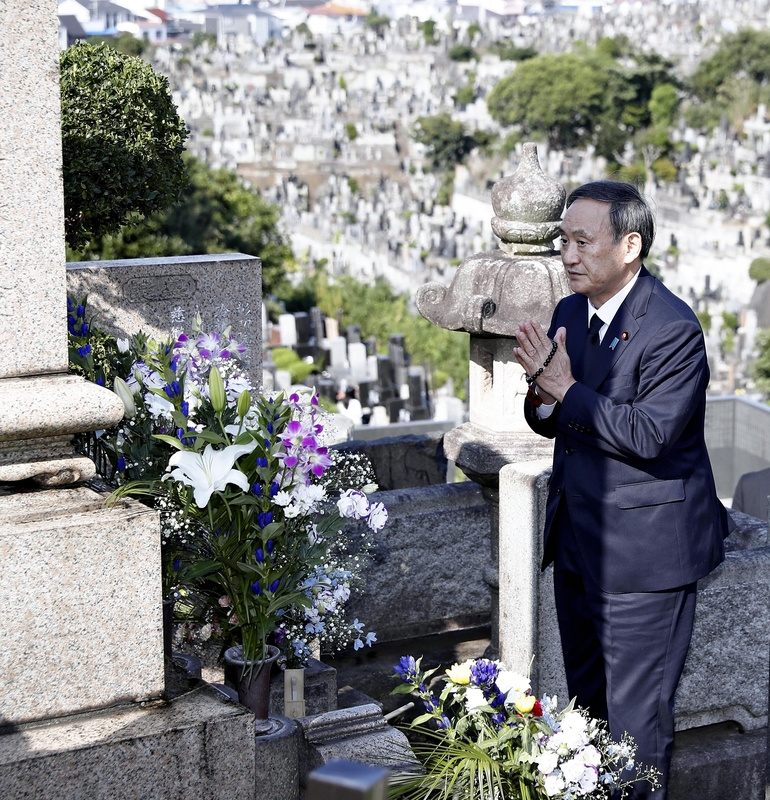
Prime Minister Yoshihide Suga said this over and over on Oct. 4, in a call he made to Kazuo Tanoi of the Yokohama City Council. Tanoi had just emailed Suga to tell him about the death of one of Suga's long-time supporters, whom the prime minister had revered as a father figure.
One of Suga's secretaries attended the funeral service on Oct. 10. A photograph was put up of the three together -- the supporter, Suga and Tanoi -- and a calling card of Suga's printed with his title of prime minister was placed inside the coffin.
"He [Suga] never forgets to express his gratitude. He's meticulous in showing his care and consideration for others," Tanoi said.
-- Nickname
Suga's "way of doing things" was established during his years as a politician's secretary. In 1975, he became a secretary for Hikosaburo Okonogi, a former construction minister who was elected from the House of Representatives' former No. 1 Constituency in Kanagawa Prefecture. Hikosaburo is the father of Hachiro Okonogi, chairman of the National Public Safety Commission.
Initially, Suga was put in the care of Kenji Umezawa, then a member of the Kanagawa Prefectural Assembly, whose constituency was located within that of Hikosaburo's. "I want to foster a secretary who will not take a lofty view, just because he's the secretary for a Diet member, but have the sensibilities of an ordinary person," Hikosaburo said.
Back then, Suga was said to be a man of few words, living life with all his energy.
Umezawa repeatedly told Suga: "Politicians who only visit their own supporters are no good." Keeping this in mind, Suga also went to houses that displayed signs for other political parties, such as the Socialist Party of Japan or the Japanese Communist Party.
At some point Suga acquired the moniker "Suga-chan," as he acted swiftly and earnestly even when responding to mounting requests for assistance.
Umezawa said, "He was not a calculating man, and his composed nature was apparent as a secretary, too."
-- The character of Yokohama
Naobumi Nonami is the president of Kiyoken Co., a company that makes and sells shumai steamed dumplings, a local specialty of Yokohama. An acquaintance of Suga's since his days as a politician's secretary, Nonami said, "The character of Yokohama, being open even to outsiders, created Prime Minister Suga."
Suga first ran for election in the Nishi Ward constituency for the Yokohama City Council in April 1987. Nonami still remembers well Suga campaigning in front of Tobe Station on the Keikyu Line.
"I ask for your support," Suga repeatedly said to commuters, but there was no response. Everyone passed in front of him without interest. Nonami recalled, "I got worried about him, wondering, 'Is he alright in this situation?'"
But Suga managed to come in second in the fiercely contested race where five candidates battled for the constituency's two seats. Suga beat the third-place candidate by a margin of 655 votes.
-- By 548 votes
After serving two terms with the Yokohama City Council, in 1996 Suga ran in the lower house's Kanagawa No. 2 constituency, which includes the district of Nishi Ward, and won a Diet seat for the first time.
He has now been elected to the lower house eight straight times. He became chief cabinet secretary in 2012, thus becoming a caretaker of the Prime Minister's Office. Until that point, he conducted grassroots campaigns for each election, exhaustively meeting as many people as possible to garner votes within his constituency.
"It's an important opportunity to gauge how the people are really feeling," Suga said, and it was not unusual for him to go to five or six places in one evening.
The biggest trial for Suga came during the lower house election in 2009 when the Democratic Party of Japan succeeded in taking the reins of government. As his Liberal Democratic Party was buffeted by headwinds, Suga was hit hard too.
On the evening of the Aug. 30 election day, with ballot-counting done on the same day, Suga was prepared for his defeat in that single-seat constituency. "To my shame, I appear to be defeated," he said to those around him.
As the vote-counting ended, however, Suga turned out to have won the race by a narrow margin of 548 votes. He vowed "not to forget the hardship" of that time, and the license plate of the car he uses in his constituency still bears the number "548."
Even after becoming chief cabinet secretary, Suga did not neglect activities in his constituency. His supporters' association visits Naritasan Shinshoji temple in Narita, Chiba Prefecture, every January, with about 1,000 people riding in about 20 buses. It's become tradition for Suga to rush to the venue where they have lunch and make the rounds among the tables, thus renewing old relationships.
Daisuke Yusa, a member of the Yokohama City Council who once served as a secretary to Suga, said, "Many people support him across generations, backing him even after the generation of supporters in their old age has been replaced by the next generations of their children or even grandchildren."
-- Unknown figure at first
Suga wore a badge indicating he was a member of the lower house for the first time at the age of 47. At the time, he was an unknown figure in the national political arena.
Back then, there was a well-known person who shared the same Chinese character as his surname, except it was read as "Kan" instead of "Suga." This was Naoto Kan, who drew attention over the issue of HIV contracted from contaminated blood products and served as prime minister from 2010 to 2011.
Suga told people who gathered at a meeting in his constituency, "When I go to the Diet now, everyone calls me Kan." But then he declared: "Please wait 10 more years. Ten years from now, everyone will know my name is Suga."
A decade later, in 2006, Suga became a Cabinet member for the first time. In 2016, two decades later, he had become the longest-serving chief cabinet secretary. This September, Suga finally found himself prime minister.
Read more from The Japan News at https://japannews.yomiuri.co.jp/