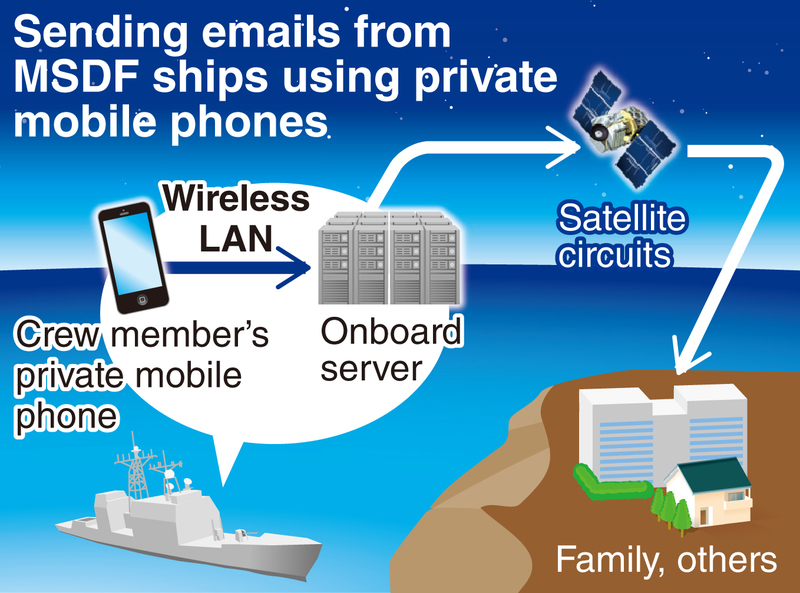
The Marine Self-Defense Force is planning to make it possible for crew members to use their private mobile phones to email family members and others while on voyages outside of mobile phone coverage, according to sources.
The MSDF has so far greatly restricted outside communications due to concerns over revealing a vessel's activities, but with smartphone use spreading mostly among younger members, it is being forced to change with the times.
In response to the start of the MSDF's antipiracy mission off Somalia and other activities, the MSDF began in fiscal 2010 to install personal computers and servers connected to satellite circuits in onboard communications rooms and other places.
This allowed crew members to email their families, but the times and places they could use the facilities were heavily restricted. Crew were allowed to bring their private mobile phones on board, but not to use them.
The new initiative combines a server with a duty-use wireless LAN, which allows crew to send and receive emails using their own private mobile phones through the wireless network, anytime and anywhere.
A trial run was conducted in fiscal 2017 on some vessels. This fiscal year, the service became possible on almost all of the force's about 70 ships that go on long, open-ocean voyages. Starting next fiscal year, the areas onboard where wireless networks can be accessed are to be steadily expanded.
The MSDF has traditionally taken a negative stance on communications with the outside world while at sea. In the security world, keeping a unit's operations secret is a cardinal rule.
"You never know when something said by accident will leak out, so as a rule, contact even with families is not allowed once we leave port," a senior officer said.
However, there have been complaints recently, mainly from younger members, about the stress of not being able to use smartphones on long voyages.
With the low birthrate and improved economy, the Self-Defense Forces are facing a shortage of qualified recruits who want to serve. The MSDF decided it needed to create a workplace that takes the needs of young people into consideration.
"It's always a battle to use the shared personal computers during breaks. And if you use the same computer, you have to worry about other crew members seeing your email," one younger MSDF member said. "It will be great to be able to use my own smartphone."
However, to maintain secrecy, communication will only be allowed between addresses registered in advance, and use of social networking services, through which information could spread, will not be allowed.
Emails will be collected on a server via a wireless network, and messages that contain vital information, such as the ship's location or duties, will automatically be stopped.
Submarines often operate in secret, and will continue to prohibit private communications with the outside world.
"It feels like a different era, but we need to change with the times," said a senior officer who has captained MSDF vessels.
Recruitment problems
The MSDF's efforts to improve its onboard communications environment are partially due to difficulty it has faced recruiting new members from the "smartphone generation."
The Ground, Marine and Air Self-Defense Forces each recruit separately by rank.
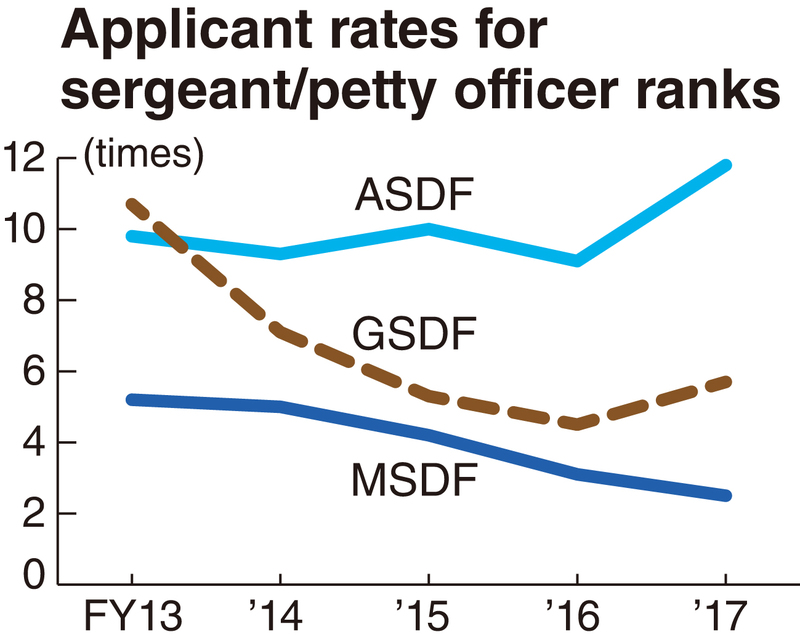
According to the Defense Ministry, in fiscal 2017, the application rate for sergeant/petty officer candidates, which make up 60 percent of the total, was at 11.8 times in the ASDF, followed by the GSDF at 5.7 times and the MSDF at only 2.5 times.
The MSDF's rate has been the lowest for the last five years and continues to decline.
"ASDF flights are at the most several hours long and the GSDF serves on land. MSDF members have to leave their families to go on voyages to distant seas for a month or longer. For young people who want to be connected with others, it's a difficult working environment," said a senior MSDF officer. "We hope that by making their lives at sea similar in some ways to regular life, it will lead to more applicants [for the MSDF]."
Read more from The Japan News at https://japannews.yomiuri.co.jp/