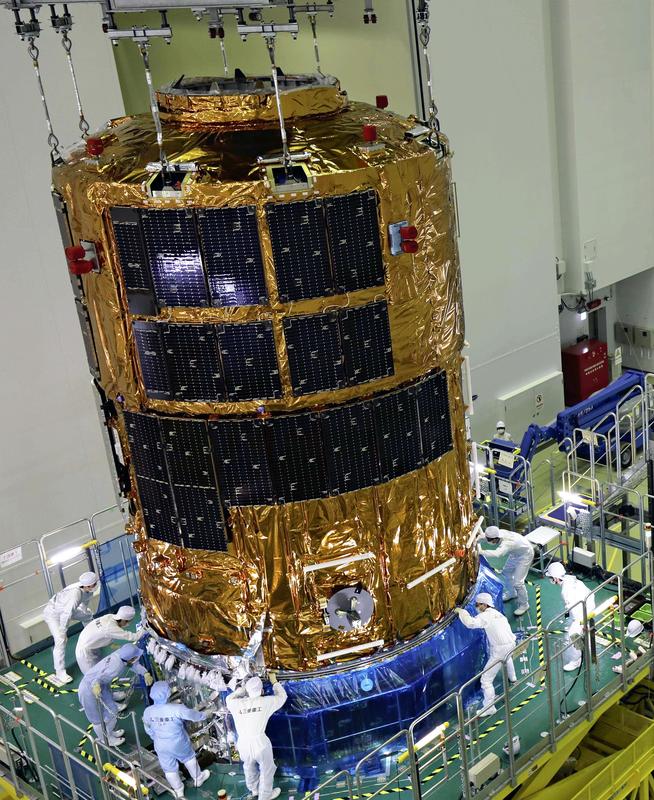
When a rocket streaked into the sky from Tanegashima island on Thursday, it marked the beginning of the end of an era. The H-II Transfer Vehicle Kounotori 9 (HTV9) -- the last in a series of nine HTV unmanned cargo transporters -- was on its way from the Japan Aerospace Exploration Agency (JAXA)'s Tanegashima Space Center in Minami-Tane, Kagoshima Prefecture, bound for the International Space Station (ISS) in orbit high above Earth.
The outer-space supply missions, which have played a significant role in Japan's international cooperation on the ISS, will be passed on to a next-generation spacecraft.
The HTV is a cylindrical supply ship about 10 meters long and 4.5 meters in diameter. It has been responsible for delivering the food and water necessary for astronauts to spend a long time on the ISS. The HTV has the world's largest transport capacity, of 6 tons in total, compared with 2 to 3 tons for cargo ships launched by the United States and Russia.
With their high transportation capacity, HTV6, HTV7 and HTV8 transported supplies essential for long-term operation of the ISS, such as large lithium-ion batteries. The HTV9 launched on Thursday carries six batteries, fresh food and drinking water, all weighing about 6.2 tons in total.
The HTV approaches the ISS and flies alongside the station at a distance of about 10 meters. A robot arm operated by an astronaut grapples the HTV and berths it to the ISS. This method was introduced for the first time with the HTV, and later U.S. suppliers adopted the method, making it a pioneering technology in the field.
"The system originated in Japan has become the world standard. It's proof that our technology was recognized globally," Hirohiko Uematsu, director of the JAXA's HTV Technology Center, said.
Development of the HTV started in the late 1990s, and the first HTV was launched in September 2009. After the retirement of the U.S. space shuttle in 2011, the HTV became highly valuable as the only supply ship capable of carrying large equipment. The HTV has demonstrated remarkable stability as the only cargo transporter in operation that has not failed.
In 2015, a series of U.S. and Russian transporters failed to supply cargoes due to rocket explosions and communication problems. The HTV5, launched in August of that year, was urgently scheduled to carry a water purifier and other items that were to have been sent by a U.S. transporter. Japanese astronaut Kimiya Yui maneuvered the robot arm to grab the HTV5. There was no problem from the launch to the docking of the HTV, and Japan's technological prowess has been praised by other countries.
The HTV's achievements are not limited to simply transporting daily necessities.
The HTV7, launched in 2018, released a small capsule containing protein crystals toward the ground when autonomously reentering the atmosphere. The capsule, which withstood high temperatures of about 2,000 C, was recovered off Minami-Torishima island of the Ogasawara Islands, helping to demonstrate a new method for bringing ISS samples back to Earth.
The HTV also transported more than 20 microsatellites. The satellites released from the Japanese Experiment Module Kibo on the ISS were developed by a variety of groups, including those from developing countries, universities in Japan, and space-enthusiast company employees, and the project played a role in expanding space development.
In the future, the next generation HTV-X, which is under development, will take over the role of cargo supply to the ISS. JAXA will face many new challenges, such as reinforcement of its transportation capacity and the introduction of technology for automatic docking without the use of a robot arm.
The HTV-X will be launched in fiscal 2021, and JAXA's HTV-X Project Team manager Norimasa Ito said, "We want to take over the legacy of the HTV vehicles and be able to play an active role beyond them."
Read more from The Japan News at https://japannews.yomiuri.co.jp/