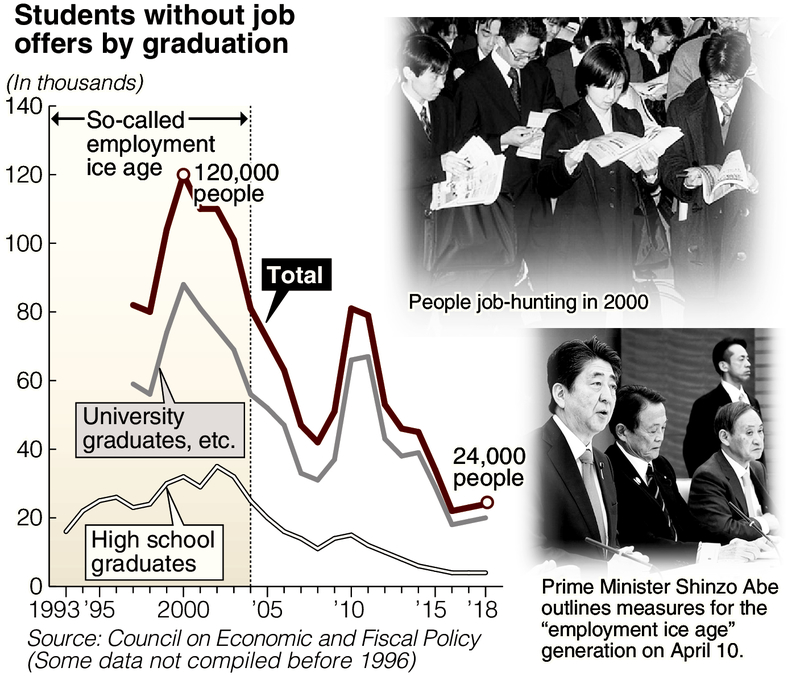
Amid a labor shortage, companies are keen to hire workers, but prefer highly skilled and knowledgeable personnel. In response, the government is set to provide full-fledged employment support for "nonregular" workers currently in their mid-30s to 40s -- members of the so-called employment ice age generation.
Measures being considered are expected to include the improvement of job training and expansion of subsidies to companies that employ ice-age workers. The key will be making sure any support offered to the generation has substance.
During a meeting of the government's Council on Economic and Fiscal Policy on April 10, Prime Minister Shinzo Abe instructed relevant ministers to swiftly consider support measures for people in the age bracket, also known as the "lost generation." This refers to people who graduated from universities, graduate schools and other such institutions around 1993 to 2004, a period when companies cut the number of recruits due to the economic downturn after the bursting of the bubble economy. Comprising about 17 million people, many in the generation were unable to find full employment and currently hold part-time or temporary work positions, dubbed nonregular work.
The government plans to implement intensive measures over the next three years. The measures include support for finding employment in understaffed industries by creating a dedicated section at HelloWork job placement offices, while promoting internship programs and easing subsidy criteria. Support for skills development in information technology and other fields is also expected to be considered.
"We definitely want to hire people in their early 40s [as we have] a shortage of personnel in that age group," said an official of a major materials company listed on First Section of the Tokyo Stock Exchange.
In the second half of the 1990s, the company curbed the number of recruits to about one-third of the previous levels because of poor business performance. In recent years, the company has tried to level off the age demographic of its employees by actively hiring mid-career workers.
Behind the aggressive hiring by companies is a recruitment market in which demand for recruits is high. The percentage of university students who have found jobs was 22.2 percent as of April 1, up 1.7 percentage points year on year, according to data released by Recruit Career Co. on April 11. For companies struggling with the fierce competition for new graduates, nonregular workers from the employment ice age generation could be a resource worth pursuing. The number of such workers is said to amount to just under 4 million.
"We are eager to hire people including those from the employment ice age generation," said Shuichi Kanno, a board director and managing executive officer of Central Security Patrols Co.
Every year, the Tokyo-based company employs about 200 mid-career workers, mainly in their 20s to 50s. Despite making its recruitment practices public, less than twice the number of people sought applied in the past few years. More than 90 percent of the company's nearly 4,000 personnel are full-time employees. However, job seekers appear to be reluctant to join, for example, because working as a security guard is thought to be difficult.
Many observers believe that vocational education and training by the government and other entities are essential to boosting employment among the lost generation.
Toru Abe, managing director in charge of Bic Camera Inc.'s corporate planning, talked about the requirements for mid-career workers at a press conference on April 11. "The preconditions are knowledge of household appliances, cameras and other products, as well as certain skills," he said.
When mid-career employees are hired, many companies pay salaries on the basis of seniority, so these workers are generally paid more than employees hired soon after graduation. Companies tend to seek mid-career workers who are highly qualified in terms of skills, personal connections and experience.
However, pessimism remains among nonregular employees.
"I'm afraid I won't be hired unless I acquire special skills," said a 37-year-old from Hiroshima. Since graduating from university, he has repeatedly changed jobs, taking positions as a contract worker or part-timer. Even though he has had job interviews for full-time positions, he thinks his lack of experience in full-time employment has hindered his success.
Besides staffing shortages, the government has been prompted to extend support for the employment ice age generation because members of the generation will reach retirement age in about 20 years. If the period of nonregular employment is prolonged, their pension benefits will be insufficient, causing a rise in the number of people from the generation who will need to rely on welfare. It is feared that such a situation could result in a significant burden on public finances.
"The issue of the employment ice age generation is not the fault of individuals. It is a policy failure," said Yohei Tsunemi, a lecturer at Chiba University of Commerce who specializes in employment affairs. "The government has shown its willingness to provide support. That should be acknowledged."
Read more from The Japan News at https://japannews.yomiuri.co.jp/