In late January at his office, Health, Labor and Welfare Minister Katsunobu Kato, who was appointed for the second time as health minister in the Cabinet reshuffle last autumn, concluded after running his eyes over senior ministry officials present, "It would be obviously difficult to designate [the disease caused by a new coronavirus] as a 'new infectious disease.'"
It was at the time when the ministry discussed whether pneumonia caused by the new coronavirus would be considered as a "new infectious disease," as stipulated in the Infectious Diseases Law.
"A new infectious disease" refers to one that "obviously differs in the state of the disease and the results of treatments" from already-known infectious diseases. As it corresponds to what can be called an "unknown threat," public administration can take such measures as isolating an infected patient in a hospital or detaining them in such places as medical institutions, when quarantining someone after they have entered the country.
This was a time when Japan had its first confirmed coronavirus patient and when it was becoming a challenge to bar people from entering the country if they were infected abroad. But the virus for the new type of pneumonia was already identified as the "new coronavirus" in China.
For the health ministry, including Kato who was knowledgeable about health and welfare administrations, it was considered reasonable not to designate the new type of pneumonia as a "new infectious disease" for legal reasons.
The argument, which was supposed to have been concluded, began again one month later, in around late February because the number of coronavirus cases in Japan soared. This intensified the calls for the government to declare a state of emergency on the basis of the law concerning special measures to cope with a new type of influenza.
With the use of the special measures law, the governor of a prefecture on which the state of emergency has been declared will be authorized to issue a compulsory acquisition or expropriation. It would empower governors to be able to utilize the property of landowners and landlords, even if they refuse, for instance, as a temporary medical facility in accordance with the declaration, or force business operators to sell pharmaceutical goods and foodstuffs. Except for influenza, only a "new infectious disease" could allow this special measures law to be utilized because it impedes on the rights of private citizens.
Opposition parties urged the government to recognize the disease caused by the new coronavirus as a "new infectious disease." At the same time, the government was not able to reverse its stance, as it made a statement in the Diet under the advisement of the health ministry, that the new type of pneumonia did "not correspond to a new infectious disease." However, the law concerning special measures was revised on March 14, making the coronavirus applicable to the new measures.
Within the health ministry, there are those senior officials who recall that at the initial stage of the coronavirus outbreak, "if the prime minister had said, 'Change the interpretation so as to consider the new coronavirus as a new infectious disease,' it would not have been impossible." But the idea of "urging the Prime Minister's Office to make a political decision" had not occurred to the health ministry, probably because the ministry had underestimated the threat posed by the coronavirus.
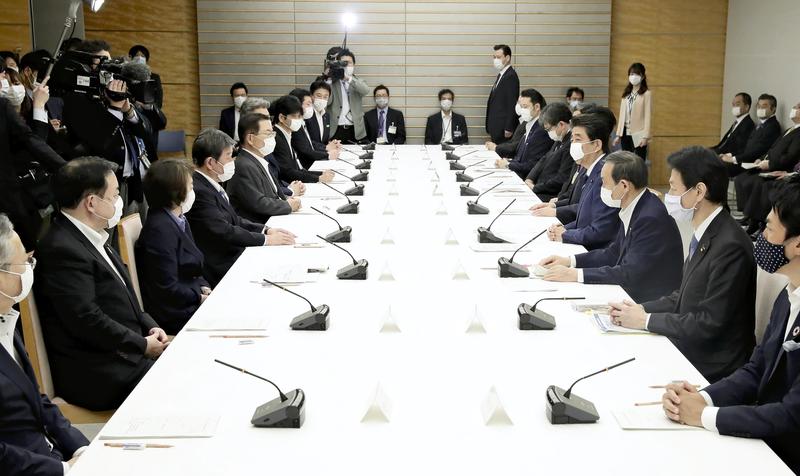
At a liaison meeting held at the Prime Minister's Office in late January, the government discussed the procedures for the Japanese residents living in Wuhan, China, following their upcoming return home via chartered flights. The health ministry initially intended to let returnees who showed no symptoms of the coronavirus go home via public transportation. However, a secretary of the prime minister said, "It's not good to let everyone go home," prompting the government to review the procedure. Then, immediately after they returned from Wuhan, two of the returnees who initially showed no symptoms, tested positive for the virus. The concern at the Prime Minister's Office proved true, which substantiated the laxness of the health ministry's crisis management.
The health ministry took an extremely backward-looking stance on detaining entrants into the country at the time of quarantine. When the Prime Minister's Office compiled a draft proposal on March 4, such border control measures as the "detention of entrants at designated facilities" were included, but Kato and Toshihiko Suzuki, vice health minister, fiercely opposed the proposal in unison.
Suzuki brought about a 10-page document to refute the proposal into the Prime Minister's Office, making such appeals as "The Cabinet's approval ratings would fall." The resistance lodged by Kato and other health ministry officials was so strong that Prime Minister Shinzo Abe became puzzled and said, "I had no idea why the health ministry opposed [the proposal] so strongly."
There are many who believe that the health ministry took such a half-hearted stance toward the detention of entrants, "because of a shortage of manpower." Should entrants be detained, the ministry would need to secure lodging for them. The ministry could not afford to allocate its personnel to such a task, which would have required a lot of time and effort. Even at normal times, the ministry, with its limited number of personnel, has been driven to handle a massive amount of administrative work related to the health, labor and welfare, leaving itself to being called "Kyosei Rodo Sho (forced labor ministry)," instead of its proper denomination of "Kosei Rodo Sho (health, labor and welfare ministry). The ministry, after all, would end up acting too late in an event of an emergency, which is certain to become a heavier burden for them.
"No matter what it does, the health ministry is extremely reluctant to do anything different from what it has done in the past," as is such a trait of the health ministry, which a government source has put it so half-resignedly. Those within the Abe administration have begun questioning themselves over the challenges its organizational structure faces and its limitations.
Read more from The Japan News at https://japannews.yomiuri.co.jp/