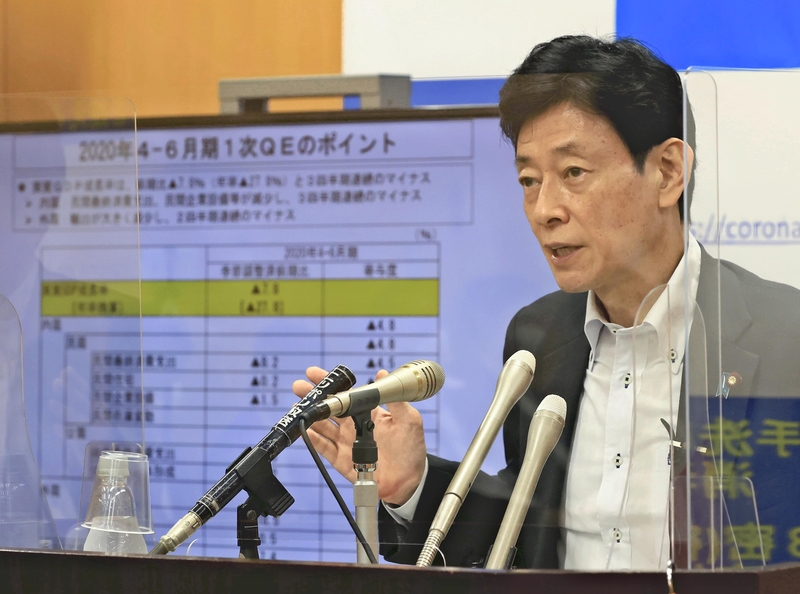
Japan's preliminary growth domestic product for the April-June quarter of this year, when the coronavirus crisis became more serious, showed the worst decline since World War II.
Rapid improvement is expected going forward, however, the recovery of personal consumption and business activities, which have slowed both domestically and internationally, is sluggish because of the measures set in place to prevent the coronavirus from spreading. There are also concerns over negative effects on employment and wages.
The economy plunged to an unprecedented level in the quarter. The main components that make up the nation's GDP all plummeted, with personal consumption down by 8.2%, exports down by 18.5% and corporate capital investment down by 1.5%, compared to the previous quarter.
When the economy saw the largest drop in the January-March quarter of 2009, after the collapse of Lehman Brothers, exports fell by 25.5% from the previous quarter, while personal consumption was down just by 0.5%. Exports suffered a huge blow because of the economic slowdown in the United States and Europe at the time, where the business of financial institutions heavily deteriorated.
Recently, as many countries placed top priority on containing the spread of the coronavirus by restricting the movements of people, it halted personal consumption and business activities at home and abroad. A wide variety of businesses were affected in a short period of time, creating a situation where there was no driving force to lead the economy. The drop in personal consumption seriously affected service industries such as restaurants, transportation and tourism. Japan Airlines Co. and ANA Holdings Inc. saw the number of passengers for international flights plummet by more than 90%. A major izakaya Japanese pub chain operator Watami Co. posted an over 40% decline in sales in the quarter compared to a year earlier.
--Won't see V-shaped recovery
Japan's GDP is expected to be positive in the third quarter of this year for the first time in four quarters, with some market players expecting an annualized growth rate of over 10%. However, this would be a temporary recovery from the large decline in previous quarters.
"It is natural to assume that the economic recovery will be modest," Takashi Miwa, a chief Japan economist at Nomura Securities Co., said.
Likewise, many observers do not expect a rapid V-shaped recovery. The government has taken economic measures totaling 233.9 trillion yen, but the future is not optimistic.
The government's "Go To Travel" campaign, which began in July to promote tourism, has been interrupted by the re-expansion of infections. There are only a few Japanese tourists seen around the Kiyomizu temple, a famous tourist destination in Kyoto.
"We can't do anything until a treatment or a vaccine for the virus is developed and people can move about freely again," said a 62-year-old female manager of a nearby bamboo ware shop.
Read more from The Japan News at https://japannews.yomiuri.co.jp/