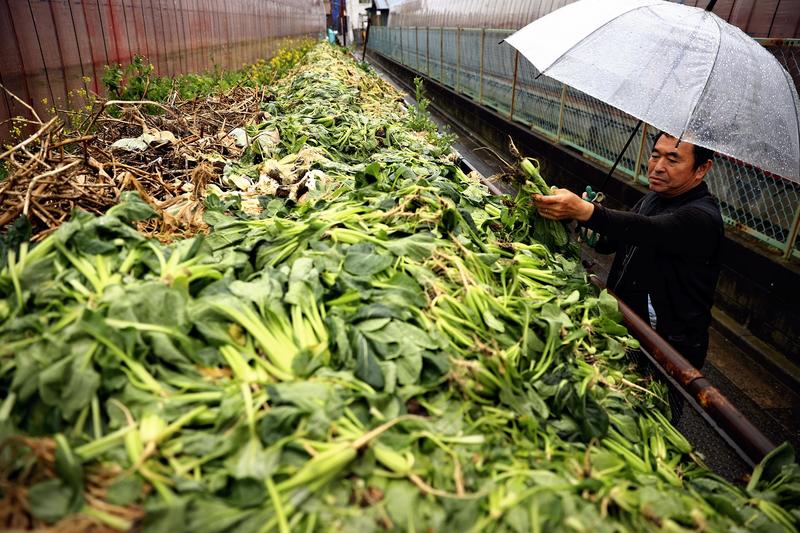
Vegetables piling up beside a greenhouse during harvest were not bound for anyone's table. Just two months after planting the seeds, a farmer in Adachi Ward, Tokyo, was discarding komatsuna Japanese mustard spinach.
For about 15 years, Kazuhiko Usami has been growing vegetables in a field of about 5,200 square meters for school lunch. He delivers leafy vegetables and eggplants that are grown without chemical fertilizers to about 50 elementary and junior high schools in the ward.
However, when the novel coronavirus spread and the schools were closed from March 2, about 1.5 tons of vegetables for school lunches had to be discarded. Late last month, he dumped about a ton more. The discarded vegetables will wither away with nothing to be done until they decompose in the soil.
The 58-year-old held up a lush green komatsuna that had just been pulled up from the soil and lamented: "I've been growing them wholeheartedly for the local children. It's really painful."
He has also been growing the portion for May, but on May 7 he was informed by the ward board of education that the school closures would be extended until the end of the month. So Usami sold some vegetables to acquaintances and put some out for direct sales, but he says there is the possibility he will have to discard them as well.
In his field, eggplant flowers are blooming and the pods of edamame are swelling for the June harvest.
"I'm afraid I'll have to throw them away again. However, when school lunches resume, I can't say, 'I don't have any vegetables,'" Usami said. "I'm growing them as if praying that they'll find their way into children's mouths without any trouble."
After the spread of the infection, a series of heartbreaking messages -- such as "Please help me" and "I don't want to throw away my food" -- were posted on internet message boards looking for buyers for food that was on the verge of being discarded.
Futaba Co. in Sanjo, Niigata Prefecture, which manufactures and sells dashi stock for commercial use, is one such company. Cardboard boxes had been stacked up to 7 meters high in its warehouse, which is about the size of an elementary school gymnasium. The contents were packs of dashi and dried bonito shavings, and some kombu kelp that had to be discarded after nine days.
Sales in April were down about 200 million yen from the same period a year earlier, as almost all the restaurants and hotels that make up the company's main clientele were closed. Of the 140 employees working at the plant, 100 have been given leave.
In late April, the company wrote on an online bulletin board that it would be selling at cost, but there were no inquiries. The company then thought about selling the products on a website where nonstandard products are for sale, but it didn't go ahead for fear the value of their products would be compromised.
Many of the products are dry goods with an expiry date of six months or so. At first, the company was not worried about having to dispose of them.
"I didn't think the effects of the infection would last this long," said Akira Eguchi, the 37-year-old president of the company.
A vegetable wholesaler in Inzai, Chiba Prefecture, was checking the size of and damage to carrots, daikon and onions while packing them into cardboard boxes. When Daiki Miura, 24, finished shipping these vegetables that were on the verge of being discarded, he smiled, saying, "I'm glad I was able to help the farmers, even if only slightly."
The day after a state of emergency was declared for Tokyo, Chiba and other prefectures on April 7, Miura went to a department store he deals with that had decided to suspend operations and saw a large amount of food remaining on the sales floor. Concerned, he immediately called a farmer in Inzai that supplies vegetables. The farmer said he had to throw out about 2 tons of vegetables due to the closure of schools and restaurants.
Miura spoke out about the farmer's plight on Twitter, attaching a photo of carrots. People who sympathized with the farmer spread the message and replied that they wanted to buy the vegetables.
After purchasing at regular prices from the farmer, Miura made 5-kilogram assortments available for purchase via an online shopping site for 2,160, yen about 20% cheaper than usual. In about 10 minutes, all 200 boxes were sold out. After that, he sold 11.6 tons of vegetables that were about to be discarded in Hokkaido, Tokyo and other regions.
Recently, he has been selling such vegetables at his own grocery store in Bunkyo Ward, Tokyo. He sells out as soon as he displays the products, with many customers saying it must be difficult for the farmers.
"I feel that the novel coronavirus has increased interest in the issue of food loss," Miura said. "I would like to use this crisis as an opportunity to promote efforts to reduce the amount of vegetables that are discarded."
Read more from The Japan News at https://japannews.yomiuri.co.jp/