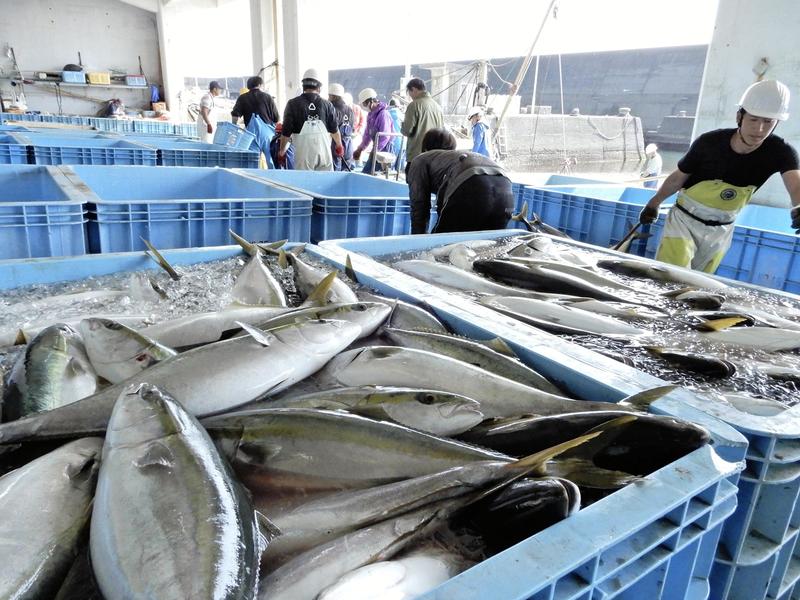
The Fisheries Agency has compiled draft regulations for domestic fishermen to set quotas on catch volumes of 15 additional species, including popular amberjack and seabream, The Yomiuri Shimbun has learned.
The move is aimed at protecting declining marine resources due to changes in the natural environment and to overfishing, and for securing future catches. However, backlash is expected from within the fisheries industry due to fears of reduced income.
The agency first plans to introduce regulations between fiscal years 2021 and 2023 covering 11 species, including Japanese amberjack, red seabream and Atka mackerel. Four other species, including amberstripe scad and red snow crab, will be added in fiscal year 2023.
Catch limits are already in place for eight species, including saury and bluefin tuna, which account for about 60% of the total catch volume in waters around Japan. Adding restrictions on 15 more species will raise that figure to about 80%.
Based on the opinions of fishermen and others in the industry, a study group including experts will make the official decision and come up with the details.
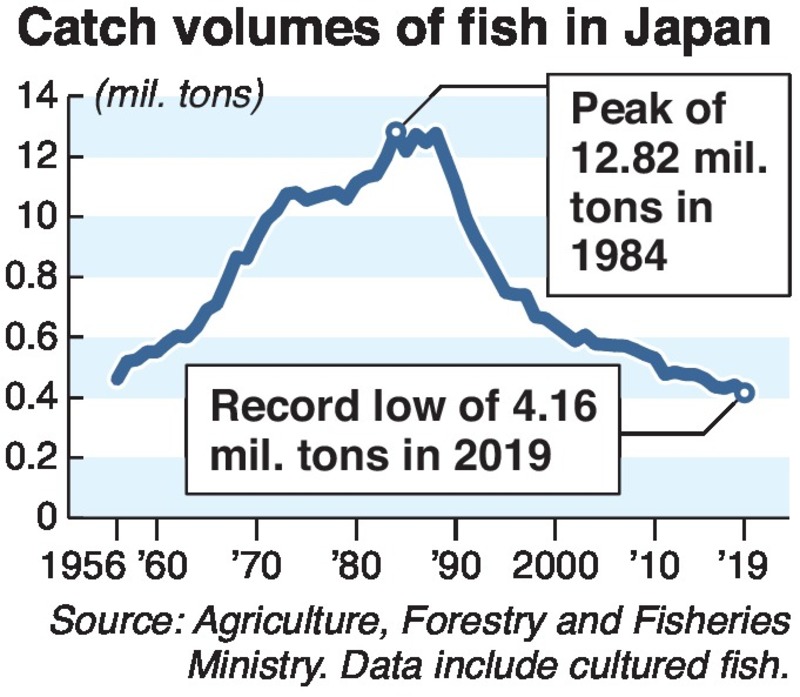
Catch volumes in Japan (including cultured fish), which peaked in 1984 at 12.82 million tons, sunk to a record low of 4.16 million tons in 2019. In recent years, catches of Pacific saury and Japanese flying squid, among others, have hit record lows across the board.
In a bid to resurrect the fishing industry, the government has set a goal of raising the catch volume, excluding cultured stocks, from 3.31 million tons in 2018 to 4.44 million tons in 2030. To achieve this, restoring marine resources becomes essential.
The revised Fisheries Law, which will come into force in December, calls for the government to strengthen its role in the management of marine resources. In response, the Fisheries Agency has been examining concrete measures it can pursue.
However, as setting limits on catch volumes leads to worries of reduced income for fishermen in the short term, those concerned are raising voices of dissatisfaction.
Fishermen in Hokkaido, where Atka mackerel fishing thrives, have since 2012 voluntarily reduced catch volumes and shortened the fishing period. As a result, catches have shown signs of recovery -- after falling from 230,000 tons in 1998 to 17,000 tons in 2015, the volume rose to 34,000 tons in 2018.
The Funadomari Fishery Cooperative in Rebun, Hokkaido, took such measures as widening its nets to avoid catching immature fish, and shortening the fishing period by three months to avoid overlapping the spawning and hatching seasons.
"At last, things are looking up for the marine resources," said a senior member of the cooperative. "If strict regulations are imposed, the fishermen will all be gone before the resources have time to recover."
Toshio Katsukawa, an associate professor at Tokyo University of Marine Science and Technology and an expert on resource management, said there is still much work to do.
"It's a commendable measure as the first step in resource management, but issues still remain, such as how to set the catch quotas," he said. "The government and fishermen need to work together to create a system."
Read more from The Japan News at https://japannews.yomiuri.co.jp/