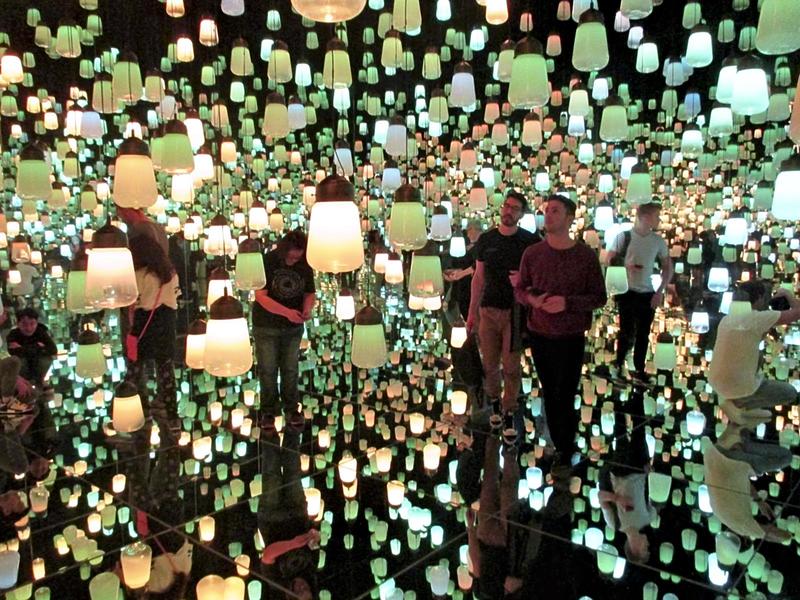
More and more museums and art events are providing opportunities to experience digital art created by cutting-edge technology, capturing the hearts of visitors. They are attracted not only by the vivid and colorful exhibition spaces but also by experience-based installations, in which visitors can see screens change in response to their movement or touch.
The Mori Building Digital Art Museum, which opened last June in Koto Ward, Tokyo, is the world's largest digital art museum, with about 60 artworks on display in the 10,000-square-meter space.
People constantly form lines at the "Forest of Resonating Lamps," a space filled with lamps and surrounded by mirrored walls. The lamps fantastically change color to pink or blue in response to visitors' movements, which makes it a popular photo spot for couples and families.
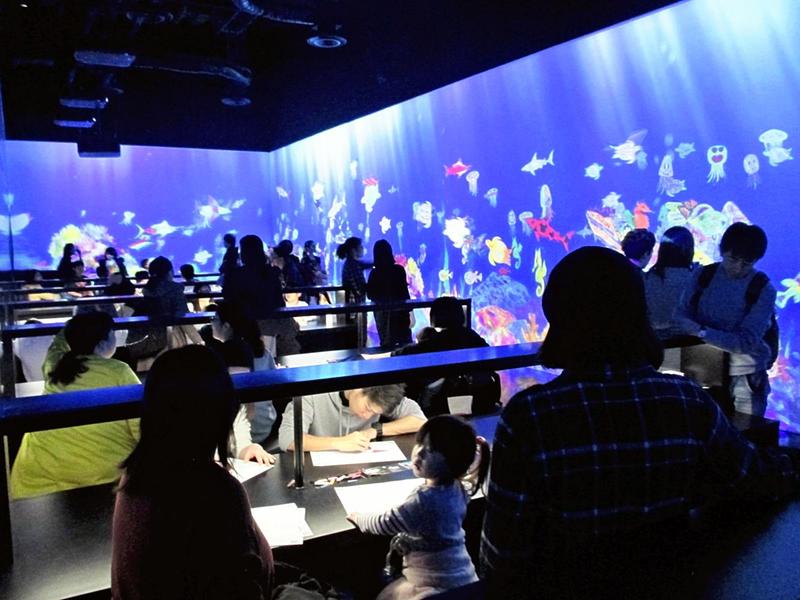
The "Sketch Aquarium" is popular with children as visitors can bring life to their own drawings, which swim across the walls. The drawings appear on the walls via computers and projectors, accompanied by audio, and sensors allow them to react to visitors' movements.
These digital art installations were created by teamLab, a group of programmers, engineers, animators and other professionals.
The museum was jointly established by Mori Building Co. and teamLab with the aim of making Tokyo into a digital art hub in preparation for the 2020 Tokyo Olympic and Paralympic Games. Although the admission fee for adults is relatively high at 3,200 yen (about 30 dollars), the museum is so popular that the operator sometimes needs to restrict the number of admissions. According to the museum, one in three visitors is from outside Japan.
TeamLab's works can also be viewed in other places, such as at teamLab Planets Tokyo, a pop-up facility that will run until 2020 in Koto Ward, and in the lobby of the Mifuneyama Rakuen Hotel in Takeo, Saga Prefecture.
Digital art is available at events, too.
Tokyo-based creative company Naked Inc. has produced "Flowers by Naked 2019 -- Tokyo, Nihonbashi," which will run from Tuesday. The exhibition will make use of projection mapping and other technology to create a space filled with cherry blossoms. The company also plans to offer a tearoom where screens within the space will reflect the movements of visitors' bodies. The exhibition will run until March 3.
Naked is also working on an event called City Light Fantasia at towers and observatories across the nation. The event is currently being held at Osaka's Abeno Harukas.
Regarding the recent digital art boom, Haruyoshi Nagumo, honorary professor at Digital Hollywood University, said: "Advances in digital technology have enabled us to become familiar with digital images and have also made it easier to build realistic, out-of-the-ordinary worlds. Such worlds are gaining attraction as images on social media. Japan's technology and creativity are highly evaluated worldwide."
Read more from The Japan News at https://japannews.yomiuri.co.jp/