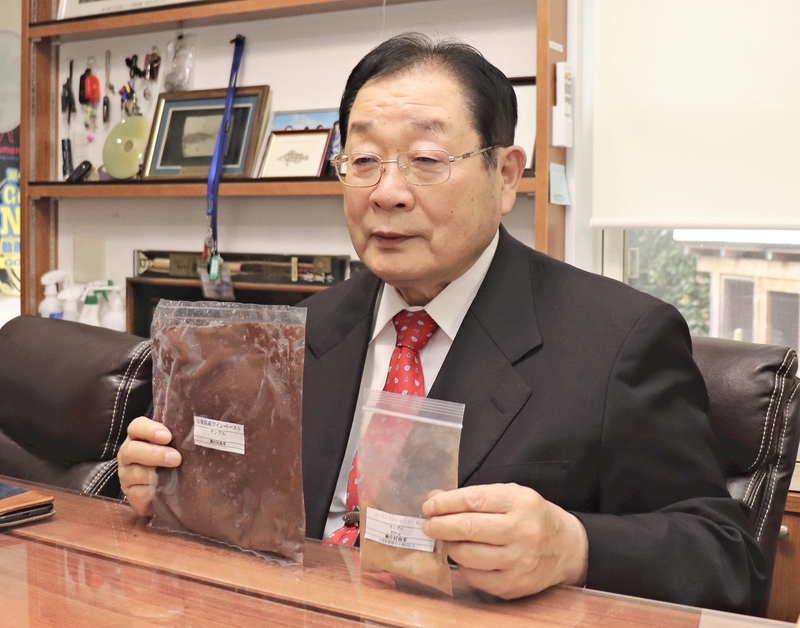
KOFU -- When makers crush grapes to extract the juice to produce wine, what is left over is called must. Japan's most well-known wine-making region is turning this must into what it calls a wine paste for cooking.
Yamanashi Prefecture is hoping this item becomes a local specialty as it promotes itself as the "wine prefecture," as it dubbed itself on Aug. 7. To do so, the prefecture will establish a nonprofit organization by the end of this year that will promote wine paste and publicize its convenience and usefulness.
This wine paste is made by mashing the must, which consists of the pulp, skins, seeds and stems of grapes. The idea is to promote this paste as a versatile ingredient to add a wine flavor to dishes such as stews or curry, or baked goods such as cake and pastries, according to Shigeru Yamashita, 76, representative director of a tourism federation in the town of Fuji-Kawaguchiko in the prefecture.
Yamashita had been concerned about some aspects related to drawing tourists to the area's locally produced grapes and wine. These products are limited to the harvest season and drivers cannot drink alcohol.
So Yamashita thought about the necessity for creating a new specialty to promote the wine prefecture concept.
Usually, must is mixed with feed for cows and pigs to produce so-called wine beef and wine pork. It is also made into jam by Nakamura Shouji, a food manufacturer and wholesaler in Tsuru in the prefecture that Yamashita has a close relationship with.
According to Nakamura Shouji, the volume of must produced equals about 10 percent of the volume of wine produced. Many large wineries dispose of the must as industrial waste.
Wine paste, however, is said to contain twice the amount of polyphenols as wine and six times as much as green tea on a same-volume basis. Its rich anthocyanin content is believed to relieve eyestrain.
"Wine paste has unlimited potential as it can be used in various foods," Yamashita said. "We can take advantage of our strength as the wine prefecture."
Fumiaki Nakamura, 50, who heads Nakamura Shouji, added: "This contributes to reducing food loss. It's also suited for the health-oriented society of today. This is born from the high quality of Yamanashi wine."
After Yamashita proposed the project to the prefectural government, a promotion committee was set up in September with Yamanashi Gov. Kotaro Nagasaki as a top adviser. The committee comprises the heads of municipalities, tourist associations, and commerce and industry associations in the prefecture. The nonprofit organization to be set up by the end of this year will work with local restaurants to develop products using wine paste and plans to sell the paste commercially.
"We'll do our utmost to make it a regular specialty of Yamanashi Prefecture," Yamashita said.
During an international rugby event from Sept. 14 to 17 held in Fuji-Kawaguchiko for parliamentary members and others from nine countries to deepen friendship through rugby, the tourism federation set up a booth to publicize wine paste. About 400 people attended. The booth sold out all 2,000 pieces of its bread made from dough kneaded with wine paste, according to the federation.
"We are thankful for the private sector's involvement immediately after making the 'wine prefecture' declaration," said Michihiro Nakada, manager of the prefectural government's tourism department. "We will do our utmost to back the efforts to make wine paste better known."
Read more from The Japan News at https://japannews.yomiuri.co.jp/