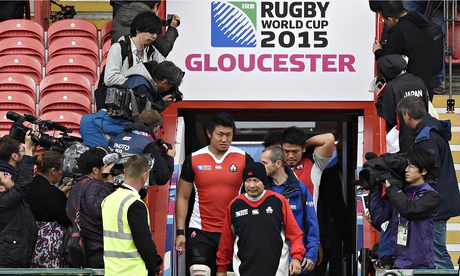
If rugby’s tectonic plates shifted last weekend, then the organiser of that seismic movement was in Gloucester on Tuesday looking for another slice of the sport’s history.
Kingsholm, home to Gloucester, may well be into its second century of hosting rugby matches but whether it has seen anything like Eddie Jones in full, pre-Test flow is another matter. After the defeat of South Africa, however, Jones was giving it both barrels as he built up his Japan squad before their game against Scotland on Wednesday.
Jones has been getting up Scottish noses all week since he suggested that, even allowing for a miserly four-day turnaround, Japan would win the match if they were close to Scotland after 30 minutes. On Tuesday he went further, asking rhetorically: “Are we fitter? Hell, yes. We’ll run their legs off.”
He also managed to invoke the spirit of two of rugby’s heartlands – the Forest of Dean, which runs alongside the Welsh border with Gloucestershire, and Melrose, home of the sevens and birthplace of dozens of former Scottish internationals – in an abbreviated press conference complicated by everything being translated for a huge Japanese press corps that has grown with every flight from Tokyo since Saturday’s thrilling win.
Extraordinarily, rugby and Wednesday’s game are very much front-page news in Japan just now but most of Jones’s lines were aimed firmly at a UK audience, much as they were a decade or more ago when he went head to head with Clive Woodward and any other England coach that got in his way at the 2003 or 2007 World Cups.
Initially he was fairly low key, saying the four-day turnaround was not unknown to the Japanese. “We’ve practised four-day turnarounds a couple of times over the last three or four years and we’re used to it.”
He also admitted there were players carrying injuries from Saturday – “Obviously you take a few knocks and bruises when you play sides like South Africa and when you play a big game it’s hard to come down” – but then he got the ball rolling, drumming up local support with a little flattery and hoping to build on the warm-up game Japan played at Kingsholm.
“The crucial part about any game played in Gloucester is that it’s one of the game’s great spiritual homes,” said Jones, laying it on with a man-sized trowel. “People in Gloucester know their rugby and we’ll get a bit of support because they normally wear red and white, so they can wear red and white tomorrow. No trouble. And we know that the English hate the Scots … ”
Were Scotland, a side never beaten by Japan, suddenly underdogs? “People still think it was a fluke that we beat South Africa, so this is a great chance to prove that is wasn’t and that we get an early chance to front up against one of the great rugby nations coming to it on the end of a perfect preparation.”
Was the 30-minute reference a suggestion of Scottish weakness? “You’re saying that, I’m not going to. Scotland score predominantly in the first half so, if we’re in the game at half-time, we’ll run them off their feet. Are we fitter? Definitely.”
Even without the Jones drumrolling Kingsholm would be full to bursting as Japan, suddenly above Scotland in the world rankings, take on a side that has won all four of their previous meetings and ran in 15 tries, a Scottish Test record, against them in 2004.
More than 24 hours before kick-off and a good two hours before the team bus was due for the final training session, Japanese fans were at the stadium gates photographing everything that moved and plenty that did not. Topping the list, for obvious reasons, was the Kingsholm Inn. The bus shelter opposite, however, which exhorts would-be passengers to “Beat the rugby traffic,” was another favourite, along with another place of local worship the Destiny Temple – not open on Tuesday to give advice on Wednesdsay’s outcome.
Inside Kingsholm was twice as chaotic: UK-based television and media outnumbered at least three to one by the flood that had followed Japan from Brighton.
Top question at the Scotland press conference concerned the fairness of the bagpipe ban imposed by the organisers. It cut little mustard with South African-born Scots such as Willem Nel, the tighthead prop, who confirmed he did not play the bagpipes and was not much interested in the issue, or the defence coach, Matt Taylor, an Australian with Scottish parents, who spent perhaps too much time insisting the Scottish coaches were more interested in the mountain of videotape amassed over the past year and more of watching the Japanese progression, than Jones’s barbs.
“We haven’t sat down and talked about Eddie to be honest,” said Taylor.
The view from Japan
Japan may not have been seized by rugby fever after the nation’s victory over South Africa on Saturday but the greatest shock in World Cup history has had an impact in its capital city as the Brave Blossoms go into their second game against Scotland.
“I was so excited by the rugby, said waitress Akiko Horiuchi from the French Bar, close to the Ginza district in Tokyo. “Japan won yesterday, right?” Well, not precisely correct but close enough.
“I lived in Auckland, New Zealand, for four years, so I know rugby. But the games are difficult to watch here, because they are on cable. Only the Japan games are on national TV. I saw the highlights on the news. And I might watch the Scotland game. But Scotland are better, right?”
Local barman Kenta Kobayashi sounded enthusiastic. “I am so excited. But rugby is not very big here. First come football, baseball and motor-cycling. But this is good. And they keep showing the highlights.”
So they do, in a number of local bars and eating places – the highlights, mainly, but occasionally the entire match. But they obviously haven’t been watched by the night porter at the Dai-ichi Hotel. “Japan and South Africa? PlayStation game? Ok? Nintendo?” There is still a wider audience to reach. Paul Weaver