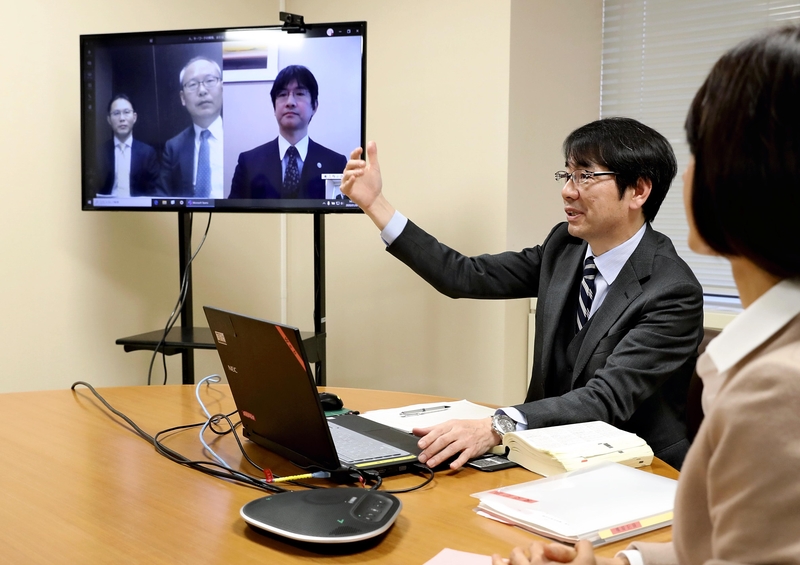
Nine courts across Japan on Monday introduced a web conference system to conduct civil court proceedings over the internet. Japan lags behind some other countries in the adoption of information technology in civil trials. The recent step is expected to accelerate the utilization of IT, although Japan still has some work ahead of it in this regard.
Done in 30 min.
Ahead of the introduction of Web conferencing, the Supreme Court released last month a mock procedure to demonstrate trials held online.
Using the scenario of a lawsuit demanding compensation for a traffic accident, the Tokyo District Court, the plaintiff's lawyer's office and the defendant's lawyer's office were all connected online for discussions.
Microsoft's Teams, a collaboration platform in its cloud service Office 365, is used in the Web conferencing. Participants can access and edit one document simultaneously from their personal computers. In the mock proceedings, the two sides discussed the terms of a settlement based on a draft drawn up by a defense lawyer. A judge filled in the settlement amount and completed the document.
This way, lawyers don't have to physically go to court.
"I can attend a trial even if I'm available for only 30 minutes," said lawyer Yuichiro Yamazaki, who played a role of the plaintiff's lawyer.
According to the Supreme Court, court procedures in civil trials (specifically, a first trial at a district court) took an average of nine months per case in 2018, which was 2-1/2 months longer than a decade before. The Supreme Court expects trials to become speedier via web conferences.
On Monday, web conferencing was introduced at district courts in Tokyo, Osaka, Nagoya, Hiroshima, Fukuoka, Sendai, Sapporo and Takamatsu, as well as the Intellectual Property High Court in Tokyo. The system will be further introduced to five district courts in Yokohama, Saitama, Chiba, Kyoto and Kobe in May, and will continue to spread to other courts.
Request from business
In Japanese civil suits, lawyers visit court whenever they file a complaint or hold oral arguments.
The Web conference from Monday is being introduced only for a part of the court proceedings, such as arranging issues to be resolved at trial. But, the government aims to eventually switch to "full computerization," in which all procedures are done online. The move comes at the strong request of the business community.
The use of IT has spread not only in the United States, where the computerization of trial records spread in the 1980s, but also in Asia in recent years. In Singapore, it has been possible to submit legal complaints in the form of e-data since 1998. Parties concerned can view their records online. A similar system was introduced in South Korea in 2010.
Japan, which is far behind in IT adoption, was ranked 50th in the field of judicial efficiency in World Bank's "Ease of Doing Business Ranking" for 2020, released last October.
Nihon University Prof. Junko Sugimoto, who specializes in the Civil Procedure Law, said: "If this situation continues, it may affect Japan's international trade, and investment in Japan. Trials have to change to meet the needs of the times."
Security issues
However, there are challenges. Parties to a civil case may participate in a trial even without being represented by lawyers, so it will become essential to offer support to those who do not have IT equipment or elderly people who are not adept at using the Internet.
Information security measures are also crucial. Lawyers' offices, as well as courts themselves, can become targets of cyber-attacks, and the effects of the resulting damage could erode global confidence in Japan's judiciary as a whole.
Read more from The Japan News at https://japannews.yomiuri.co.jp/