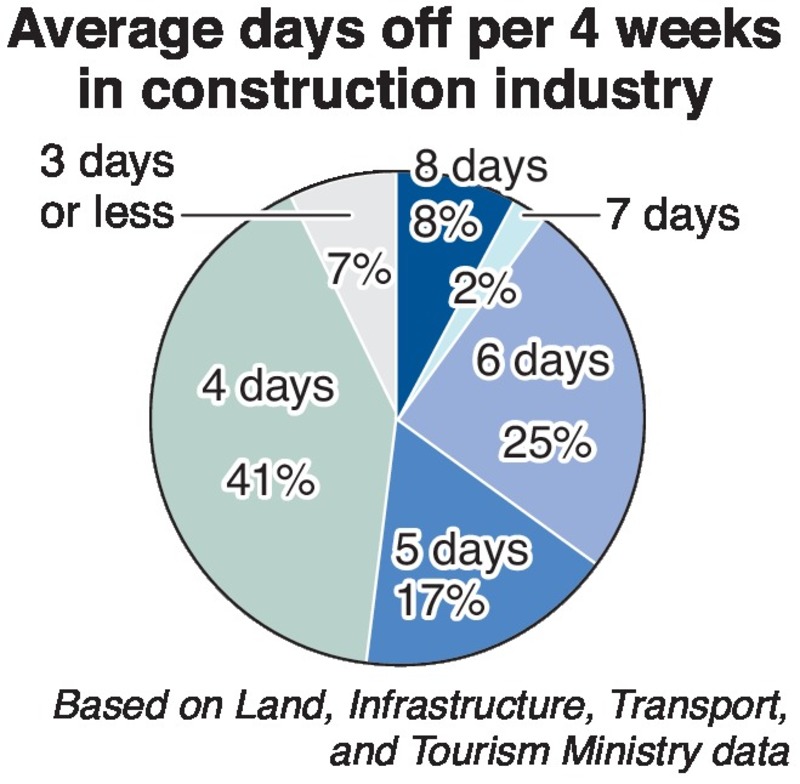
Work style reform is beginning to move forward at construction sites, which are said to be representative of so-called "tough, dirty and dangerous" workplaces. The centerpiece of the reform is the introduction of a five-day work week that is already common among other industries.
The Land, Infrastructure, Transport and Tourism Ministry drew up guidelines for the reform, promoting the effort for two days off per week in collaboration with the private sector. However, the key to the reform is raising awareness among entities that set construction schedules, including local governments and private firms.
Taking 6 days off every 4 weeks
Outside the white fence of a construction site near Tokyo Dome in Bunkyo Ward, Tokyo, on Aug. 22, a digital sign with that week's work schedule read, "construction on weekdays," and "Saturday and Sunday are days off." A message saying, "Work style reform is underway" was also seen on the lower part of the billboard.
Shimizu Corp., a major general contractor, undertook the construction of the building in autumn last year. The company adopts a system where workers take six days off every four weeks. That means every other Saturday and every Sunday are days off. Public holidays are also days off.
"Due to the construction period, our system falls short of being an actual five-day work week. Still, we take a progressive approach within the industry," said Minoru Iitsuka, 50, head of Shimizu's construction office.
"Workers can only take Sundays off at almost all construction sites other than here. That is physically tough. I feel it is more comfortable to work here as I can keep a balance between work and my private life," said Junya Matsukawa, 23, who is engaged in plastering work at a subcontracting company.
Big builders lead 5-day week
Taking days off at construction sites has been a long-pending challenge. In 1992, when a five-day work week system was introduced for national public servants, the ministry took the initiative in solving the challenge by setting well in advance the construction period in building work ordered by the then construction ministry on the assumption of Saturdays, Sundays and holidays being days off.
However, when looking into construction projects ordered by the Land, Infrastructure, Transport and Tourism Ministry in fiscal 2015, the system was not employed in most cases.
There are two major reasons for the low number of days off in the construction industry. It is believed that construction schedules do not often work out due to weather conditions, and the industry has yet to raise awareness on taking days off.
The situation changed in March last year when the government launched work style reform.
In July last year, it was revealed that a construction company employee, who was engaged in a project to construct the new National Stadium, was overworked and committed suicide. As a result, the ministry drew up guidelines for the reform, requiring the industry to consider setting a construction period based on the five-day work week system.
In July this year, the ministry set the goal of increasing the number of cases that expand the five-day work week system, especially for public works projects.
The Japan Federation of Construction Contractors (JFT), which comprises major general contractors and other entities, established the promotion headquarters for a five-day work week system last March with the aim of realizing a five-day work week system in the industry by the end of fiscal 2021.
"If major companies take the lead in promoting the system, it will take root among subcontractors," a person at JFT said.
Local govts behind in reform
On the other hand, local governments are falling behind in promoting work style reform at construction sites. According to the ministry, no measures had been taken in 1,523 municipalities, which account for about 90 percent of the total, as of the end of March last year.
There are some cases of construction projects ordered by the central government and prefectural governments whose construction periods are set for more than one fiscal year. However, in most cases ordered by cities, towns and villages, the contracts are on a single-year basis and the construction periods are set at the end of a fiscal year.
"There are construction sites where workers inevitably cannot take days off at all for a month as the end of fiscal year approaches," said Toru Ono, 70, president of Ono Kensetsu, a construction firm in Mishima, Shizuoka Prefecture, and vice chairman of Zenkoku Chusho Kensetsugyo Kyokai (the national association of small and midsize construction companies).
Hitoshi Mihara, a professor of building production at the Institute of Technologists, had experience as a foreman at a construction site when he worked for a general contractor.
"Measures taken by the public and private sectors are not wrong. However, considering the large number of construction projects ordered by the private sector, a five-day work week system would not take root without the understanding of private firms," he said. "It is also necessary to give consideration to subcontract workers under a contract where the more they work, the more money they earn."
Read more from The Japan News at https://japannews.yomiuri.co.jp/