NAHA -- Chief Cabinet Secretary Katsunobu Kato has expressed the central government's eagerness to relocate the U.S. military's Naha Military Port to nearby Urasoe, Okinawa Prefecture, during his first visit to the prefecture after assuming the post.
The central government intends to seek public understanding of the relocation of the U.S. military's Futenma Air Station in Ginowan in the prefecture to an area off the Henoko coast in Nago. It apparently hopes to do so by working to reduce the burden on Okinawa of hosting U.S. bases, such as through the relocation of the military port and demonstrating its stance to give consideration for people in the prefecture.
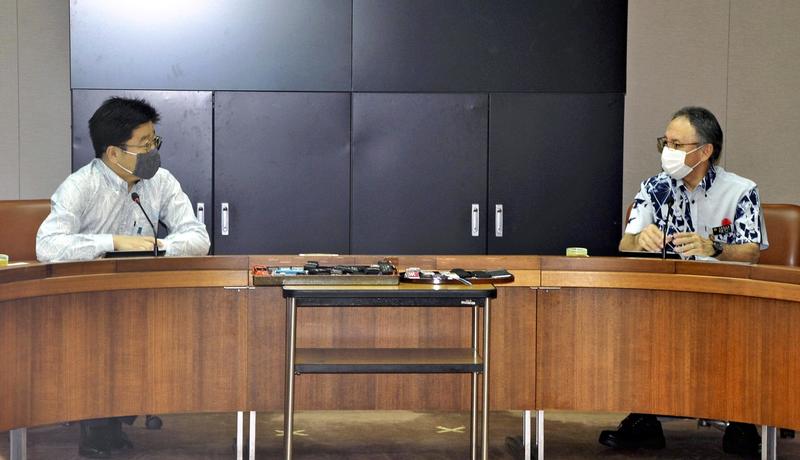
"The Naha port facility is adjacent to Naha Airport, the gateway to Okinawa," Kato said Saturday during a meeting with Gov. Denny Tamaki at the Okinawa prefectural government building. "Efforts must be accelerated steadily to achieve the relocation to utilize [the land] in the future."
Then, referring to the relocation of the Futenma base, Kato said: "I think it's the only solution. We would like to do everything possible to reduce the burden of hosting the bases while making efforts to gain the understanding of local residents."
On the same day, Kato observed U.S. military facilities in the prefecture from the air aboard a Self-Defense Forces helicopter. He then visited a facility from which he could get a wide field of view of the Naha Military Port.
In 1974, the Japanese and U.S. governments agreed to return the military port's land, which covers about 56 hectares in central Naha, on condition that the port be relocated. Tokyo and Washington later agreed that the return should occur in fiscal 2028 or later.
Consultations between the central government and the Okinawa side have run into difficulties. In August this year, the Urasoe city government, which had wanted the military port to be relocated to the south side of Urasoe Wharf, accepted the central government's plan to move the port to the north side.
Since his time as chief cabinet secretary, Prime Minister Yoshihide Suga has regarded the issue of U.S. military bases as linked to measures for Okinawa Prefecture's development. As the military port is located near Naha Airport, the development of the site where the port currently stands is expected to generate great economic effects. Within the prefecture, there are also big expectations for the relocation.
As the prefecture's economy has been hit hard by the novel coronavirus pandemic, the central government apparently intends to use economic leverage to sway Tamaki, who as governor has the authority to approve reclamation work for the relocation of the port.
-- Tamaki in tough position
The Okinawa prefectural government's position on the relocation of the military port is different from that concerning the Futenma relocation. Tamaki's predecessor, the late Takeshi Onaga, had approved of the relocation of the port, and he has also taken this position, saying during a prefectural assembly session on Sept. 25, "Based on the circumstances so far, I will end up approving the relocation to Urasoe."
However, opposition to the relocation remains strong from reformist members of a group called All Okinawa, which supports Tamaki.
The group consists of some conservatives and reformists, some of whom are from the Japanese Communist Party. Some conservative members have increasingly distanced themselves from Tamaki, who is leaning toward the left-wing side in a legal battle over the land reclamation for the Futenma relocation. Given that, Tamaki has been wary about moves that could alienate the reformists.
Tamaki has shown his stance to accept the relocation of the port in principle, but has yet to clarify his position about the central government's relocation plan.
"We want the return of the port to be carried out ahead of schedule, rather than implementing a time-consuming plan in which the return will be carried out" after a facility in the relocated site is built, he said during the talks with Kato.
As the Okinawa gubernatorial election is scheduled for 2022, Tamaki apparently wants to put off his decision on the land reclamation, according to a senior central government official.
In an election for the 48-member prefectural assembly in June, supporters of Tamaki maintained a majority of seats, but the Liberal Democratic Party, which opposes the governor, increased its number of seats to 19. In the run-up to the next gubernatorial election, the LDP hopes to highlight Tamaki's contradiction in opposing the reclamation of the Henoko district and approving of the Urasoe reclamation in principle, according to a source familiar with the LDP.
Read more from The Japan News at https://japannews.yomiuri.co.jp/