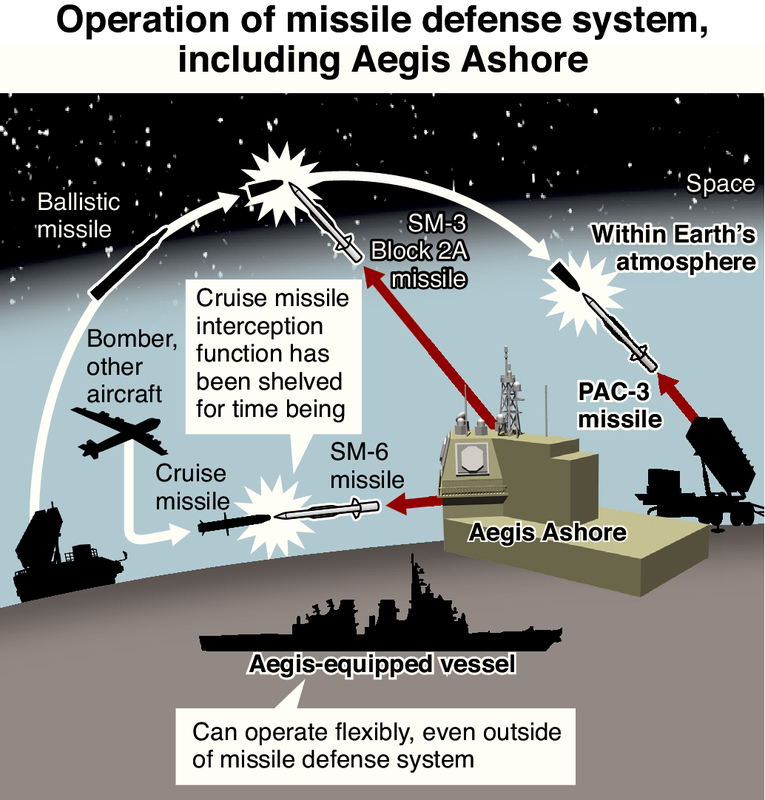
The cost of deploying two Aegis Ashore land-based missile defense system units has exploded to at least 400 billion yen, more than double the initial estimate, The Yomiuri Shimbun has learned.
In response to the surging cost projections, the Defense Ministry will scale back some of the Aegis Ashore system's capabilities. The ministry plans to put off, for the time being, equipping the system with a function to intercept cruise missiles (see below), a capability that had been considered with China's increasingly sophisticated cruise missiles in mind.
The nation's existing two-tier missile defense system involves SM-3 interceptor missiles deployed on Aegis-equipped destroyers, and PAC-3 surface-to-air guided missiles. Aegis Ashore is a land-based system dedicated to reinforcing the missile defense capabilities of Aegis vessels.
The ministry plans to station one Aegis Ashore system unit each at training grounds in Akita and Yamaguchi prefectures. The ministry aims to start operating the system in fiscal 2023.
In December 2017, the government formally decided to introduce the Aegis Ashore units, following North Korea's repeated ballistic missile launches in 2016 and 2017.
That month, the ministry estimated each unit would cost about 100 billion yen. It also mentioned the price tag could change, depending on the system's design and capabilities.
A cutting-edge radar system is one factor that has inflated the cost. The ministry plans to use the Solid State Radar (SSR, also known as LMSSR) developed by U.S.-based Lockheed Martin Corp. While the SSR was cheaper than a rival high-tech radar system, it was more expensive than the Aegis vessel radar systems.
The base price for two units will be about 250 billion yen. After accounting for snowballing related expenses, such as security measures and facility maintenance, the final total cost came to more than 400 billion yen.
A single SM-3 Block 2A, a new interceptor missile for shooting down ballistic missiles, also comes with a hefty price of 3 billion yen to 4 billion yen. It is possible this price could increase further. A proposal to equip each unit with a launcher fitted with 24 missiles is also seen as viable.
In addition to missiles capable of intercepting ballistic missiles presumably fired by North Korea, the ministry planned to equip the Aegis Ashore system with a capability called "Integrated Air and Missile Defense," which would enable it to also simultaneously intercept China's increasingly advanced cruise missiles.
Countering these cruise missiles would require the deployment of SM-6 multipurpose surface-to-air missiles. However, this would involve further acquisition and personnel training costs, prompting the ministry to delay the missiles' planned introduction from the launch of the Aegis Ashore system in fiscal 2023 until the latter half of the 2020s or later.
-- Cruise missile
Unlike a ballistic missile that travels a parabolic path and comes down on its target from high above, a cruise missile flies in a straight line just above the ground or sea surface. It is a precisely guided weapon that uses onboard radar and other technologies to fly toward its target. A cruise missile uses the curvature of the Earth to conceal itself by flying below the horizon, making it difficult for the targeted side's ground-based radar to detect it until the missile is very close. The U.S. Tomahawk is a well-known cruise missile.
Read more from The Japan News at https://japannews.yomiuri.co.jp/