The nation's 19 leading railway operators, including publicly traded JR firms, posted consolidated net losses totaling about 501.5 billion yen for the April-June first quarter of fiscal 2020. These numbers bring to the fore the huge damage wrought on their businesses by the plunge in passenger traffic demand amid the spread of infections with the novel coronavirus.
Railways had been reckoned as an industry intrinsically tolerant even to economic slowdowns as it can expect stable revenue from commuters, including students. But in the wake of the declaration of the state of emergency, railway operators were hit by an unusual situation, with people's movement drastically restrained to curb the spread of infections.
Among the 19 railway operators -- four listed JR group firms and 15 other major private railways -- East Japan Railway Co. (JR East) posted the biggest consolidated net loss of 155.3 billion yen for the 1st quarter, compared to a net profit of 91.5 yen in the same quarter last fiscal year. This was followed by West Japan Railway Co. (JR West), with a net loss of 76.7 billion yen, and Central Japan Railway Co. (JR Tokai) with a net loss of 72.6 billion yen.
Among private railway operators other than JR companies, Seibu Holdings Inc., which also operates hotels and leisure businesses, posted the biggest consolidated net loss of 28.7 billion yen, compared to a net profit of 14.2 billion yen in the same quarter last fiscal year.
All 19 railway operators posted more than a 10% year-on-year decline in revenue. JR East and JR West posted record quarterly losses.
JR West President Kazuaki Hasegawa called it "the greatest crisis we have ever experienced."
As the number of infected cases has been increasing again, the number of passengers has also remained low. JR Tokai and JR West have seen the number of passengers using Tokaido Shinkansen line and Sanyo Shinkansen line in July fall by 60-70% from the same month last year. Passengers' use of conventional JR lines in Nagoya and its vicinity and in the Kinki district have dropped by more than 30% from a year earlier.
--At a crossroads
According to the Land, Infrastructure, Transport and Tourism Ministry, the number of passengers handled by the country's railways totaled about 1.16 billion in April, down 45.5% from the same month last year, and about 1.18 billon in May, down 46.8% from a year earlier.
JR East, the biggest railway operator, registered losses in operating income, ordinary income and net profit for the first time since it was inaugurated in 1987.
"Our corporate philosophy at the time of our inauguration was for our company to stay in the black and we had been able to do so ever," Ryoji Akaishi, an executive director of JR East, said with a pained look at a recent press conference. "We need structural reforms."
--Dispersion of demand
JR East and JR West have been moving ahead with considering the introduction of passenger fares based on the hour. Should passenger fares be set by time period, fares could rise during peak hours such as rush hour, and could become cheaper during other times. By raising the fare during peak hours, thus dispersing demand, railway operators would be able to reduce staffing and railway cars needed during peak hours.
JR East is also considering moving up the time of last trains. By moving up the last trains and securing more time for maintenance of trains and tracks during the night, JR East hopes to reduce days needed to do so, thus curtailing relevant expenses. The firm plans to realize this plan when it revises its train timetables next spring.
Yomiuri Shimbun file photo
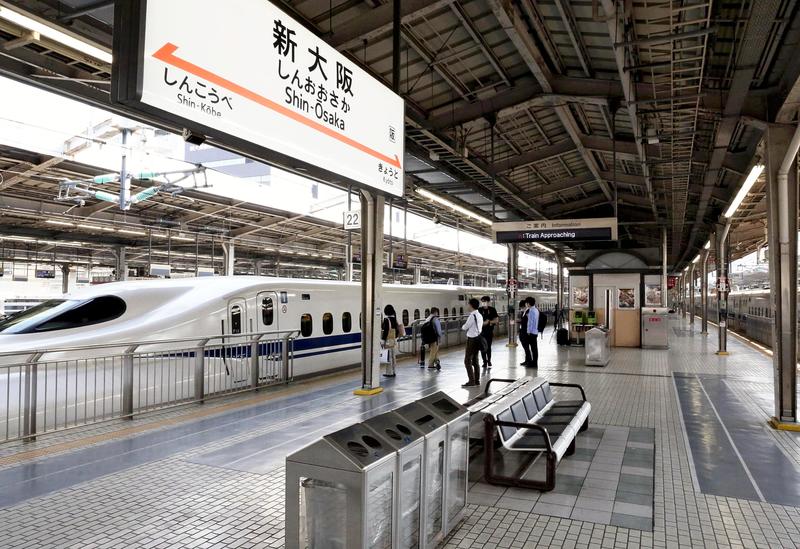
There are few passengers on a Shinkansen platform at JR Shin-Osaka Station amid the novel coronavirus outbreak on May 2.
Read more from The Japan News at https://japannews.yomiuri.co.jp/