Five years have passed since Japan and South Korea agreed to a "final and irreversible" resolution of the comfort women issue. However, the administration of South Korean President Moon Jae-in has effectively scrapped the agreement unilaterally, turning it into a mere shell.
With no sign that Moon intends to follow the accord, the Japanese side has been left with no other option but to continue calling for the agreement to be respected.
-- Vacant lot
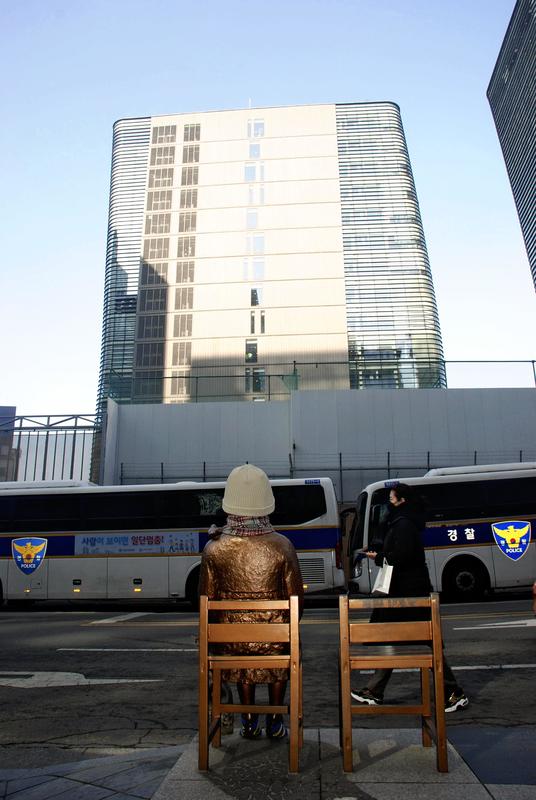
A plot of land in central Seoul where the Japanese embassy once stood has sat vacant since the demolition in May 2016 of the old embassy building.
A statue of a girl symbolizing the comfort women stands in front of the site, at which citizen groups hold protests every Wednesday, making it difficult for the embassy to carry out work in a quiet environment.
The embassy has been left in limbo, paying about 300 million yen per year to rent space in a nearby commercial building.
"There are security concerns in the commercial building, but we can't go back to that humiliating place," a Foreign Ministry official said.
In the 2015 agreement, South Korea pledged to "strive to solve" the issue of the statue, but according to a source in the South Korean government, "The statue of the girl is sacred and the prospect of removing it is basically zero."
A vacant lot surrounded by a fence is a fitting symbol of Japan-South Korea relations, which many believe are at their worst since World War II.
The Japan-South Korea agreement was reached under the conservative administration of former President Park Geun-hye.
President Moon, a liberal who was critical of Park's government, pledged in the election campaign to go back to the drawing board with the accord.
The Moon administration took power in 2017 with the position that the comfort women issue remains unresolved. Ever since, South Korean groups have tried to turn international opinion against Japan, by erecting more statues of girls domestically and abroad, such as in Germany, among other efforts.
"I intend to continue to call on the South Korean side to steadily implement the Japan-South Korea agreement," Foreign Minister Toshimitsu Motegi stressed at a press conference Friday.
-- Allegations
One factor that could influence the Moon administration is allegations involving the group that erected the statue in front of the embassy.
Yoon Mee-hyang, former head of the group and a ruling party member of the South Korean National Assembly, is being tried on charges including embezzlement of corporate funds and fraud. Although this has been a blow to Moon, who has worked with the group, it could lead to a more hardline stance on the comfort women issue.
The Moon administration's approval rating fell to 38% in December, its lowest ever, in part due to scandals involving senior administration officials.
Losing the support of the left in the run-up to the 2022 presidential election would be ruinous.
Moon and his party "are likely to take a strong anti-Japan posture in areas such as the comfort women issue, which plays well with the left," according to a source.
-- Eyes on Biden
The Japanese government will pay close attention to developments under the incoming administration of U.S. President-elect Joe Biden.
The United States has pushed Japan and South Korea to improve their relations in the past, out of a desire to strengthen Japan-U.S.-South Korea ties to counter China and North Korea.
When the Japan-South Korea accord was reached in 2015, it was welcomed by the administration of U.S. President Barack Obama. Biden was vice president at the time.
While many in the Foreign Ministry believe Biden understands the background of the issue, the Japanese government still plans to carefully explain its position to the U.S. side.
A ruling on a case in South Korea in which former comfort women are suing the Japanese government for compensation is expected in January.
The Japanese side has not participated, citing the principle of sovereign immunity under international law, which holds that a sovereign state cannot be sued before the courts of another sovereign state without its consent.
If the district court were to issue a ruling rejecting sovereign immunity, further deterioration of Japan-South Korea ties would be inevitable.
-- Japan-ROK agreement
The accord was announced by the foreign ministers of Japan and South Korea on December 28, 2015. On the Japanese side, then Prime Minister Shinzo Abe expressed "sincere apologies and remorse," and both sides confirmed that the comfort women issue was "resolved finally and irreversibly." The South Korean side established a "reconciliation and healing foundation" to support former comfort women, to which the Japanese government contributed 1 billion yen.
Read more from The Japan News at https://japannews.yomiuri.co.jp/