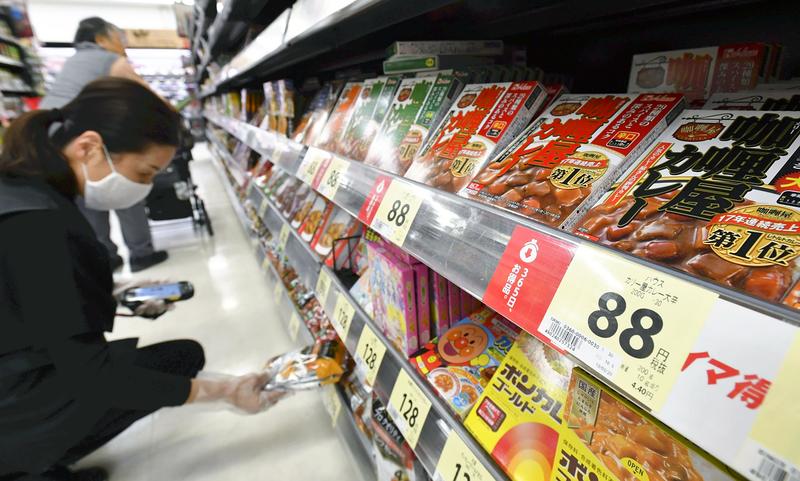
Consumers are being increasingly thrifty in response to the economic downturn caused by the spread of the novel coronavirus, prompting retailers to cut prices on a wide range of products. Concerns have emerged about deflation, which could keep prices falling if competition further intensifies among retailers.
-- Households on defensive
"The restaurant where my husband works was closed for a month due to the coronavirus, and even after it reopened, his income after tax dropped by about 30,000 yen. We can't cut back on food expenses for our growing children, and we're having a hard time making ends meet," sighed a part-time worker, 49, in Tokyo's Nakano Ward. She lives with her husband and three children, who are junior high and high school students.
She is trying to shop less frequently these days. "I double-check the toothbrushes, shampoo and other items I have at home to make sure I only buy what I need," she said.
According to the Cabinet Office, savings accounted for 23.1% of household disposable income in the April-June period, significantly higher than the 7.8% seen in January-March. The April-June percentage is the highest level since comparable data was first compiled in 1994.
The rise in the savings rate is a sign that consumers are becoming defensive.
"Consumption is slow except for a few sectors, such as consumer electronics. The combination of the fear of infection and uncertainty about the future has led to a high savings rate," said Kentaro Koyama, chief economist at Deutsche Securities Inc.
-- Changing tack
Retailers have also begun to change their strategies. In the spring, when the coronavirus began to spread, they held off discount sales to avoid congestion in their stores, but recently they have begun to hand out fliers advertising bargains. In many cases, retailers are avoiding lowering prices on set days, as that will lead to crowding on those days.
Major supermarket Seiyu has cut prices on 765 daily necessities by an average of 5.1% and by a maximum of 17.7% since September. Sales of discounted snacks "were up 20% compared with before," a Seiyu employee said.
Home improvement retailer Cainz has reduced prices on about 7,200 items ranging from daily necessities to sundries and foodstuffs, and also is offering volume discounts on some products. Even though many of its suburban stores, which have large shopping areas and are less crowded, were experiencing higher sales, the company decided to cut prices.
-- Necessary expenses
Supermarkets have captured a certain amount of "nesting consumption" since the virus began to spread, but if prices are reduced for a prolonged period of time, profits will be smaller. They also need to invest a certain amount of money in measures to prevent infection, such as the installation of acrylic sheets and measures to handle online shopping.
"Every time economy goes down, they keep cutting prices. They need to create attractive stores, instead of just cutting prices," said Yutaka Suzuki, senior researcher at the Distribution Economics Institute of Japan.
Read more from The Japan News at https://japannews.yomiuri.co.jp/