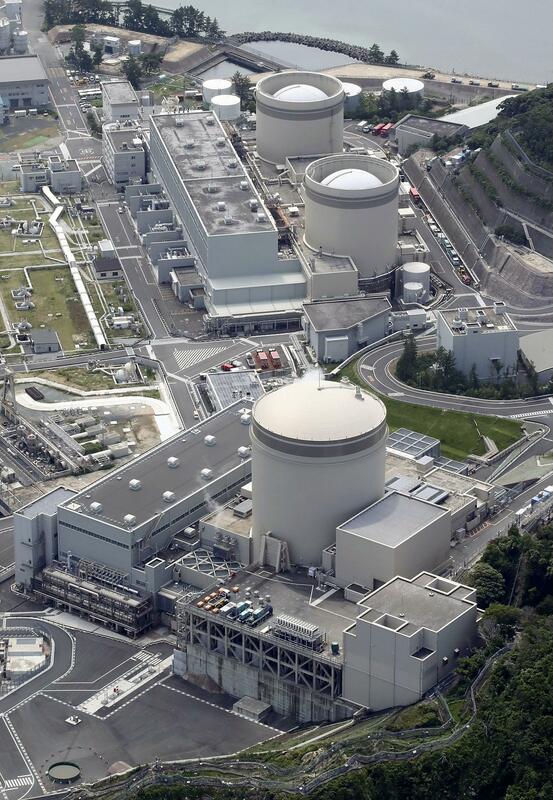
Mihama nuclear power plant's unit No. 3 on Wednesday became the first reactor over 40 years old restarted in the nation.
After the nuclear accident at Tokyo Electric Power Company Holding Inc.'s Fukushima No. 1 nuclear power plant, the operating period of reactors was set at 40 years in principle, but it can be extended once for up to 20 years if the safety is confirmed and the Nuclear Regulation Authority grants approval.
The 826,000-kilowatt Mihama No. 3 reactor at the Kansai Electric Power Co.'s nuclear plant in Mihama, Fukui Prefecture, resumed operating for the first time since it was suspended for periodic inspections from May 2011.
It also marked the first step toward the long-term use of nuclear reactors whose safety have been confirmed.
The No. 3 reactor started operating in December 1976 and is the first nuclear reactor to which the regulatory standard was applied. After passing the safety review by the NRA, its operating period has been extended to 2036.
KEPCO finished inspections for restarting the reactor by Tuesday. At 10 a.m. Wednesday, in the presence of NRA officials, power plant workers began the process of pulling out the control rods that suppress the nuclear fission reaction and turned on the reactor.
According to KEPCO, the reactor was set to reach criticality, when the fission reaction continues in a stable manner, at around 1 a.m. Thursday. The power generation system will be connected to transmission network next Tuesday to start the supply of power.
After an adjustment period of about one month, the reactor is expected to start commercially operating on July 27.
It will be shut down again on Oct. 23 for periodic inspections, however, as the reactor has not been able to meet the deadline for the construction of anti-terrorism facilities required by the latest regulations.
More than 80% of Japan's nuclear reactors were built during the 1990s or earlier, and 16 of them, including the Mihama No. 3 reactor, have been in place for more than 30 years as of Wednesday.
After the Great East Japan Earthquake, the decision was made to decommission 14 reactors, including the Nos. 1 and 2 reactors at Mihama, due to factors such as low profitability, in addition to 10 reactors at the Fukushima Nos. 1 and 2 nuclear power plants.
The longer-term use of nuclear reactors will lead to the prevention of power shortages in summer and winter. As nuclear power plants emit no carbon dioxide while operating, they can also contribute as a measure against global warming.
There are three other nuclear reactors in Japan that have received approval from the NRA to extend their operating period beyond 40 years: KEPCO's Nos. 1 and 2 reactors at the Takahama nuclear power plant in Takahama, Fukui Prefecture; and a reactor at Japan Atomic Power Co.'s Tokai No. 2 nuclear plant in Tokai, Ibaraki Prefecture.
These three reactors, however, are not expected to be restarted in the foreseeable future. The Takahama Nos. 1 and 2 reactors have obtained the necessary local consent to start operating again, but the completion of anti-terrorism facilities at the plant is not yet in sight, while the Tokai No. 2 nuclear power plant has not yet received the local consent required for its restart.
Read more from The Japan News at https://japannews.yomiuri.co.jp/