The travel time between Tokyo and Hakodate, Hokkaido, is expected to drop to under four hours on the Shinkansen bullet train as early as this fiscal year, as the safety of the Seikan Tunnel has been confirmed and there is no problem if the speed of the Shinkansen, which currently runs a little faster than conventional express trains, is raised.
The shortened time will only be three minutes, but the travel time will break the four-hour barrier (see below), which is a key mark to winning a share of the competition from airline services.
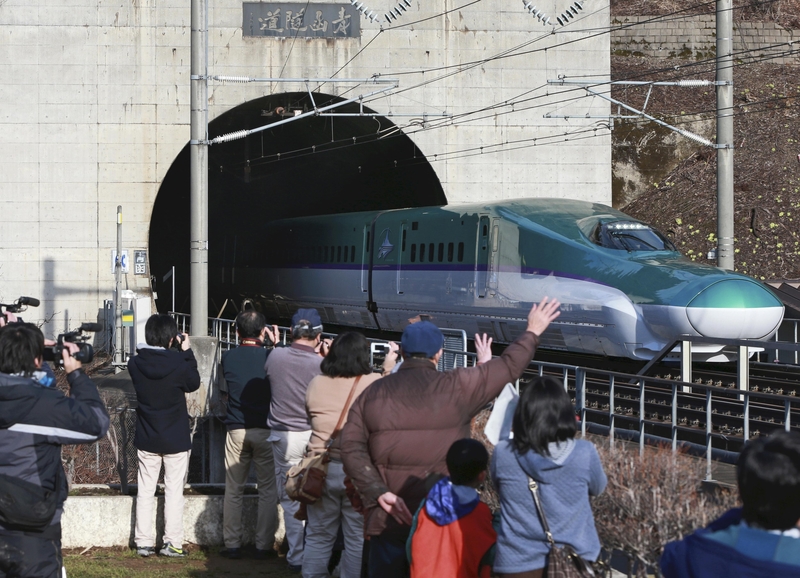
On early Sept. 2, a Shinkansen train passed by a freight train in the 54-kilometer undersea Seikan Tunnel connecting Aomori Prefecture and Hokkaido, with the Shinkansen running at a speed of 160 kph. The freight train was equipped with a device to measure wind pressure, with this information and other data sent to a train control center in Sapporo.
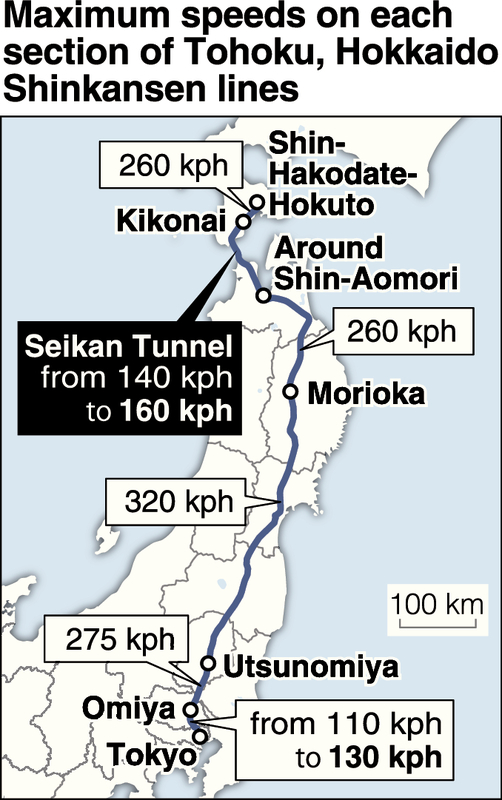
The Seikan Tunnel is the nation's only tunnel in which Shinkansen and freight trains pass by each other. In order to prevent a load collapse from occurring, Shinkansen trains run at a speed of 140 kph in the tunnel. The maximum speed on the Tohoku and Hokkaido Shinkansen lines is 320 kph.
During the test runs that were carried out at 160 kph for three days in September, no accidents such as a load collapse were reported. Therefore, the allowable speed in the tunnel will be raised by 20 kph to 160 kph as early as this fiscal year.
As a result, the shortest travel time between Tokyo Station and Shin-Hakodate-Hokuto Station in Hokkaido -- which is currently four hours and two minutes -- will be reduced by three minutes.
The maximum speed of E5 and H5 series trains on the Tohoku and Hokkaido Shinkansen lines is 320 kph -- the fastest train speed in the nation. However, the section between Morioka and Utsunomiya is the only section that Shinkansen trains can run at that speed. On other sections, trains run slower than 320 kph, and the length of the 320-kph section is only about half of the overall distance of the service.
The Shinkansen section north of Morioka is maintained by the Japan Railway Construction, Transport and Technology Agency. Because of a difference in the specification of tracks, Shinkansen trains can run at a speed of up to 260 kph.
In consideration of residences over noise and other factors, Shinkansen trains run at 275 kph between Utsunomiya and Omiya stations, and at 110 kph between Omiya and Tokyo stations.
East Japan Railway Co. (JR East) is carrying out work to make noise barriers higher at a section between Omiya and Ueno in Tokyo. When the work is completed, the speed in the section will be raised to 130 kph in 2020 or later.
JR East is also developing a Shinkansen train that can run at a service speed of 360 kph.
"To showcase the Shinkansen's advantages, it's vital to realize a higher speed," JR East President Yuji Fukasawa said.
"It is an important factor in shortening the travel time," Aomori University Prof. Motoo Kushibiki said. "But what consumers want varies, such as not being affected by bad weather, accurate runs and prices."
The professor at the Faculty of Sociology at the university, who is well versed on Shinkansen issues, added, "I want Shinkansen to compete for reasons other than speed, such as being internet friendly and having cashless payment services."
-- Four-hour barrier
Refers to a phenomenon in which travelers tend to choose Shinkansen bullet trains instead of airline services when the travel time is under four hours. According to JR, 85 percent of travelers between Tokyo and Osaka use the Shinkansen, while 15 percent use air services, with the Shinkansen connecting Tokyo and Shin-Osaka stations in about 2 hours 20 minutes at the fastest.
Read more from The Japan News at https://japannews.yomiuri.co.jp/