Imports of wine, cheese and pork from Europe are surging due to the new economic partnership agreement (EPA) between Japan and the European Union that entered into force on Feb. 1.
With the Japan-EU EPA, the effects of tariff reductions and eliminations have emerged quickly.
More and more wine shops and supermarkets are cutting prices on affected products. While the trade pact has delivered benefits to consumers, it represents a headwind for domestic companies and those in non-EU member states as they are losing ground to imports from EU.
According to trade statistics from the Finance Ministry, wine imports from the European Union reached about 14,000 kiloliters in February, up about 40 percent from a year earlier. Imports from major producing countries such as France, Italy and Spain have increased.
Total imports of cheese from the EU, mainly from the Netherlands and France, have grown 30 percent. EU pork imports, including Iberian pork produced in Spain, also rose about 50 percent as a whole.
Under the Japan-EU EPA, tariffs on more than 90 percent of goods were eliminated or reduced. As for bottled wines, the 15 percent or 125 yen per-liter tariff was eliminated immediately.
The 29.8 percent tariff on natural cheese was lowered to 27.9 percent. The 4.3 percent tariff on premium pork was slashed to 2.2 percent. As a result, EU goods produced in globally known production areas and having high brand recognition can enter Japan more easily.
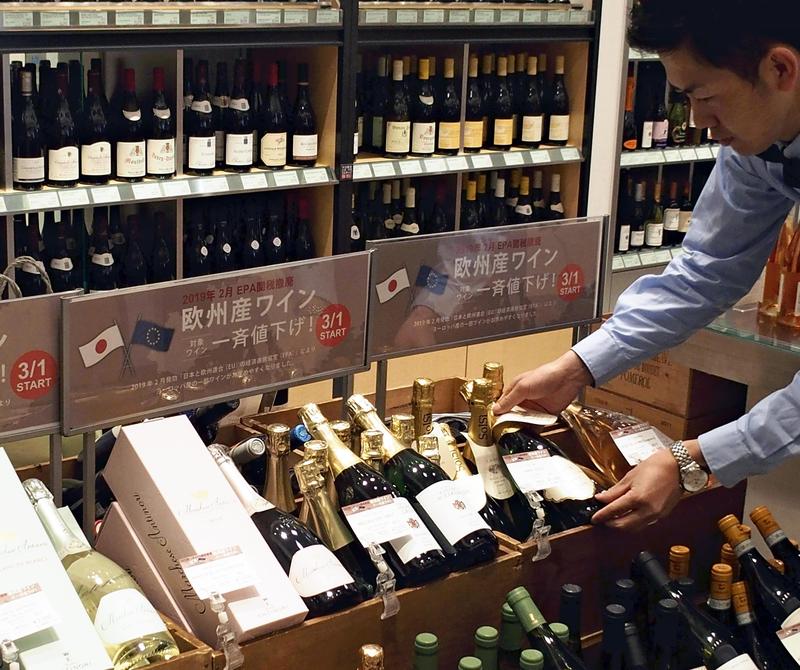
Meanwhile, an increasing number of businesses are reducing the prices of goods. Wine trading company Enoteca Co. reduced prices for 61 EU wines by about 3 percent to 18 percent in March.
"Many customers visit our stores because they knew about the tariff reductions under the EPA, and they are very interested in the issue," an official in charge of public relations at the company said. "We have heard that some consumers are trying new wines because of the price reductions."
High-end supermarket chain operator Seijo Ishii Co. has also cut prices of wines, raw ham and other products from the European Union, and its sales have been growing.
On the other hand, imports of Chilean wines, which have gained popularity for reasonable prices, declined about 30 percent in February.
Given that overall wine imports grew about 5 percent, the increased price competitiveness of EU wines might have brought about a change in the market dynamic.
Domestic producers who are exposed to intensified competition from overseas products are speeding up efforts to counter them.
In particular, there is an increasing sense of urgency among producers in Hokkaido, the nation's leader in dairy farming. In March, the Sapporo-based Hokuren Federation of Agricultural Cooperatives opened a satellite store to sell Hokkaido cheese and other products in the Jiyugaoka district in Meguro Ward, Tokyo -- the federation's first permanent shop outside Hokkaido.
"In order to compete with European products, we would like to first make the charms of domestic products known to consumers, so that we can expand their consumption," an official at the federation said.
Read more from The Japan News at https://japannews.yomiuri.co.jp/