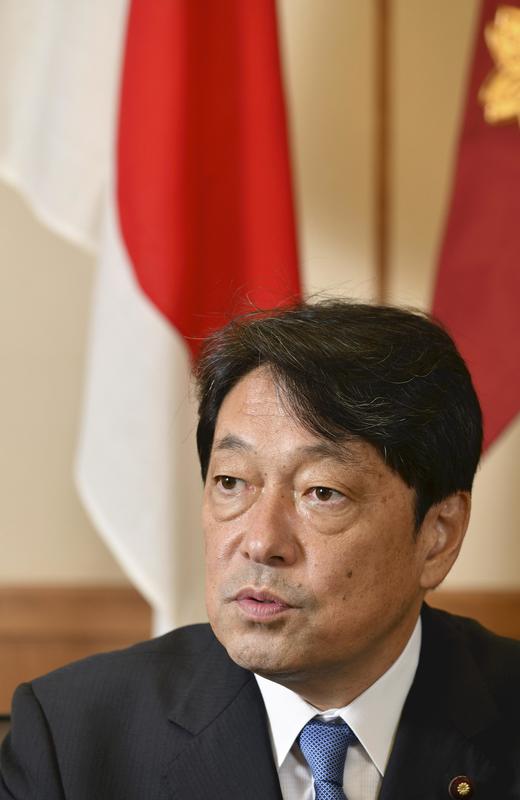
Japan's national security environment has grown more severe as it deals with North Korea's nuclear and missile development and China's maritime advances. The government will formulate new "National Defense Program Guidelines" at the end of the year (see below). Defense Minister Itsunori Onodera explained his views on the current state of national security during an interview with The Yomiuri Shimbun.
The Yomiuri Shimbun: What is your view on the current situation of North Korea's nuclear and missile issues?
Itsunori Onodera: We should welcome the dialogue between the United States and North Korea. North Korea's references to denuclearization are a significant sign, in my view. International pressure can be said to have contributed to the North changing its policy to this extent. Since the summit talks between the leaders of the United States and North Korea, however, the reality is that we have not seen any tangible progress from North Korea toward abondoning nuclear materials and missiles.
With dialogue still ongoing, it's difficult to imagine that North Korea would abruptly conduct ballistic missile tests and the like. Nonetheless, the situation could change at any moment. We've been preparing for every possibility.
The worst-case scenario for Japan is that the status quo becomes normal -- North Korea does not abandon its nuclear materials and missiles, and continues to behave as a de facto nuclear state and state with ballistic missiles. We should support efforts to make North Korea move concretely toward the abandonment of its nuclear materials and missiles at the earliest date possible.
China's rapid military buildup
Q: In addition to North Korean issues, Japan's national security environment is also in a difficult situation because of China's maritime advances.
A: A majority of experts on security matters identify East Asia as one of the areas with destabilizing factors in the realm of security, and they demonstrate strong concern about Japan's neighbors in this regard. That's obviously because of North Korea, but it's also due to China's military build-up as well as the presence of Russia, which has recently strengthened its military power in the northern territories and elsewhere.
With China in particular, it's estimated that its military spending -- publicly announced figures only -- has increased by 50 times over the last 30 years. During this period, Japanese defense spending has not fluctuated and the country has taken restrained positions. But China has realized the most rapid increase in military spending, probably at an unprecedented pace in our history. This phenomenon deserves our close attention.
China has aggressively continued its maritime advances, heightening its activities around Japan. For example, China has been constructing domestically made aircraft carriers at a remarkably fast pace. With several aircraft carriers in the near future, it's possible that Chinese fleets with aircraft carriers will be deployed constantly in the South and East China seas.
Q: New guidelines are scheduled to be formulated this year.
A: As China expands its defense expenditures, North Korea is making rapid progress in its missile capabilities along with nuclear development. Moreover, new domains -- outer space, cyberspace, and electromagnetic waves -- have become increasingly important. Without properly dealing with those changes, Japan cannot defend itself. The new guidelines will be formulated to handle the situation.
Restraining defense spending
Q: Japan's defense budget hit a record high. What moves are you making amid tight fiscal conditions?
A: As far as the defense budget goes, it's important to determine what is really needed and sort that out. However, recent defense equipment is extremely advanced and expensive. Given that neighboring countries are securing state-of-the-art equipment, the necessary defense budget should be effectively increased.
Q: It's been reported that the cost of the Aegis Ashore ground-based missile defense system will be nearly twice the initial estimate. Is Foreign Military Sales (see below) a factor in the increase?
A: To procure highly advanced defense equipment, especially state-of-the-art items, our choice narrows down to acquiring U.S. defense equipment through FMS. Normally, highly confidential equipment should not be available to other countries, but Japan is exceptionally qualified to procure that equipment as an ally and a vital country [for the United States]. Regarding transparency and cost reduction, strong requests have been made at the ministerial level [to U.S. Defense Secretary Jim Mattis] and some results have already been produced.
Since North Korea's missile capability has increased steadily, we plan to introduce the Aegis Ashore system, the most advanced missile defense system in the world, to deal with the situation.
The system enjoys a remarkably higher capability to respond to a lofted trajectory, in which a projectile is launched at a steeper angle than normal, and simultaneous multiple missile attacks. While the initial budget is expected to be more expensive than the conventional system, I don't believe it will be excessively expensive, as our efforts to reduce costs continue.
We plan to deploy two Aegis Ashore units to defend all of Japan. Eight Aegis ships are needed to maintain the same defense capability, and each costs 200 billion yen. In addition to its operational benefits, it can reduce the burden on Self-Defense Forces personnel and the number of required staff.
Q: The Aegis Ashore systems are scheduled to be installed in Akita and Yamaguchi prefectures. A thorough explanation must be provided to local communities.
A: I agree. The deployment might place a burden on local communities, and it's natural that they have a lot of worries. We'll continue to make efforts to gain understanding from the residents in those areas via thorough explanations to address their various concerns.
--This interview was conducted by Yomiuri Shimbun Senior Writer Koichi Mochizuki.
(From The Yomiuri Shimbun, Sept. 13, 2018)
-- Itsunori Onodera / Defense Minister
Born in Miyagi Prefecture, Onodera earned a master's degree from the University of Tokyo. He was elected seven times to the House of Representatives. He served as a visiting research fellow at the School of Advanced International Studies at Johns Hopkins University, and as state minister for foreign affairs.
-- National Defense Program Guidelines
Basic guidelines that formulate defense strategy over period of 10 years. The first guidelines were drawn up in 1976. The current guidelines were devised in 2013 with a plan to build a "Dynamic Joint Defense Plan," in which Ground, Maritime and Air Self-Defense Forces operations would be integrated with the aim of defending the Nansei Islands. For the new guidelines to be formulated at the end of this year, examinations are being conducted mainly to enhance SDF response capability in new domains including outer space, cyberspace and electromagnetic waves.
-- Foreign Military Sales
U.S. security assistance program to sell military equipment to foreign countries, including its allies. It is utilized when the SDF introduces the most advanced or highly confidential U.S. equipment. Because the U.S. government controls the program, it has been said to lack transparency regarding equipment prices and therefore heightens Japan's defense budget. The amount of FMS-based contracts jumped to 691.7 billion yen in the Defense Ministry's budget request for fiscal 2019 from 43.2 billion yen in fiscal 2011.
Read more from The Japan News at https://japannews.yomiuri.co.jp/