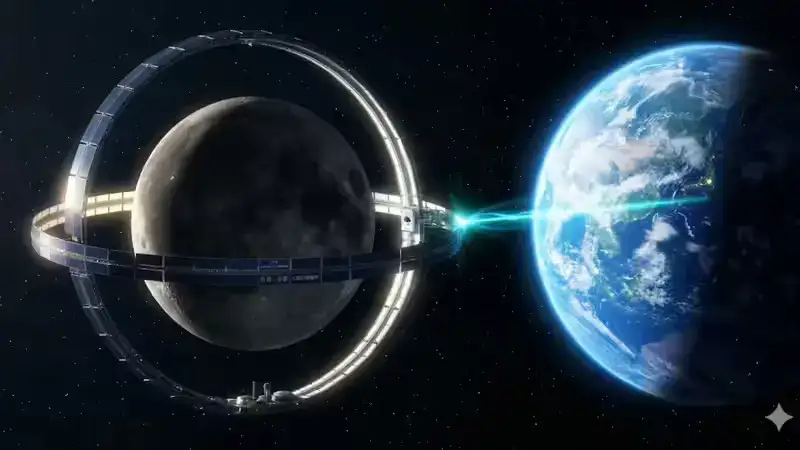
In Japan, engineers are imagining a concept building a huge ring of solar panels around the Moon which aims to send electricity Earth using energy beams. Known as the "Lunar Solar Ring", the concept by Shimizu Corporation is still at a proposal stage and has no public funding. The proposal envisions a massive belt of solar panels built around the Moon’s equator to capture solar energy continuously and transmit it back to Earth. Though the idea sounds like science fiction, researchers behind the project studied the concept elaborately as a long-term solution to the world's growing energy and environmental challenges amid concerns over climate change and rising electricity demand.
Japan's 11,000 km lunar 'solar ring' project
The Lunar Solar Power project, also known as the “Luna Ring,” is a futuristic energy concept that proposes building a giant belt of solar panels around the Moon’s equator. According to Shimizu Corporation, the system would collect solar energy continuously on the Moon and transmit it back to Earth for use as clean power.
ALSO READ: Putin meets former German teacher Vera Gurevich
Stretching nearly 11,000 kilometres in length and several hundred kilometres in width, the Luna Ring would rank among the most ambitious engineering projects ever imagined. The concept gained attention in Japan as the country explored alternative energy solutions following the Fukushima nuclear disaster.
The “Luna Ring” concept would wrap the Moon’s equator with solar panels. The goal is to keep at least part of the system generating power as sunlight moves across the surface.
Unlike solar farms on Earth, the Moon offers conditions that could make solar energy generation far more efficient. With no atmosphere, clouds or weather disruptions, sunlight can reach the panels almost continuously, allowing the system to generate power for much longer periods than Earth-based solar installations. Supporters have suggested construction might start as early as 2035 and have attached enormous output estimates, according to Ecoticias.
How the energy would get to Earth
The concept behind the Luna Ring is designed to generate solar power on the Moon and send it back to Earth using wireless technology. Solar panels installed across the Moon’s surface would absorb sunlight and convert it into electrical energy and that energy would then be transmitted to Earth through laser beams or microwaves.
Once the energy reaches Earth, special receiving stations known as “rectennas” would convert the transmitted signals back into usable electricity and distribute it through power grids. It also notes that sunlight in space is stronger than what reaches the ground.
One of the biggest advantages of the system is that at least one side of the Moon receives sunlight almost constantly, allowing power generation to continue nearly 24 hours a day. According to the proposal, the system could theoretically generate around 13,000 terawatts of energy per hour — far exceeding current global energy demand.
Speaking to ABC News, Tetsuji Yoshida said that if the energy produced by the lunar panels could be fully transmitted to Earth, it could eventually remove the need for fossil fuels such as coal and oil, as well as biomass-based energy sources.
The broader goal of the project, according to Shimizu Corporation, is to shift humanity away from Earth’s limited natural resources toward what it describes as “nearly limitless clean energy.”
Current status of the Lunar Solar Ring project
Despite its ambitious vision, the Lunar Solar Ring remains a theoretical concept and has not moved into active development. According to reports, there is currently no confirmed construction timeline, government backing, or official programme support from major space agencies such as NASA or JAXA.
At present, the idea largely exists as a long-term proposal from Shimizu Corporation rather than a real-world engineering project. However, some of the technologies connected to space-based solar power are gradually advancing. Smaller-scale experiments and research projects have already explored the possibility of transmitting solar energy from space to Earth using microwaves.
Challenges facing space-based solar power
Several major obstacles still stand in the way of turning the Lunar Solar Ring into reality. Building such a massive system on the Moon would require highly advanced robotics capable of mining lunar soil, constructing infrastructure, and operating in extreme space conditions.
The project would also face enormous logistical and financial challenges, including transporting materials into space, coordinating international cooperation, and safely transmitting energy across the nearly 384,000-kilometre distance between the Moon and Earth.
Even the creators of the concept have acknowledged that it is a long-term vision, with earlier discussions suggesting a possible timeline extending into the mid-2030s and beyond.
Why the idea continues to attract attention
What makes the Lunar Solar Ring especially intriguing is the scale of its ambition. Rather than focusing on limited resources and energy shortages, the concept imagines a future built around abundant clean energy generated beyond Earth.
Supporters of such ideas argue that solving future environmental and energy challenges may require unconventional thinking and bold technological experimentation far beyond traditional power systems.
(With TOI inputs)