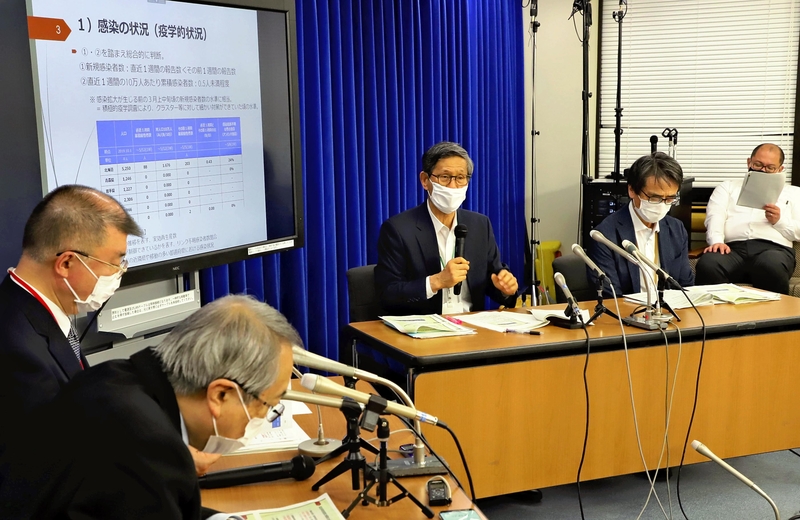
Japan's response to the new coronavirus entered a new phase on Thursday, as the government's panel of experts called for prefectures for which the declaration of the state of emergency were lifted to resume social and economic activities in a phases while at the same time implementing measures to prevent the further spread of the virus.
The experts panel, chaired by Takaji Wakita, director of the National Institute of Infectious Diseases, released its own proposal on Thursday, when the government decided to lift the declaration for 39 prefectures.
In its proposal, the panel focused on 28 prefectures, mainly in the Tohoku, Chugoku and Kyushu regions, saying their numbers of people infected "has steadily turned downward" as no new cases had been reported for more than a week as of Tuesday.
On the other hand, the panel said Tokyo and Hokkaido, as well as Kanagawa, Osaka and Saitama prefectures, still have to remain on alert because the weekly number of new cases stood at 200 for Tokyo and more than 50 each for the others.
To prevent a new outbreak from occurring, the panel said the nation's 47 prefectures should be placed into three categories depending on the number of cases each area has: "Special-alert" prefectures, those that "require precaution against a new outbreak," and those that "should keep watch for infections." It called for the prefectures to take countermeasures depending on their own risks.
Whether a specific prefecture should fall into the special-alert status depends on its cumulative number of cases and the pace of the increase. This status applies to Tokyo and seven other prefectures, for which the government decided to put the declaration in place on Thursday.
For the other two statuses, however, governors are expected to decide into which status their prefectures should fall.
At a press conference on Thursday, Wakita said the 39 prefectures for which the declaration was lifted fall under the category of the "keeping watch" status.
A new outbreak could happen if measures against the virus are relaxed, said Shigeru Omi, deputy chair of the panel.
"It is crucial that we balance preventing the further spread of the virus and promoting social and economic" activities, he said.
Read more from The Japan News at https://japannews.yomiuri.co.jp/